


Estelas Islands
About this heritage
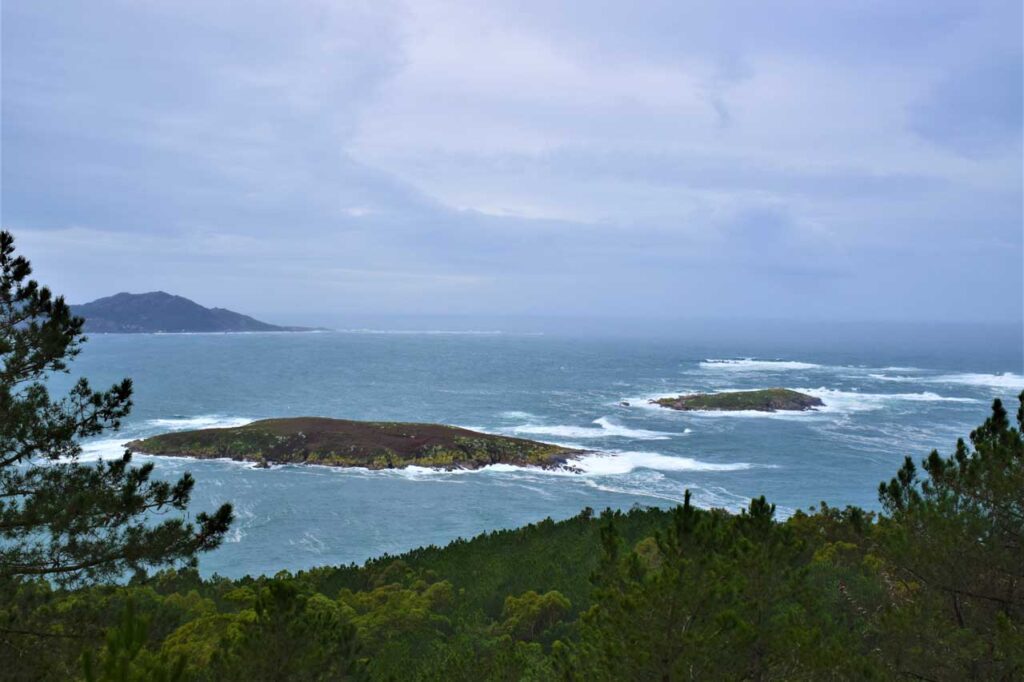
The Estelas Islands are an archipelago situated across from the Monteferro peninsula on the northern margin of the Bay of Baiona and belong to Nigrán.
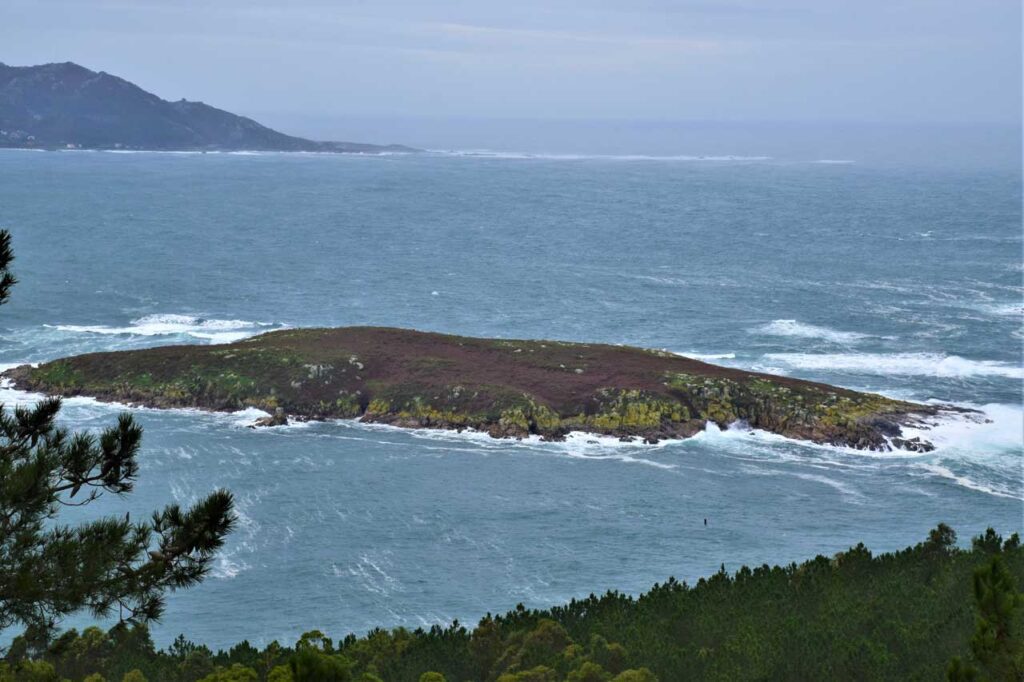
This set of islands is formed by two major islands: Estela de Dentro with an area of 9.6 hectares, Estela de Fora (outer) which area covers 7 hectares and a group of islets called As Serralleiras, in addition to other smaller islets.
The archipelago as a whole has a surface area of 19 hectares. The two largest islands look like a plateau. They are mostly covered by dense scrub with a predominance of gorse (Ulex europaeus lactibracteatus) and heather (Erica sp.).
There are populations of the common lizard (Podarcis hispanica) which is larger than its neighbors of the continent, given their adaptation to insular life.
A small colony of yellow-legged gulls (Larus michahellis) nest here, residents of the Maritime Terrestrial National Park population of the Atlantic Islands of Galicia, which represent one of the largest populations of yellow-legged gulls in the world.
The islands lack structures and constitute an important seafood bank.
The archipelago and the Monteferro coast are part of the Natura 2000 Network as a Special Conservation Area (SAC)
The islands have an artificial reef formed by fragments of a ship that ran aground in 1976. The undersea is basically rocky and there is an extension of sand and mud.
The environment and seabed have a high ecological value, as the porpoise (Phocoena phocoena), one of the most endangered cetaceans are part of the harbour.
To learn more
The peninsula of Monteferro extends into the sea by nearly 1.5 km and occupies an area of more than 100 hectares. Almost the entire hill reaches 147 meters and is covered by a forest where pines and eucalyptus are in abundance.
It is called Monteferro because of the abundance of this mineral (iron, ferro in Galician) and is probably what attracted the ancient inhabitants of the area.
The cliffs surrounding the mountain make it impossible for large beaches to exist, but there are small coves such as Portocelo and Rocas Blancas on the southern slope.
At the top there is a monument that represents the Virgin of Carmen, patron saint of sailors, Monument to the Universal Navy or also known as Monument to the Martyrs of the Sea.
The maritime area of the Estelas Islands formed by rocky bottoms and low draft is dangerous for navigation and with good reason, sailors have a lot of respect.
The Estelas Islands have borne witness to several shipwrecks throughout history, such as the one of the Muslim fleet sent by Emir Muhammad I of Cordoba (852-886), which sank along these coasts in the 9th century, losing between 20-30 boats. Or the Wolfgang that shipwrecked in the area of Laxes de Carracido on February 10, 1904.
Not that far long ago was that of the "IVY" on the night of Saturday, January 30th , 1976 when the entire coast of Galician suffered the lashing of a violent winter storm. A bad calculation and subsequent impact, caused the 216 meters long Liberian bulk carrier "IVY" , ran aground on the Estelas islands while approaching Vigo, to unload 50,000 tons of ore it was carrying on board. Of the 34 crew members on board, including officers and sailors, as well as the wife of the chief of officers, many could get to safety by their own means and reached the beach of Patos. They were given shelter and provided with clothing and food, spending the rest of the night at the Panxón leisure residence. Four other Liberian sailors lost their lives in the shipwreck.
The aft section was recovered.
To know it better
The Estelas Islands are formed by two islands, Estela de Tierra and Estela de Mar, occupying a total surface area of 19 hectares. These can be observed from the coast of Val Miñor and Baiona, as well as from the lookout point of Monteferro, where you can see these small islands, where colonies of seagulls, cormorants and different banks of marine species settle.
The Estelas Islands are special, not only for what they are, but for what we can find in their undersea. January 30, 1976 was a night of strong waves, wind and rain and these islands witnessed the shipwreck of the Liberian ship Ivy, which ran aground in front of the islands. The ship was scrapped underwater and left large pieces scattered in the sea, found today between 15 and 25 metres deep.
The undersea of the Estelas Islands are largely rocky, allowing seaweed species to adhere to them - such as sponges, bryozoans or ascidians. In addition, you can find marine fauna such as octopus, cuttlefish, squid, velvet crabs, spider crabs and lobsters.
Gallery
Location
- Town
- Panxón
- Municipality
- Nigrán
- Province
- Pontevedra
- Country
- Spain
The asset
- Type
- Island
- Eco-destination
- Ría de Vigo
- Environment
- Natural
- Relevance
- Regional
How to get there
- Access
- By sea
- Port
- Puerto de Panxón
- Distance
- Solo se puede llegar en barco privado
The visit
- Visitable
- No, they can only be seen from the As Estelas viewpoint
- Interpretation
- Do not
- Accessible
- No
- Parking
- No
Coordinates
- Latitud
- 42.14645000
- Longitud
- -8.86444500