


Cíes Islands. Monteagudo and Middle Islands and phoenician trade
About this heritage
The Cíes, christened as the "Islands of the Gods" by Ptolomeo, were a transit route for the Paleolithics and Neolithics, reason for which no settlements were established until the Bronze Age. The As Hortas castrum, a fortified settlement which sits on the slope of Monte Faro, and other similar structures in Alto da Campá, date back to this period. The village of As Hortas is situated on a steep slope and was inventoried in 1992. Its location, as with the rest of the fortifications, is acknowledgement to the exceptional conditions of visibility and defense offered by the location. This spot has a series of natural shelters, such as the "Druidic Altar", with the appearance of a skull and with channels on its surface, which many interpret as a shrine of sacrifice, in honour of the Gods.
To learn more
The castro of A Hortas has approximately 4 to 5 quadrangular dwellings that included double-leaved doors. The middens from this period (deposits formed by remains of shells, bones, ceramics, etc.), reveal grey, ochre or orange-coloured primitive ceramics, with simple decorations; and other more evolved techniques such as smoothing, burnishing and spatula. These also provided valuable information on the dietary pattern of the first inhabitants of the Cies. These settlers already included shellfish and fish from surrounding seawaters in their diet. The discovery of stone anchors and ceramic remains, similar to those found in other parts of the Iberian Peninsula, indicates that they traded with other cultures, such as the Phoenicians.
To know it better
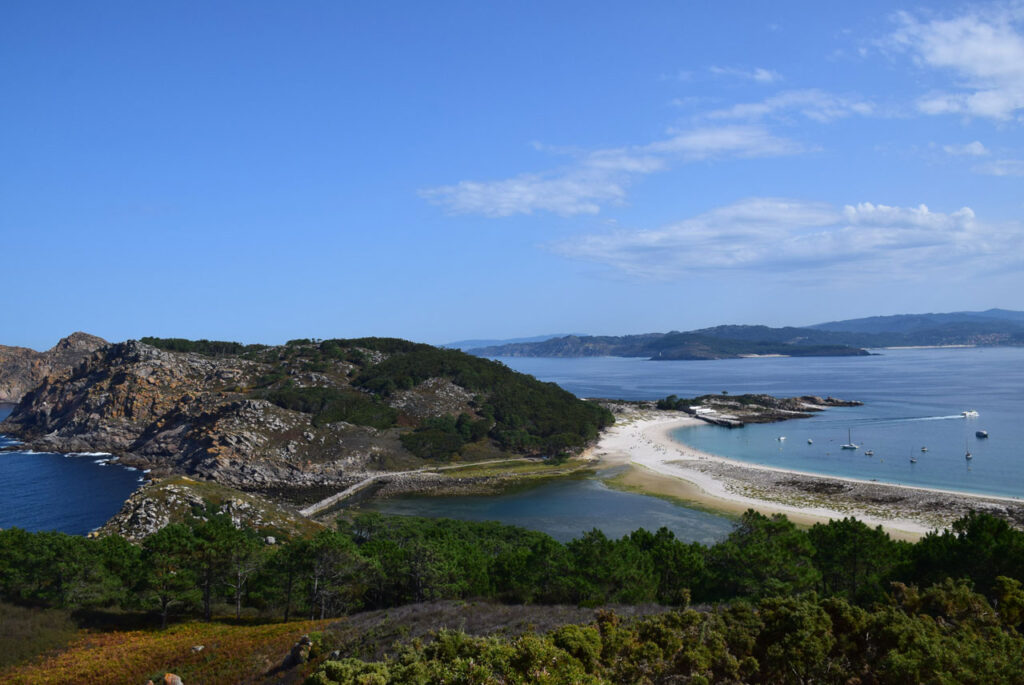
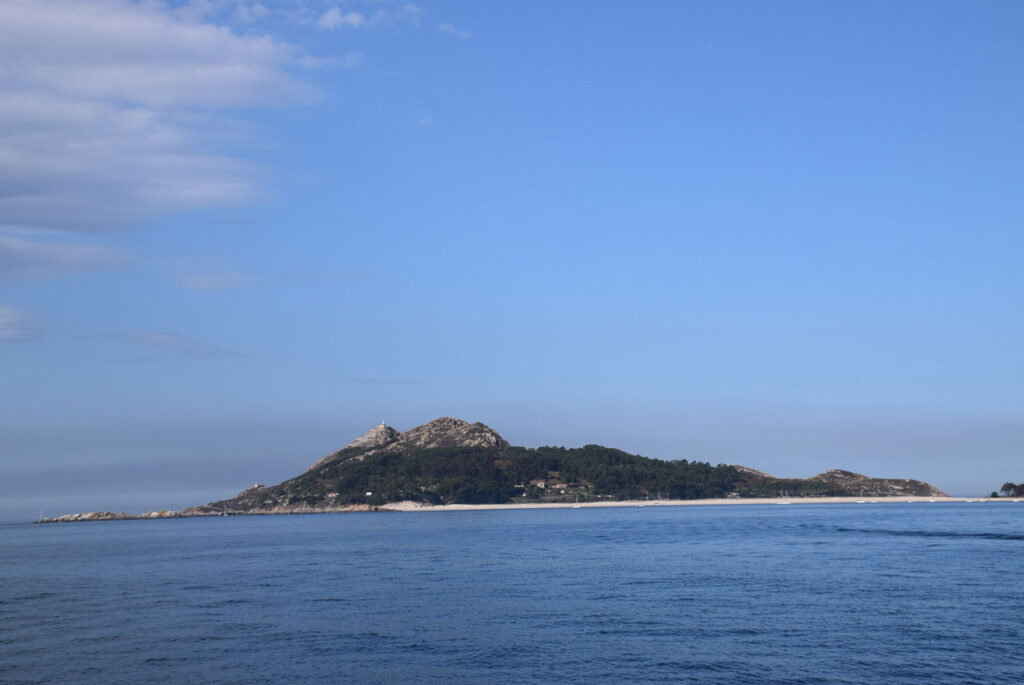
Known as the Islas de los Dioses (Islands of the Gods), the Cies Islands became the Phoenician’s (experts in maritime navigation), place of reference for trading. This archipelago is located on the Vigo river (province of Pontevedra) and is formed by three islands: Norte (North) or Monteagudo, del Medio (Middle) or Faro and Sur (South) or San Martin or San Martiño
The human race arrived at the Cíes around 3,500 B.C., although the first settlement was in the Bronze Age, as a castrum was found on the hillside of Mount Faro. Ruins of structures which correspond to an ancient fortification, surrounded by a rampart, can be found here. Located in the upper part of the mountain, the As Hortas castrum corresponds to the Bronze Age, where four quadrangular dwellings can be distinguished, amphorae, ceramics and utensils, which ensures the later arrival of the Romans, were found.
Worth mentioning on the Faro island, is the San Estevo convent, dating back to the 11th century (Middle Ages). The interpretive centre, located along the path going up toward the Faro mountain, is located there. It was an artillery warehouse in the time of the defence of the Vigo river era, during the attacks from Francis Drake and allies.
Moreover, the Faro and Monteagudo islands are connected and stand out for their natural and environmental wealth. Varying species of flora and fauna, cliffs, beaches and marine species can be seen here. The archipelago holds grand cultural and patrimonial value.
Gallery
Location
- Town
- Si
- Municipality
- Vigo
- Province
- Pontevedra
- Country
- Spain
The asset
- Type
- Island
- Eco-destination
- Ría de Vigo
- Environment
- Natural
- Relevance
- International
How to get there
- Access
- By sea By land
- Distance
- 0 km
The visit
- Visitable
- Yes
- Interpretation
- Yes
- Accessible
- No
- Parking
- No
Coordinates
- Latitud
- 42.22773800903427
- Longitud
- -8.903074624456911