
Punic Temple
About this heritage
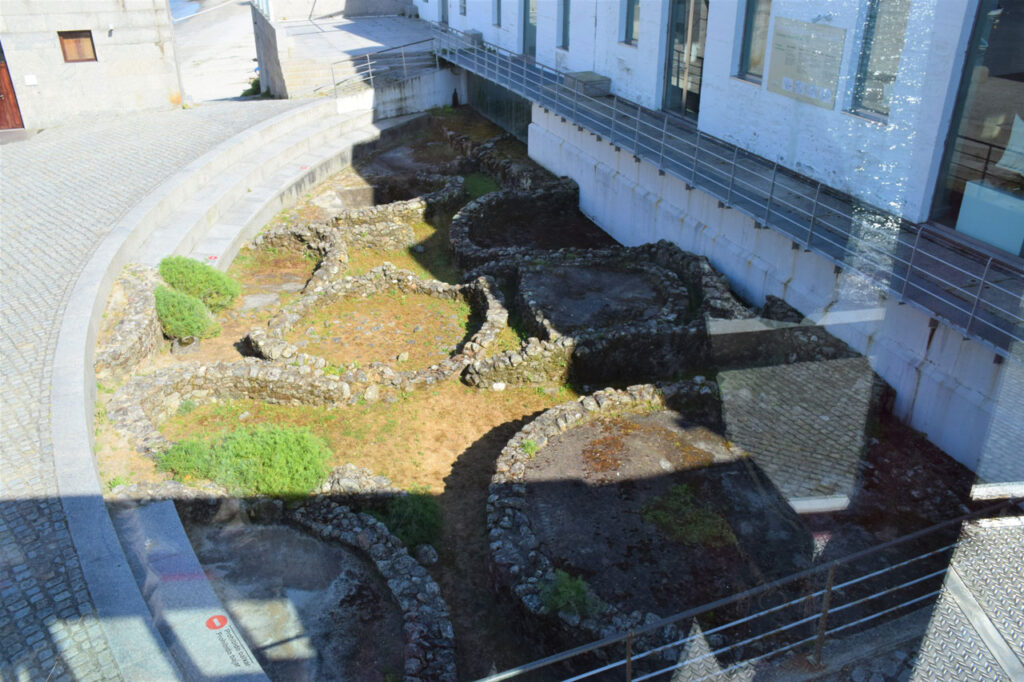
One of the most surprising findings of the Punta do Muíño fortification in Vigo, is the Punic temple discovered during the works carried out on the Galician Museo do Mar. This is a rectangular structure with three polished granite baetylus (obelisks) secured to the floor in its interior, half a metre of which protrude from the ground. There is a large amount of Punic pottery associated with this structure, which could be interpreted as remains from ritual activities. These type of baetylus were also discovered in the Toralla fortification. This temple, similar to those found in the Andalusia and Levante region, would have been a port sanctuary the Mediterranean merchants would use to carry out their transactions. The advantage of this type of location was twofold: they were easily accessible from the sea and securer for trading transactions.
To learn more
Dating back, most probably, to the end of the 5th century B.C. or beginning of the 4th A.D., the typical castro stone houses with a circular design, are constructed at the start of the 4th century A.D. (according to the characteristic indigenous materials). The site continued to carry out exchange trading between the Punics and Galician, as evidenced by the number of Punic amphorae - about 2,000 fragments have been found - until its abandonment in the 2nd century B.C. or beginning of the next century. A lot of six socketed axes have also been found, together with the initial iron smelting cone.
In addition, more than 20,000 fragments of items were found, which have made it possible to identify a new type of ceramic christened as "Potiño Alcabre".
To know it better
Investigation experts have found the foundations of a Punic altar in the Punta do Muíño ancient fortification. This is one of the oldest ancient fortifications in the city of Vigo and is located on the coast.
It all began in 2001, when a series of construction work was being carried out on the Mar de Vigo Museum. Several castra, belonging to different periods, appeared. The oldest ones date back to the year 7 B.C.
In addition, the ruins of a punic temple, a sacred enclosure built by the Phoenicians, were found. Three stones in a rectangular structure appeared, which were identified as the bases of an altar, required for the worshipping of a Mediterranean religion.
Gallery
Location
- Locality
- Vigo
- Municipality
- Vigo
- Province
- Pontevedra
- Country
- Spain
The asset
- Type
- Temple
- Eco-destination
- Ría de Vigo
- Environment
- Rural
- Relevance
- International
How to get there
- Access
- By sea By land
- Distance
- 2,8 km / 6 minutos en coche
The visit
- Visitable
- Yes
- Interpretation
- Yes
- Accessible
- Sí
- Parking
- Sí
- Signposted
- Yes
Coordinates
- Latitud
- 42.22436000
- Longitud
- -8.76997600