


The Stone of the Frog (A Pedra da Rá)
About this heritage
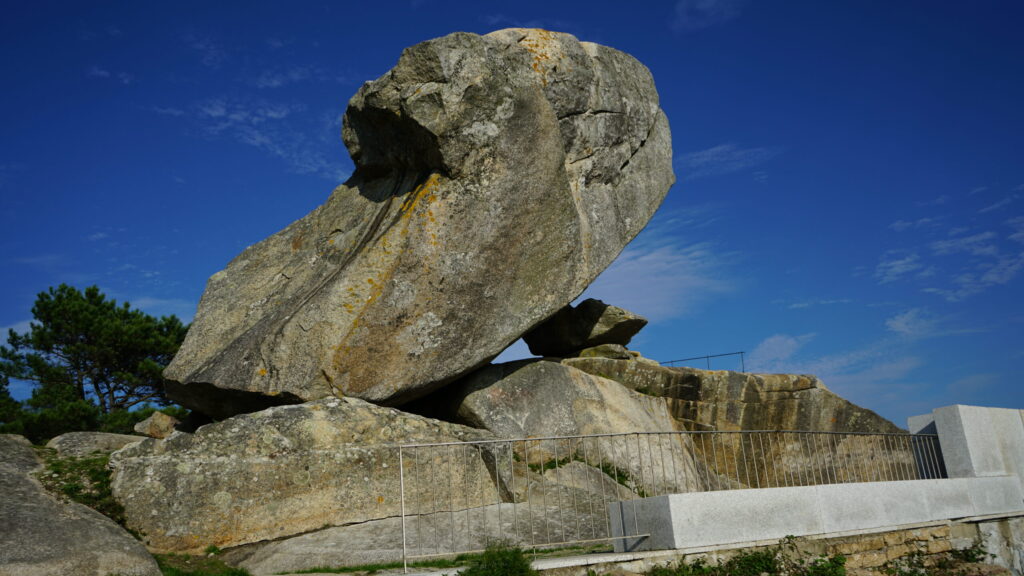
Below the pre-Roman fortress of the city (Castro da Cidá), a few meters westbound, and through a path not suitable for all audiences stands a rock known as Pedra de A Rá (Stone of the Frog).
From its viewpoint, one can enjoy the landscapes of the Lagoons of Carregal and Vixán, the Dune System of the Corrubedo Natural Park, and even in the distance, the Corrubedo Lighthouse. Southbound, the view reaches as far as Cíes, Ons, and Sálvora islands and northbound Mount Facho and Mount Tahúme.
A Pedra da Rá is a large rock shaped like a frog; hence, its name (The Stone of the Frog), slightly resting on other smaller ones and rising vertically about 15 meters and equipped with stairs and a platform, where anyone can locate its viewpoint.
This place is part of an accessible route for people with reduced mobility, offering them the opportunity to enjoy the sensory experience of being there.
To learn more
Located in Mount O Castro within the parish of Carreira is the rock known as "Pedra da Rá" (Stone of the frog) since, from the west coast, anyone can see a shape similar to that of a mouth-open frog. Formed by a central-granite rock and several blocks making a bench, Pedra da Rá is slightly supported on other smaller rocks and vertically elevated about 15 meters.
Little do we know about this large rock; some believe that it might be an ancient natural monument of a sacred character and, most likely, used as a benchmark sight.
In the 1980s, they built a concrete staircase to climb over the rock to enjoy the views of the Atlantic horizon, becoming a viewpoint since then; however, over the years, this original access deteriorated, which has prevented its use.
By 2016, the place underwent a profound remodeling, aiming to recover the natural state of this site. They demolished the concrete staircase since it was unfriendly to the environment and with the rock itself. Carlos Seoane was the architect in charge of the design of the project, which led him to win several international awards. Among others, he won the 3rd prize in the category of Urban Projects, Rural Projects, Landscape & Pubic Spaces-Europe, awarded by the specialized magazine 2A Magazine; the COAG Architecture Award from the Official Architects' Association of Galicia; the FAD Architecture Award for Spain and Portugal, and the Enor Award. He was also a finalist in the Arch-Daily Building of the Year Awards and the European Award for Intervention in the Architectural Heritage of the Association of Architects of Catalonia. Further, both the Venice Biennale and the International Architecture Biennale of Argentina invited him to exhibit his selected projects.
Mr. Seoane led a team of architects to work in a 3,300 square meter area. Given the character of the material chosen for this project – wild-type granite – and the kind of vegetation – upholstered creeping plants, the resulting space needs none or little maintenance.
Currently, they are working on an extension for a second viewpoint, commonly known as Mirador do Piñeiro.
To know it better
On the same mountain, and close to the Castro, we can find the viewpoint of Pedra da Rá (Stone of the Frog) since the 1980s. Its name comes from the frog-shaped design, showed on the rock at its viewpoint, from where one can enjoy the views of the Atlantic Ocean and a large part of the Natural Park, which integrates a broad area of Corrubedo.
The Natural Park occupies nearly 1,000 hectares, formed by the dunes, Corrubedo beach, the freshwater lagoon of Vixán, and the seawater lagoon of Carregal, in which anyone can observe species such as birds and otters.
The pre-Roman fortress of the city (Castro de A Cidá) is in the municipality of Ribeira in the province of Coruña, more specifically, between the parishes of San Xián de Artes and San Paio de Carreira.
To talk about Castros, one has to travel back to the Bronze Age, to the 7th century BC, and imagine what life was like thousands of years ago. These fortifications were the villages where the Celts lived. Their shape could vary from oval to circular, and they used to be in elevated areas.
This military settlement, located on Mount Cidá or Cibdá, was inhabited from the sixth century BC to the first century AD. All its constructions deteriorated over the years until their discovery in 1924, which led to the beginning of archaeological works and excavations by 1932. In 2014, another series of diggings near the summit revealed approximately fifteen houses from the Castro era and a more modern structure.
Location
- Town
- Natural
- Municipality
- Ribeira
- Province
- A Coruña
- Country
- Spain
The asset
- Type
- Viewpoint
- Eco-destination
- Ría de Arousa
- Environment
- Natural
- Relevance
- Local
How to get there
- Access
- By sea By land
- Distance
- 4,1 km
The visit
- Visitable
- Yes
- Accessible
- No
- Parking
- No
Coordinates
- Latitud
- 42.55989600
- Longitud
- -9.01574500