


Downtown Rianxo. Port. Seafaring Town
About this heritage
Rianxo is a municipality on the Galician coast, located in the south of the Coruña province, on the right bank of the Arousa Estuary, and the mouth of the Ulla River.
This municipality borders, to the north, with the Lousame and Rois towns. To the east, with Boiro and Catoria in the province of Pontevedra, across its bridge over the Ulla River. It also borders with the Arousa Estuary in the Barbanza region to the south.
It has an old area made up of a multitude of narrow cobbled streets typical of seafaring towns. It is also known as "vila dos escudos" (Town of the two coats of arms) since in the facades of the houses, anyone can observe a high number of heraldic words because many feudal lords settled in this town with medieval power.
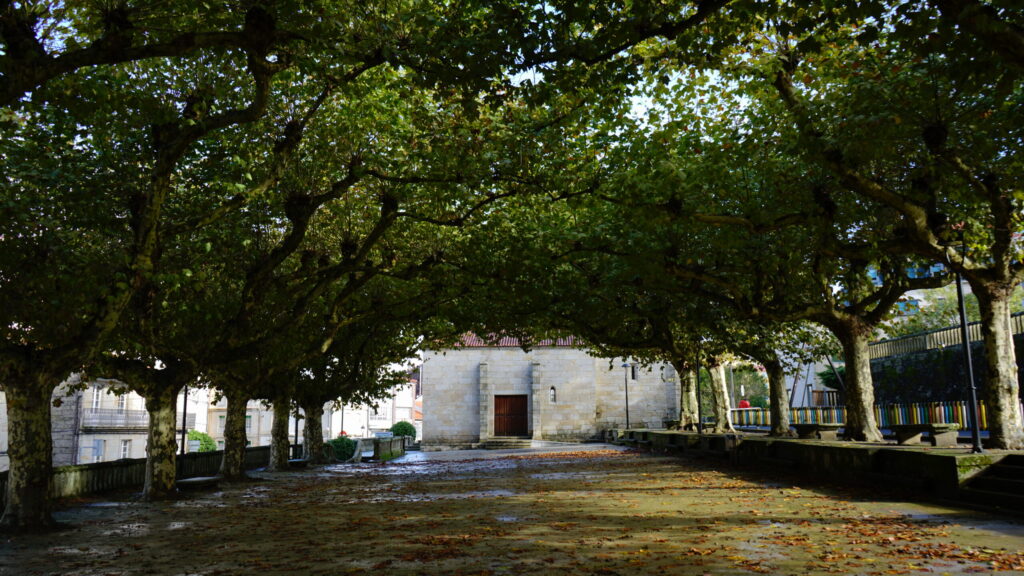
The Town Hall is in Castelao Square, where the boulevard (Alameda) and the Sanctuary of the Virgin of Guadalupe are. The stonemason master Bartolomé González built this sanctuary over a previous one, Our Lady of the Cross. It houses an 18th-century image of the Virgin of Guadalupe by the Rianxeiro religious Friar José de Santiago, who made it in paper pulp. The Virgin of Guadalupe is of great devotion among the Rianxeiros, who known her as "A Virxe Moreniña" (the little brown virgin). She presides over the most important festivities of Rianxo, held in September. It also stands out in this square the "Casa do Coxo" and the "Cuartel Vello." The latter was an old apothecary and children's school that later become the weaponry quarter and the Regional Guards (Guardia Civil) Barracks. Today, it houses the Sea Museum and the House of Culture (Casa da Cultura).
Illustrious rianxeiros of all times were born or lived in Rúa de Abaixo (Down Street), closely linked to politics and contemporary Galician literature. The most outstanding were Alfonso Daniel R. Castelao, father of Galician nationalism, and Rafael Dieste, born in 1899, and a remarkable intellectual and poet of the "Generation of 27." This street gives access to the Rafael Dieste Square, where one can find the Lordly House (Pazo) of Martelo, a structure that sits on the 14th-century medieval tower of Baroque style by Paio Gomez Chariño. It has a large stone balcony and houses the Municipal Public Library. The building became, officially, a Historic-Artistic Monument in 1973. The Rafael Dieste Square also has a Baroque style cross that still preserves some features of polychrome, attributed to the sculptor José Ferreiro de Noia. The late 15th-century parish church of Santa Comba completes this landscape.
Between the streets of the village, we access "A Praciña" where you will find "as Casas do remo" (The houses of Rowing), called like that because they measure the width of their facades with a rowing paddle to guarantee equal distribution of the land among the sailors. Besides, these houses were formerly next to the sea. One of the oldest cruceiros in Rianxo and, possibly, in Galicia presides this square.
In the port area, accessed through a curious passage from this square, anyone can find the chapel of San Bartolomeu. The property was originally on an islet and joined to land because of the port fillings.
An enormous rectangular-shaped seawall protects the port. From here, travelers can appreciate a stunning panoramic view of the seafront and the mountain ridge of Barbanza. You can also see a variety of vessels that make up the Rianxeira fleet, such as the "bateeiros" used in mussel picking, or small seine, artisan, and shellfishing boats, as well as traditional ones, such as the "Xeiteira." The "Xeiteira" boat was fundamental in the development of the fishing industry in Galicia because its functionality is to catch small fish, such as the sardine. Currently, it is possible to contemplate in the port of Rianxo, a replica of a "xeito boat," the so-called "xeiteira," property of the city council.
Rianxo has the largest fleet of "xeiteira" boats in all of Galicia, which was only possible for the affection and hard work of men who put all their feelings into their work.
From the port, visitors can walk along Manuel Antonio's promenade, flanked by a line of gardens. Along this promenade, travelers can contemplate monuments in honor of "Manuela" de Castelao, Rafael Dieste, Manuel Antonio, A Rianxeira, and Rosalía de Castro e Brea Segade, and finish the walk in the Setefogas Port. From there, the promenade that joins Rianxo with the Tower (Taragoña) Beach begins.
To learn more
The term Rianxo has a certain aura of mystery; does it mean "Wide River" or "the angel laughs;" most likely, it means curve or angle of the estuary, referring to its location at the initial vertex of the Arousa Estuary on the Galician west coast.
Rianxo has been inhabited since the Palaeolithic era. They have abundant archaeological remains to prove the different cultures that settled in its land, from pre-Celtic and Celtic to Roman. Throughout history, their inhabitants have had a special bond with the sea as a source of sustenance and communication. Even today, it is a substantive element of their personality, their culture, and their economy.
Rianxo is a town that lives from the sea due to the deep-rooted seafaring tradition of this town, as well as using a traditional fishing art, called "o xeito." They applied this art to all instruments used for the capture of marine animals. In this case, they use the so-called Drift Net Fishing technique, in which the fish is intercepted as it moves and gets caught in the meshes of the net. It is possible to work at dusk "axexo" or dawn "luzada." They lay the gear into the sea for an hour and a half, and every so often, they lift it a few meters to check the level of catches. They perform the final lifting by hand using a wooden roller, "rulo de madeira," as a trolley, or by using a mechanical machine. One crewmember is in charge of the lifting so that the rest can unmesh the catches (disentangle the fish from the mesh), which is a delicate process since the quality of that depends on this step.
The fishing season in Rianxo runs from April to November. This art is selective, only fishing sardine ("xouba" in Galician) of size ranging between 11 and 14 centimeters, being the latter the most high-priced catch. They also capture anchovy and all the species of surface, which are harmless for the rest of the species. "O xeito" is very respectful with the captures, always arriving in the best conditions of consumption to the local markets.
Rianxo's sailors continue fishing with the same techniques their parents and grandparents used. "O mar feito tradición" (the sea made tradition) is a saying that in Rianxo has a profound meaning: respect for traditions as the way of "xeito," of understanding life.
Rianxo is the birthplace of great Galician writers, such as Manuel Antonio that crossed the different meridians as a pilot and a sailor in sailing boats, reflecting in his poems the cosmic grandeur and melancholy of the Atlantic. He died in 1929, in the middle of his youth. Also from Another Rianxeiro is Alfonso Daniel R. Castelao, son of sailors and one of the highest leaders of Galicanism, the driving force behind the populist movement "As Ligas Agrarias" (The Agrarian Leagues). A versatile man, apart from studying medicine, he was also a cartoonist, painter, writer, ethnographer, and essayist, among others. He founded the "Castelao" tour in Argentina, which had Ángel Romero, known as the author of the song "Rianxeira," as its director.
One of the Castelao routes establishes a visit to 19 places of the village linked to his life, work, and legacy. Among these places, it is worth mentioning the parish church of Santa Comba, where he received his baptism in 1886, his First Communion, Confirmation, and where they held his funeral after his passing in 1950. Castelao's cousins, the Insua brothers, and his friends Manuel Antonio and Rafael Dieste are also buried in the Rianxo cemetery.
At the Setefogas dock, Castelao met Ramón Fernández Mato because his father built it. Mato was the president of Celta de Vigo and founder of El Pueblo Gallego. Later, they would meet at the Tuna Compostela, where Mato was president.
Among the illustrious characters of the time, one cannot forget Alonso Fernández de Bastón, a tithe collector. In 1671, he built the chapel of the Cross, called today Chapel of Guadalupe and whose Virgin "La Moreniña," is the symbol of Rianxo.
To know it better
Located in the Barbanza Region, Rianxo is a municipality that borders the mouth of the Ulla River and forms the division between the provinces of Coruña and Pontevedra. Its name is associated with the fa-mous song La Rianxeira and the Virgin of Guadalupe, its patron saint.
The territory comprises the parishes of Araño, Asados, Isorna, Leiro, Rianxo, and Taragoña. In 1821, the region had three town halls: Rianxo, Taragoña, and Asados. However, in 1836, with the territorial reorgan-ization, only Rianxo remained.
This town has several significant monuments that form a historical-artistic heritage site: the Chapel of Our Lady of Guadalupe, in maritime Gothic style, founded in 1671 on top of a previous one from 1561. Other are the houses of famous writers, Alfonso Rodríguez Castelao, Manuel Antonio, and Rafael Dieste, among others; the square, dedicated to the latter author, and the Pazo de Martelo; and the route through the maritime area.
People call the coastline promenade of Rianxo by three names: Paseo del Muelle (Pier Walk), Paseo da Ribeira (Ribeira Walk), or Manuel Antonio. There, travelers can see different artistic works dedicated to these three writers: bronze busts of Castelao and Manuel Antonio, a ceramic sculpture by Rafael Dieste, and even a granite statue of Rosalía de Castro.
The main economic activity of this municipality is fishing and the canning factories. During the 19th century, the salting factories were the most important. The port of Rianxo is of great significance, and in it, the most predominant are mussel fishing and inshore fishing boats. In front is the fish market, whose facilities are worth visiting.
Location
- Town
- Rianxo
- Municipality
- Rianxo
- Province
- A Coruña
- Country
- Spain
The asset
- Type
- Village
- Eco-destination
- Ría de Arousa
- Environment
- Urban
- Relevance
- Regional
How to get there
- Access
- By sea
- Distance
- 0 km
The visit
- Visitable
- Yes
- Accessible
- No
- Parking
- Sí
Coordinates
- Latitud
- 42.65200600
- Longitud
- -8.81831500