


Cíes middle Islands: Lago dos nenos. Fauna, fish
About this heritage
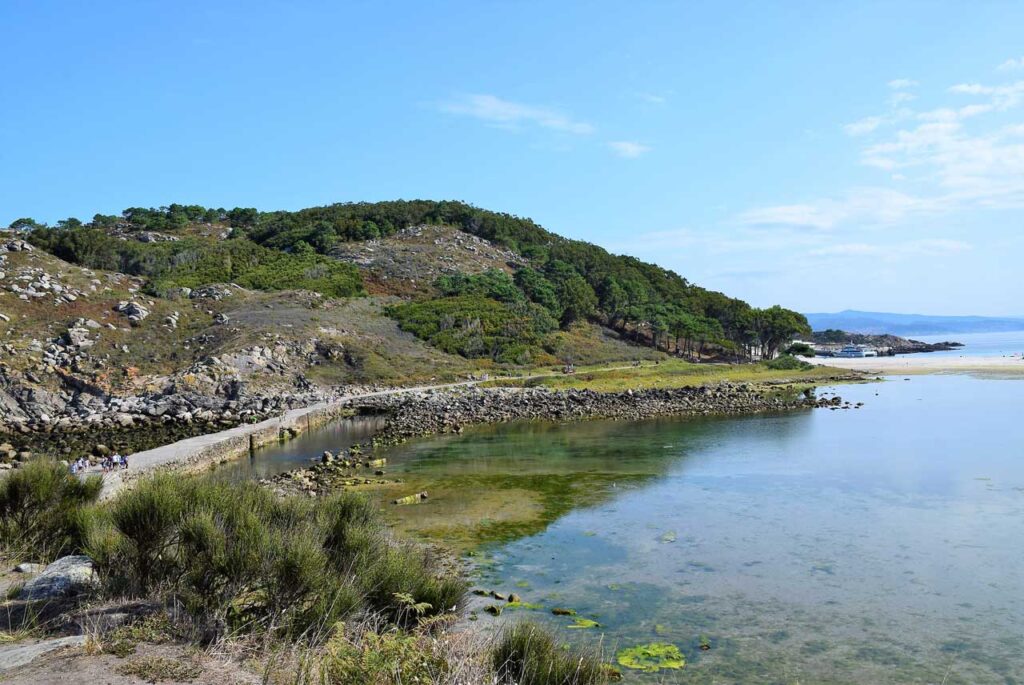
“Lago dos nenos”, is a lake that has the singularity of being salt water and is located between the northern island or Monteagudo and the middle island or Faro. This lake is located between the beach and Rodas dunes and the artificially built dike that links the two islands mentioned.
The formation of the lake has much to do with the formation of the beach of Rodas, since as a result of the accumulation of sand that make up the beach of Rodas and the dunes that flanked, it began to form this lagoon that at first was communicated permanently with the ocean on the west side. On the narrowest side of the lagoon, the west side is full of rocks that act as a natural dike making a smoother communications with the sea. Thanks to the smooth communication, the sea water enters with little force and sands and silts are deposited on the bottom, which are essential for the permanence of aquatic plants with flowers such as the Marine eelgrass, a place that many fish and molluscs choose for reproduction and breeding.
The infrastructures built a few decades ago on the coast of Cíes islands have an important influence on the dynamics of the currents. The artificial dam that communicates the two islands interrupts the natural exchange of water from the lake with the ocean, entering its waters with much less force, causing more sands and silts to be deposited and even filling the lagoon.
To learn more
“Lago dos nenos” is a salt water lake located between the northern island or Monteagudo and the middle island or “Faro” in the Cíes archipelago. It is located between the artificial dam that links these two islands and the dune ranges that flank the beach of Rodas.
This lagoon is characterized for having a great quantity of sediments, aquatic plants like the Marine eelgrass, a great quantity of food and places of refuge for the fish. These characteristics make it a place that many species of fish and mollusc choose for reproduction and breeding, making it a space of great biodiversity. Some of the species that can be seen in the lake are: the thicklip grey mullet (Chelon labrosus), transparent goby (Aphia minuta), white seabream (Diplodus sargus sargus), two-banded seabream (Diplodus vulgaris), Ballan wrasse (Labrus bergylta), European Pollock (Pollachius pollachius), Rainbow wrasse (Coris julis), European conger (Conger conger), Gobius (Gobius spp.), Blenius (Blennius spp.) and even European eel (Anguilla anguilla). Sometimes it can also be seen species such as octopus (Octopus vulgaris), common cuttlefish (Sepia of-ficinalis) or the Atlantic spinous spider crab (Maja brachydactyla) in its natural environment.
Given these characteristics and the large number of species that live in it, it´s a space of great sensitivity and fragility with a great ecological value. The effects of the construction of the artificial dike and the quay on it are currently being studied, since in recent years a siltation rank has been observed in the lake due to the accumulation of sediments. For these reasons, it has been declared a Reserved Zone in the Natural Resources Management Plan of the Galician Atlantic Islands, one of the legal instruments of the national park.
To know it better
In Cíes, between the middle island or Faro and Monteagudo island, there is a salt water lagoon known as “Lago dos nenos”. This place is an ideal location for the development of fish and fauna such as thicklip grey mullet (Chelon labrosus), Two-banded sea bream (Diplodus vulgaris) or the Ballan wrasse (Labrus bergylta). In addition, you can also find plant formations due to the ground´s humidity, as well as endemic birds and plant species.
The fauna and flora of the “Illas Atlánticas National park” has a unique maritime-terrestrial ecosystem, as they are a must stop for migratory birds colonies. In addition, thanks to the sea currents, the water has different species of animals and plants. Amphibians and reptiles are not very represented in this national park, but you can see salamanders, species such as Iberian newts or also reptiles such as the ocellated lizard. If we talk about mammals, we can find the wild cat, rabbits, mice, moles or minks.
In its autochthonous forests there are species like two kinds of oaks, “Melojo and Carballo”, holly, butcher´s broom and “retama” broom. We can also see rabbits, mice and other small mammals such as mice, rats and moles.
The Cíes islands are located in Pontevedra´s province. They have nine beaches of fine white sand and crystal clear waters.
Location
- Town
- Vigo
- Municipality
- Vigo
- Province
- Pontevedra
- Country
- Spain
The asset
- Type
- Island
- Eco-destination
- Ría de Vigo
- Environment
- Natural
- Relevance
- International
How to get there
- Access
- By sea By land
- Distance
- 0,200 km
The visit
- Visitable
- Yes
- Interpretation
- Yes
- Accessible
- No
- Parking
- No
Coordinates
- Latitud
- 42.22348900
- Longitud
- -8.90451900