
Middle Cíes islands. History. Lighthouse
About this heritage
The middle island, also called the Faro (Lighthouse) Island of the Cíes archipelago, there are two lighthouses, the Lighthouse of Cíes and the Lighthouse of Porta. There are 4 lighthouses in the whole archipelago, but the first one to be built was the Cíes lighthouse in 1852. The other three lighthouses built in the 20th century mark the entrance to the estuary: lighthouse do Peito on the north island, lighthouse da Porta on the middle island and lighthouse dos Bico on the south island.
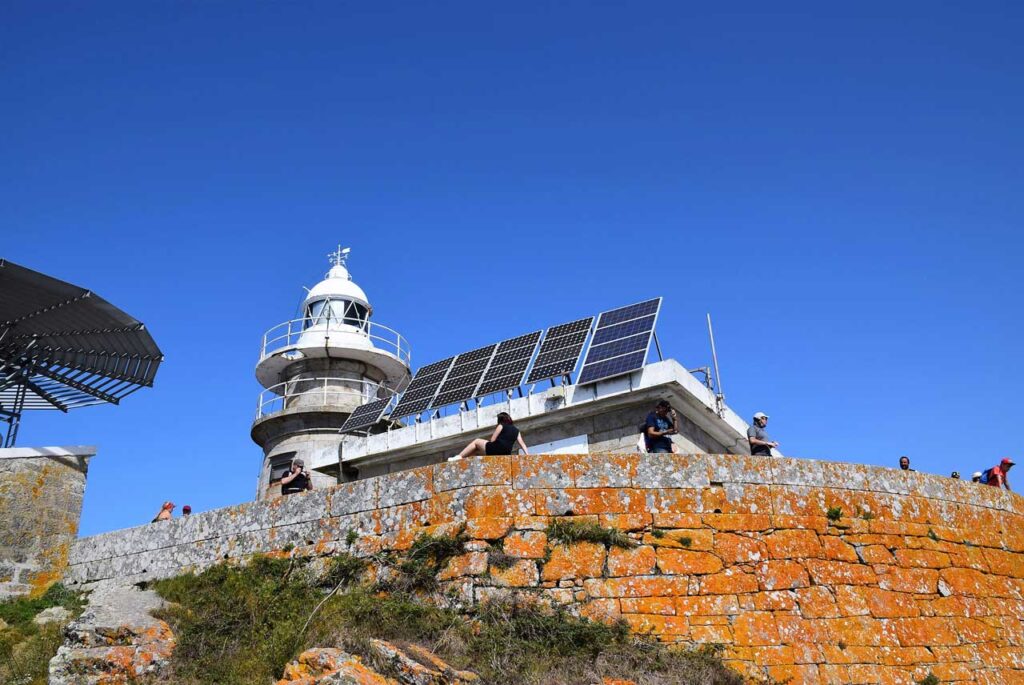
The Cíes lighthouse is 171 metres high and has a lantern tower and rooms for the lighthouse keepers built inside the tower. Several reforms were made to the two structures so that they are now independent and the lighthouse operates autonomously through the energy it obtains from solar panels.
The construction of the lighthouse was preceded by a plan to fortify the island at the beginning of the 19th century with the aim of repopulating it. Through this fortification plan, an artillery store, barracks for the kingdom's police and a prison were built near the beach of Nuestra Señora. Thanks to this plan, in 1840, when the islands depended on Vigo´s City Council, the island was gradually repopulated and two salting factories were set up: one on the North Island where the Rodas restaurant is currently located and another on the South Island with a warehouse and a dock.
To learn more
In the Cíes archipelago, the oldest remains found are the "As Hortas" settlement of the Castro-Roman type on Mount Faro´s slopes, which date from the Bronze Age. The Romans called the islands "Islands of the Gods" and legend has it that Julius Caesar was on them because he was chasing the Herminios by sea, a Celtic people from the north of Portugal who took refuge on the islands. Due to the Roman legacy of Christianization in Galician lands, different religious orders proliferated in the Middle Ages. Thus in the 6th century two convents were installed on the islands of San Estevo on the island of the middle and San Martiño on the South Island. The convents were destroyed by Norman attacks under the command of the great Olaff "El Gallego" (The Galician).
They were later transferred to the Benedictine order in 1152 and to the Franciscans in 1377. These orders maintained a feudal regime with the population that settled there and remained until the middle of the 16th century. The ecclesiastical abandonment of the islands was due to pirate attacks until the 18th century, the Modern Age. The situation of insecurity in these times caused the abandonment of the islands. A fortification plan was carried out in the 19th century thanks to which the islands were repopulated. The proliferation of canneries caused the population to abandon the islands. At the beginning of the 20th century the tourist interest in the islands began and little by little it became massive. Thus the need to protect them arose and in 1980 it was declared a Natural Park. Later, in 2002, it was declared a National Park.
To know it better
The Cíes Islands are located in the province of Pontevedra. They have nine beaches of fine white sand and crystalline waters.
The Lighthouse of the Cíes Islands is located on Monte del Faro (Lighthouse mountain) on the Middle island, the most important island of the archipelago. This lighthouse was built between 1851 and 1853, made of granite and equipped with 13-meter high walls, two balconies and a lantern. Next to it, we find a single-storey house, which was inhabited until the 1960s. At the end of 2018, the Port Authority of Vigo restored the Cíes Islands Lighthouse, thus improving its function.
Thanks to the hiking route, we can reach this construction, which is located at the highest point of the island, 178 meters above the sea level. The lighthouse has been sending out its sparkles from the coast for some 150 years.
Location
- Locality
- Vigo
- Municipality
- Vigo
- Province
- Pontevedra
- Country
- Spain
The asset
- Type
- Island
- Eco-destination
- Ría de Vigo
- Environment
- Natural
- Relevance
- International
How to get there
- Access
- By sea By land
- Distance
- 3,600 km
The visit
- Visitable
- Yes
- Interpretation
- Yes
- Accessible
- Sí
- Parking
- No
Coordinates
- Latitud
- 42.214158
- Longitud
- -8.914571