


North Cíes islands. Fauna. Gulls.
About this heritage
The northen island or “Monteagudo” is a place where many birds colonies choose to establish their nests. Given the importance of birds in the archipelago, it was declared ZEPA (Special protection area for birds) by the Spanish State and the Europea Community. The archipelago is also a place they choose to hibernate or rest during their migratory journeys.
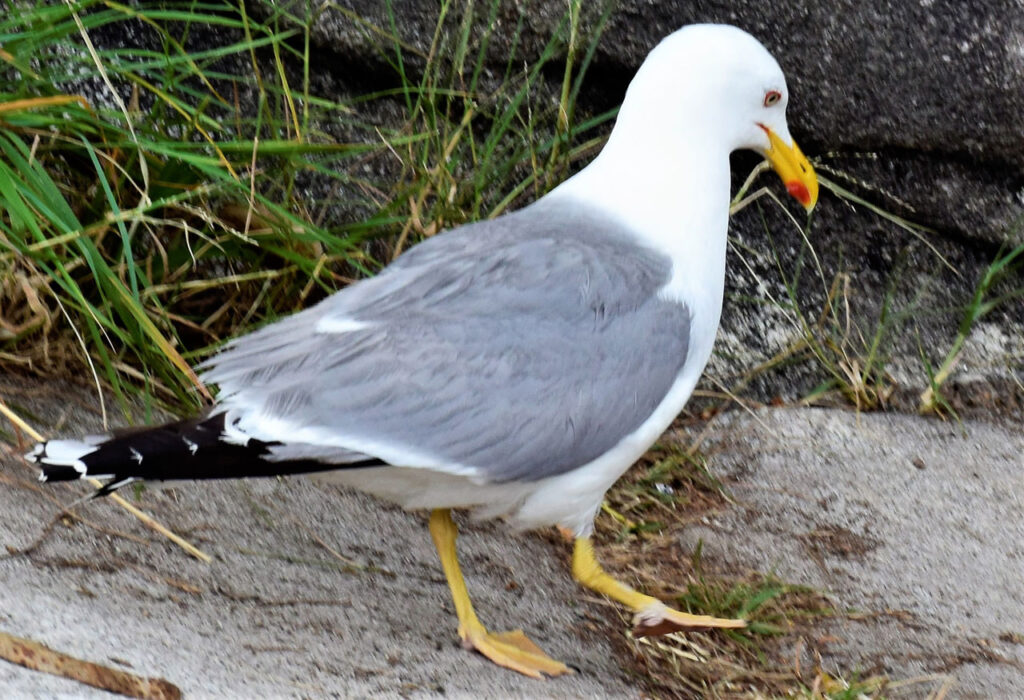
Some of the birds species that breed on the Cíes islands are the yellow-legged gull (Lares cachinas) and the common shag (Phalacrocorax aristotelis), this two species are the most numerous on the islands. The lesser black-backed gull (Larus fuscus) and the storm petrel (Hydrobates pelagicos) also breed there and both species are few in number in the iberian peninsula. Other larger bird species such as the northern gannet (Morus bassanus), northern goshawk (Accipiter gentilis), black throated loon (Gavia arctica) and peregrine falcon (Falco peregrinus) can also be seen on the islands at certain times of the year. The manx shearwater (Puffinus puffinus), black-headed gull (Larus radibundus) and common murre (Uria aalge) are other species that can also be seen.
In addition to birds, the islands are also inhabited by other animals. The mammals that inhabit are rabbits (Oryctolagus cuniculus) and north hedgehogs (Atelerix algirus) and eventually you will find some other otter (Lutra lutra) that swims to the islands. There are also reptiles such as the lizard (Lacerta hispanica) the arnal lizard (Lacerta Lepida) and the bedriaga´s skink (Chalcides bedriagai)
To learn more
The Cíes archipelago was declared a Special Protection Area (ZEPA) by Spain and the European Community. Due to the scarce human presence and the abundance of marine resources for food, as well as breeding sites, make the archipelago the ideal place for a large number of birds species. Sea birds have a characteristic webbed feet and waterproof plumage to be able to live in the marine environment.
The birds of which there are a large number of colonies nesting on the island are the yellow-legged gull, the common cormorant, the lesser black-backed gull and the European storm petrel. The most abundant is the yellow gull, among all the islands that are part of the National Park, there are more than 30.000 breeding pairs, constituting the largest concentration of this bird in the world. These birds are characterized by choosing each year the same pair to reproduce and usually lay between 1-3 eggs. The chicks are greyish-brown and remain in the nest until 2 months. Between the third and fifth year of life they become adults, acquiring the ability to reproduce and the characteristic white and grey plumage. Its beak and legs become the yellow colour that gives the name to the species. In the beak they have a red colour spot that serves as a simulation point for the chicks to peck and the parents regurgitate the food.
To know it better
On the northern island of the Cíes islands or “Monteagudo”, the water has different species of animals and plants thanks to the sea current. Amphibians and reptiles are not very well represented on the island, but you can see salamanders, species such as the Iberian newts or reptiles such as the ocellated lizard. If we talk about mammals, we can find wild cats, rabbits, mice, moles, or minks.
Likewise, what stands out most on the island are the birds, as they host one of the most numerous colonies of seagulls. These sea birds get their food directly from the sea. These species use the cliffs of the Atlantic islands to nest and, among them, we find the yellow-legged gull, the most abundant bird in the Park. Each pair usually lays from 1 to 3 eggs and the chicks stand out for their greyish-brown colour.
In its autochthonous forests there are species like different types of oaks (Melojo and Carballo) holly, broom and also butcher´s broom. We can also see rabbits, hedgehogs and other small animals such as mice, rats and moles.
The Cíes islands are located in Pontevedra province. They have nine beaches of fine white sand and crystal clear waters.
Location
- Town
- Vigo
- Municipality
- Vigo
- Province
- Pontevedra
- Country
- Spain
The asset
- Type
- Island
- Eco-destination
- Ría de Vigo
- Environment
- Natural
- Relevance
- International
How to get there
- Access
- By sea By land
- Distance
- 2,000 km
The visit
- Visitable
- Yes
- Accessible
- No
- Parking
- No
Coordinates
- Latitud
- 42.24134600
- Longitud
- -8.90266400