


Product. Oyster
About this heritage
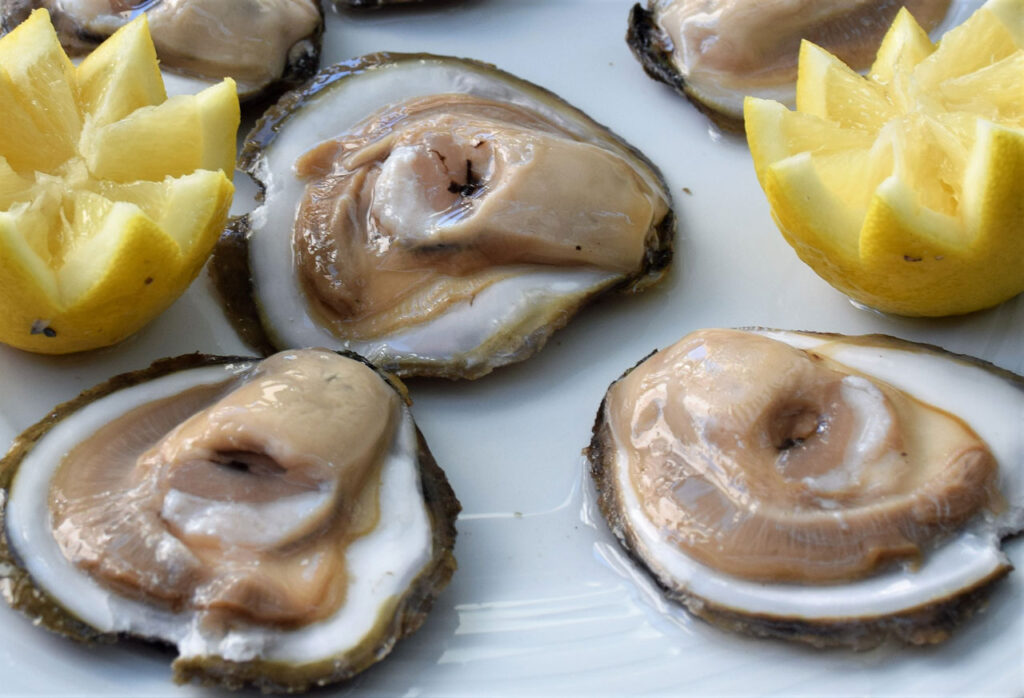
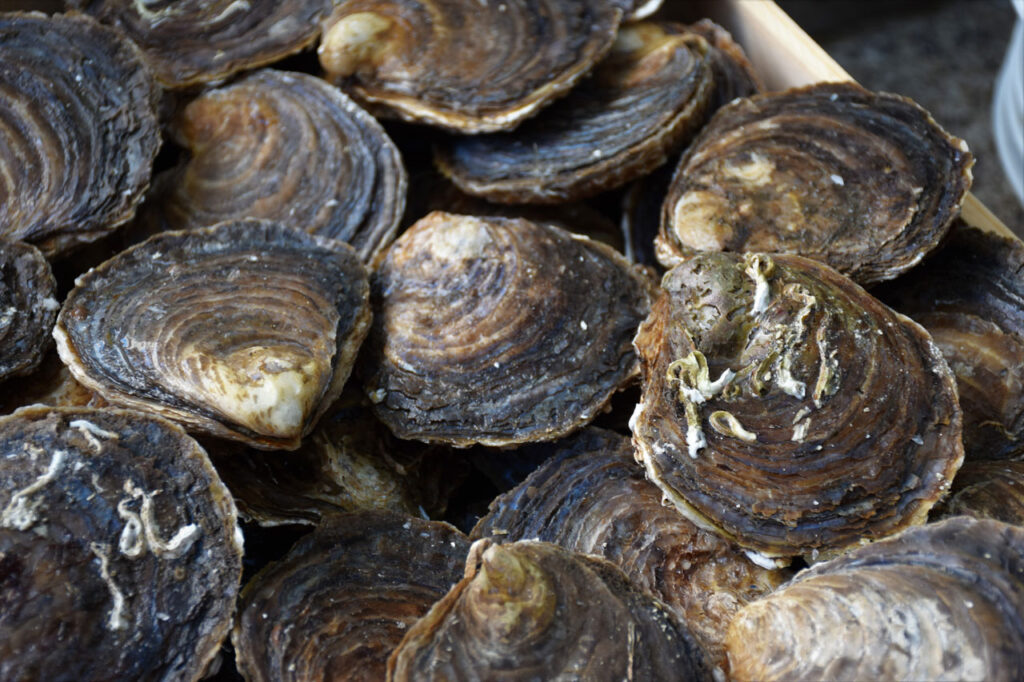
Ostrea edulis (Linnaeus, 1758) is commonly the flat or European oyster. It is a bivalve mollusk of the Ostreoida family. It has a shell formed by two uneven valves; in the outer part, the surface is marked and rough. Its upper right shell is flat while its lower left shell has a convex shape. The coloration varies between white, brown, or purple.
The mantle wraps the soft body, which is also the shell's forming organ. It has an adductor muscle that controls the closure of the valves.
During their lifetime, they alternate the production of male and female sex cells. The male releases his gametes into the sea while the female retains the oocytes. After expelled from the gonad, inside the pallial cavity, they are fertilized by the sperm.
The resulting larvae remain within the pallial cavity for 7 to 10 days before they are expelled to the sea.
From the last larval phase, it lives attached until it finds a substrate and secretes a cementitious fluid to join it. If the oyster becomes detached, it cannot attach itself again.
It is located in rocky substrates, gravel seabed, and artificial collecting devices in waters of the infralittoral zone from the surface to 80 meters in depth.
It feeds on phytoplankton and particulate organic matter. They trap in their gills these microscopic algae that pass to their mouth with the help of their labial palps, where they selected them, expelling the unwanted ones. They can filter more than 200 liters of water a day.
It is considered one of the most appreciated edible seafood, being its most usual way of consumption fresh and raw, although it admits other cooking preparations.
The minimum size allowed by measuring the dorsoventrally axis is 60 millimeters.
Its extraction is regulated in the specific resource management plans of the Regional Ministry of the Sea employing hand harvesting, as the oyster currently comes from a culture in rafts.
To learn more
Ostrea edulis (Linnaeus, 1758) is commonly the flat or European oyster. It is a bivalve mollusk of the Ostreoida family. It has a shell formed by two uneven valves; in the outer part, the surface is marked and rough. Its upper right shell is flat while its lower left shell has a convex shape. The coloration varies between white, brown, or purple.
Found all over the Cantabrian Sea, Ostrea edulis or flat oyster was particularly abundant in Galicia.
The increase in consumption and the out-of-control exploitation has contributed to the disappearance of many Galician oyster banks, which has provoked production restrictions in the Vigo and Arousa estuaries, coming to a halt during the '50s by the exhaustion of the natural banks of the Vigo, Arousa, and Noia estuaries.
During the '70s, it was the higher production period of the oyster in Galicia. The seeds were imported from France and fattened in more than 300 rafts in the Galician estuaries.
Later, as a result of the shortage of French oyster seeds and their poor conditions, oyster farmers began to import them from other places with truly poor results.
Currently, the cultivation of this species has disappeared, and the oysters marketed as Galician oysters come from imports of adult ones kept for one or two months in rafts.
If quality seed were to appear again, the production capacity in Galicia could be several thousand tons a year.
To know it better
The oyster is a bivalve mollusk of the Ostreoida family that lives at depths of about 80 meters. Found attached to rocks or buried in the sand, they are one of the Galician products more consumed throughout the year.
According to different investigations, oysters were already consumed in prehistoric times, but more appreciated by the Romans. They are usually eaten raw and alive, and they have always been considered a sea delicacy. In fact, many Spanish and European markets demand this product thanks to their fame and exquisite taste.
In Galicia, there are different festivals in which one can enjoy a serving of oysters at a good price along with typical pie (empanadas) and other various common local foods. Besides, they are beneficial due to their richness in minerals and vitamins.
Gallery
Location
- Town
- Arcade
- Municipality
- Soutomaior
- Province
- Pontevedra
- Country
- Spain
The asset
- Type
- Fish product
- Eco-destination
- Ría de Vigo
- Environment
- Urban
- Relevance
- Regional
How to get there
- Access
- By sea By land
- Distance
- 0 km
The visit
- Accessible
- Sí
- Parking
- Sí
Coordinates
- Latitud
- 42.34077900
- Longitud
- -8.61424900