
Vilanova de Arousa. Sculpture “Lighthouse of the Moons” and Urraca Castle
About this heritage
Between the region of O Salnés and the Arousa estuary, no elevations are notable close to the coast. Characterized by low areas, the landscape rises very little above sea level. Thus, the few existing mountains could have been used, logically, for defensive and strategic purposes; that is the case of Mount Lobeira, whose summit is only 294 meters high and located in the Vilanova of Arousa council. It stands alone like a pyramid, less than one kilometer from the fascinating views of the 228-meter Lighthouse of the Moon (Faro da Lúa). Almost at the top, we find a circle of stones from the Neolithic period and two burial mounds of stones or mámoas, confirming the place magic and rousing the interest of the region dwellers over time.
A fortress erected between the 10th and 14th centuries and belonging to the archbishopric of Santiago was a vantage point to watch over the passway between the coast and the interior. It witnessed the battles fought between Raimundo de Borgoña and Lady Urraca for its possession. Lost by both at the hands of Arias Pérez and later recovered by Lady Urraca. In 1175, King Ferdinand II of Galicia and León donated it to the Miter Compostelana, and Mariño de Lobeira demolished in the 17th century.
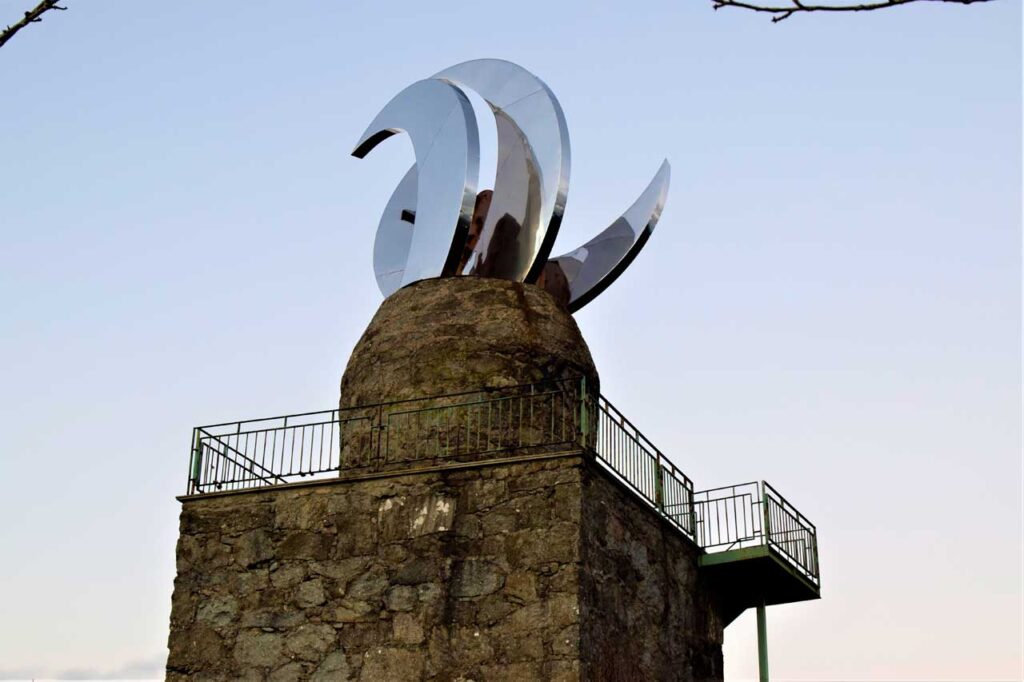
Many remains, still preserved today although in state of wear, can be appreciated, such as the weapons courtyard (patio de armas), a dungeon or underground cistern (aljibe), the stairs, a wall, and a vaulted cavity. One kilometer west of Lobeira, there is another mountain of 228 meters, where a large 9-meter high monolith stands, composed of small stones in the form of masonry and crowned with a stainless steel sculpture created by the artist from Vilagarcia, Manolo Chazo. The work created in 2002 represents three moons in the waning quarter phase, in which the sun reflects differently according to the time of day. At close and night, we can also look for the silvery reflection of the moon on the sculpture of the well-known Lighthouse of the Moons (Faro das Lúas).
To learn more
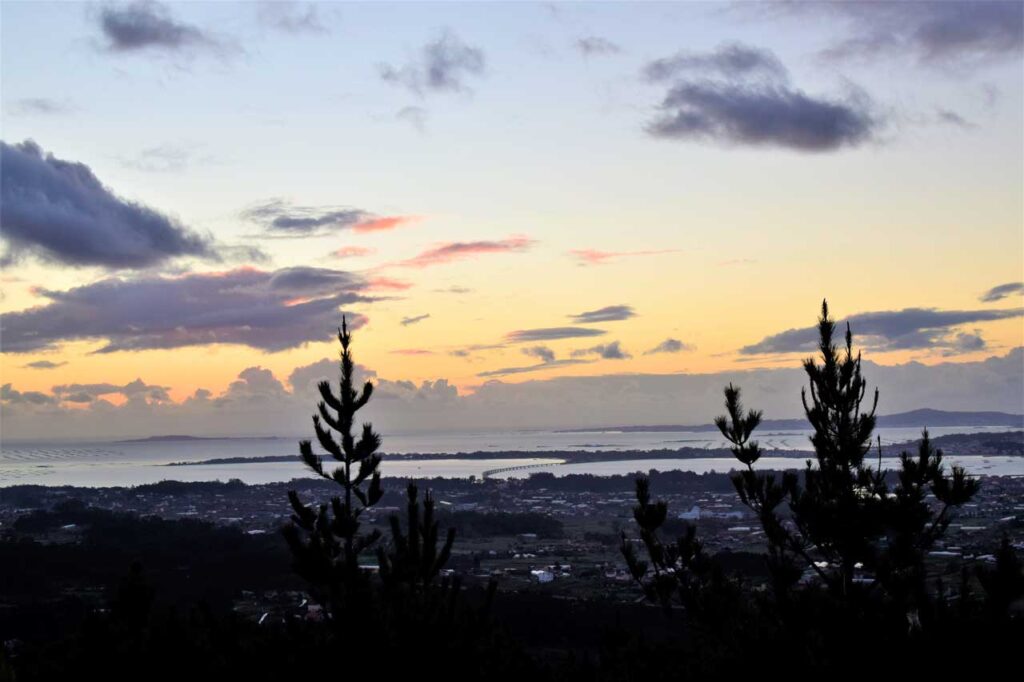
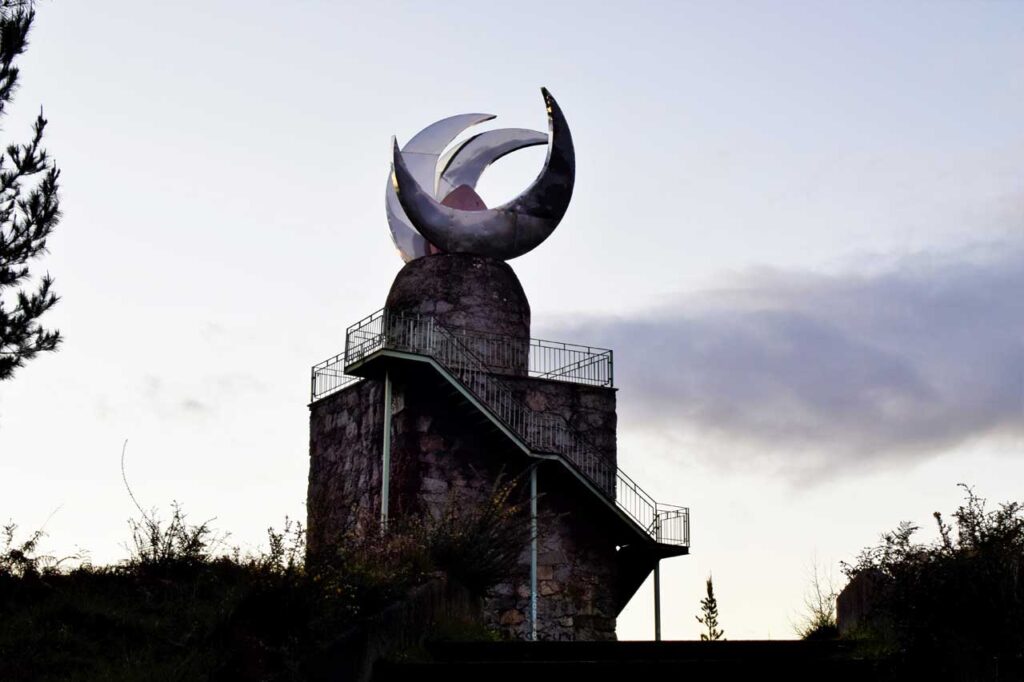
From the highest point of the O Salnés region and the Arousa estuary, we can see a considerable section of the coastline from O Grove to Catoiraa, and towards the south, the Barbanza peninsula and the Salnés area while towards the west, we can see Cambados, Vilagarcía, the Island of Arousa, San Sadurniño Tower, Siradella, and Mount Xiabre. Moreover, towards the interior, we can dominate the wide scenery of the Umia valley and several areas near the capital, Pontevedra. Extremely close – less than a kilometer away – is another hill of 225 meters with another exceptional viewpoint, the Lighthouse of the Moons ("Faro das Lúas"), from which we can access the sculpture by using a metal staircase that surrounds the monolith and ends in a fabulous "balcony," where a plaque reads: "Listen to the estuary and embrace the land" ("Escoitar a ría e abrazar a terra"). Created by Manolo Chazo in 2002, the art piece represents three moons in the waning quarter phase, in which the sun reflects differently according to the time of day. At close and night, we can also look for the silvery reflection of the moon. Between this and the castle of Monte Lobeira, we find the toponym "Salgueirón," rather common in zones near many old locations of ancient medieval fortresses, whose meaning is unknown unless it has some relation to the Willow tree, in Galician "Salgueiro" tree, particularly common in our geography.
The entire area has been razed to the ground by the fires from the middle of the first decade of the 21st century; thus, there is practically no arboreal vegetation. Thanks to the villagers of András (Vilanova of Arousa), the area has been valued, both historically and naturally, promoting archaeological studies and planting indigenous species. One of these studies has found various coins from the 15th century, as well as several pieces of pottery of high value due to their origin.
In Mount Lobeira, we find the remains of an ancient fortification from a signposted viewpoint with good access and even a parking area and a small recreational area. The place is a passage for several hiking routes that go through these natural areas. From the weapons courtyard, which today is the parking, we climb up a long staircase to see various cavities and spaces made by both man and nature and used by their ancient inhabitants. Several points seem to have been employed for surveillance, apparent by multiple fillings and flattening of the terrain. There are still the remains of a defensive wall that surrounded the most unprotected points, as well as the access to the summit, where the watchtower stood. Advanced eroding can be observed in the rocks that, in the past, were the foundation for the ashlars that formed the Lobeira Castle.
We can also notice a fantastic cistern (aljibe) to store the water, covered with a vault. Little can be recognized of the Fort (Castro) since the subsequent fortification distorted the majority of the former archeological rests. Close to the wall's remains, we find what could be an old "concheiro" - a prehistoric deposit of shells, remains of mollusks, and fish, or of various objects like several pieces of anomal's teeth. The ashlars of the castle were used for various palatial constructions near this mountain. At the end of the first decade of the century, because of the construction of a road, a long arched tunnel was discovered in Piñeiro, which served as a water mine for the Vistalegre's old Lordly House (Pazo) and convent. It is believed to be larger than one kilometer and to come from the foothills of Mount Lobeira. A legend tells that from Lobeira, a treasure was hidden in the tunnel to later bring it to Vilagarcía, towards Vistalegre Lordly House (Pazo). The first dating of the tunnel corresponded to the 17th century although, some maintain, that is one more century older.
At the top, the viewpoint is surrounded by a metal fence and in the center, a large metal cross. In its ascent, various modern texts, carved in the rock, as well as two commemorative plaques. One of them reminds us of the wreck of the English ship "Serpent" off the coast of Cape Vilán, in Camariñas. The placing of the plaque in this location, slightly far from the tragic point of the English vessel, was Vilagarcía's service to part of the English fleet since it was a mooring and distribution port, and on a visit in 1896, it was inaugurated to pay homage to the "Serpent."
That same year, the magnificent iron cross of nearly four-meter high was installed at the highest point; placed under the commissionte of the Commander of the Maritime Province of Vilagarcía, by the Navy Captain Adolfo de Reynoso. In 1961, the Command of Marín installed another plaque in memory of all of those who died in these coasts, located beside the one above mentioned.
To know it better
In Vilanova of Arousa county in Pontevedra, near Mount Lobeira, and 200 meters above sea level, stands the sculpture "Lighthouse of the Moon" (Faro da Lúa), created in 2002 by the local artist Manolo Chazo. The work represents three moons in the waning quarter phase, in which the sun reflects differently according to the time of day, and at night, one can look for the Moon's reflection on the sculpture.
The art piece has a metallic staircase that ends in a viewpoint, so one can admire the Arousa estuary, Vilanova, A Illa, Cambados, and the peninsula of O Grove. There is also a plaque that reads: "Listen to the estuary and embrace the land" ("Escoitar a ría e abrazar a terra").
Additionally, on this mountain is the castle of Lobeira, which has a medieval fortress, rebuilt due to the passage of time. The Vilanova of Arousa county, in the Pontevedra province, and integrated into the region of O Salnés is a place with antiquity; hence, with History.
Gallery
Location
- Town
- aunque ha sido reconstruido debido al paso del tiempo.El ayuntamiento de Vilanova de Arousa se localiza en la provincia de Pontevedra. Integrado en la Comarca de O Salnés, Cambados y la península de O Grove. Además, cerca del monte Lobeira y a 200 metros de altura, con historia.", de acero inoxidable, en el mismo monte, En el municipio pontevedrés de Vilanova de Arousa, encontramos la escultura Faro da Lúa, encontraremos una placa que dice Escoitar a ría e abrazar a terra". Por otra parte, es un lugar con antigüedad y, podremos buscar el reflejo de la Luna sobre la escultura.La obra cuenta con una escalera metálica que acaba con un mirador donde veremos la Ría de Arousa, por ello, por la noche, realizada en el año 2002 por el artista local Manolo Chazo. Esta obra, representa tres lunas en fase de cuarto menguante en las cuales se refleja el sol de una forma diferente según la hora del día. Además, se encuentra el castillo de Lobeira. Dispone de una fortaleza de época medieval, Vilanova y A Illa
- Municipality
- Vilanova de Arousa
- Province
- Pontevedra
- Country
- Spain
The asset
- Type
- Viewpoint
- Eco-destination
- Ría de Arousa
- Environment
- Rural
- Relevance
- National
How to get there
- Access
- By land
- Distance
- 8,200 km
The visit
- Visitable
- Yes
- Accessible
- Sí
- Parking
- Sí
- Signposted
- Yes
Coordinates
- Latitud
- 42.56070700
- Longitud
- -8.77315200