
Product. European pilchard
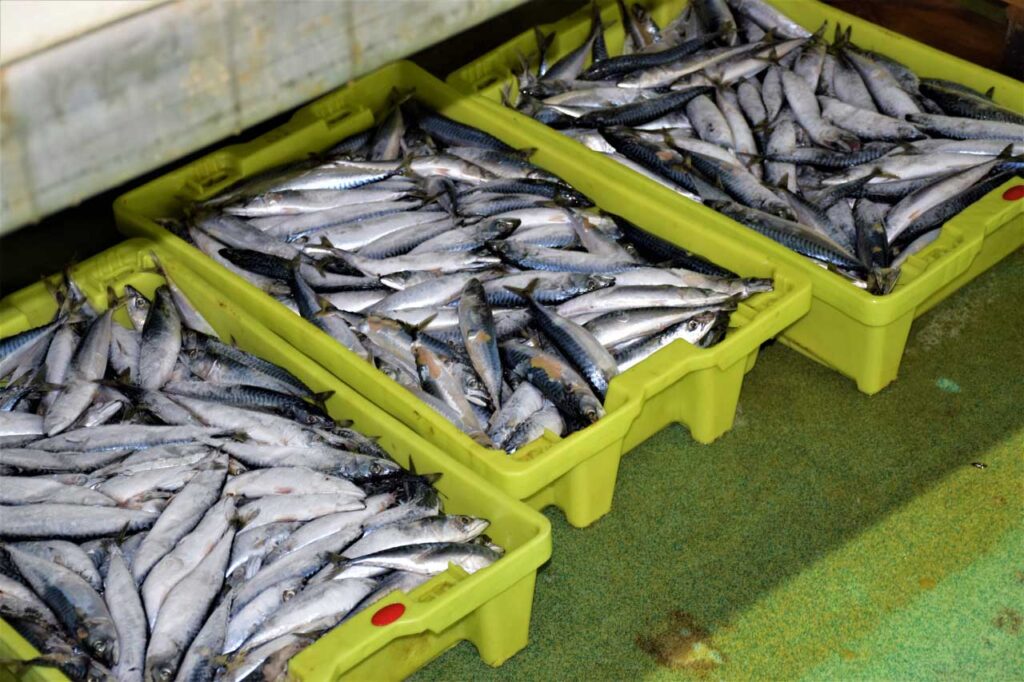
About this heritage
The European pilchard Sardina pilchardus (Walbaum, 1792),also known as “parrocha” or “xouba” (in Galician language), is a saltwater oily fish that lives in waters of about 12 to 24 degrees. It belongs to the Cupleidae family and is one of the most abundant groups of pelagic fish distributed throughout the world.
The specimens that are caught range in weight from 50 to 200 gr and the dimensions that they reach are usually between 11 - 30 cm. It is a gregarious fish that lives in large shoals of 15 to 50m, capable of forming schools that move in unison as a defence against larger predators that, seeing the formation, do not dare to attack it. It can be found both on the coast and in the sea and is the food for many predators.
Its food consists of plankton, small fish, crustaceans and other species´ eggs. It is a species whose fishing is strictly regulated by the European Union. Its meat has an excellent taste, although it is poorly preserved. It is sold fresh in most of the fishing ports along the Spanish coast, although it is also widely used by the canning industry. It can also be found as semi-preserved, dried, salted or smoked.
It is fished by purse seine during the night and also with another fishing gear known as the “xeito"; regulated by the specific management plans. They are usually caught between March and September.
To learn more
The European pilchard Sardina pilchardus (Walbaum, 1792) belongs to the same group as anchovies and herrings. It is a fish with an elongated slender body, of oval section (fusiform), bluish or greenish on the back, with flanks or backs covered by a bright blue longitudinal band and, sometimes, by a series of small black spots behind the head.
Its body is compressed laterally. A dorsal fin. Big scales that tend to fall. Abdominal area in sawn keel, with modified scales in gussets. Operculum with 4 or 5 bone striations.
It is distributed along the coasts of the eastern North Atlantic, from Iceland, where it is more rarely found, and the North Sea, southward to Goree´s bay, Senegal. Also in the Mediterranean, in the Marmara Sea and the Black Sea.
It is a fast growing species so the stock has great capacity for recovery. They are caught using purse seine gear, and bottom trawling is also used. In Galicia it is fished with a fishing-gear called “xeito"; which is a type of drift gillnet made up of a rectangular cloth extended between two meshes, the upper one, which consists of a buoyancy system that allows the draught at variable depth, and the lower one which is dragged with weights.
In Galicia, there is a saying “Por San Xoán, a sardiña molla no pan"; (something similar to: “In San Xoán, is time to eat pilchard with bread”) which warns of the best time to eat sardines, as its amount of fat is ideal for grilling them in the open air. Pilchards are part of the Galician gastronomy and you can find typical dishes such as the “xoubas" pie, and other kinds of preparations such as pickled pilchard, also smoked, and dried and salted sardines, were modalities very used in the past in a greater extent.
To know it better
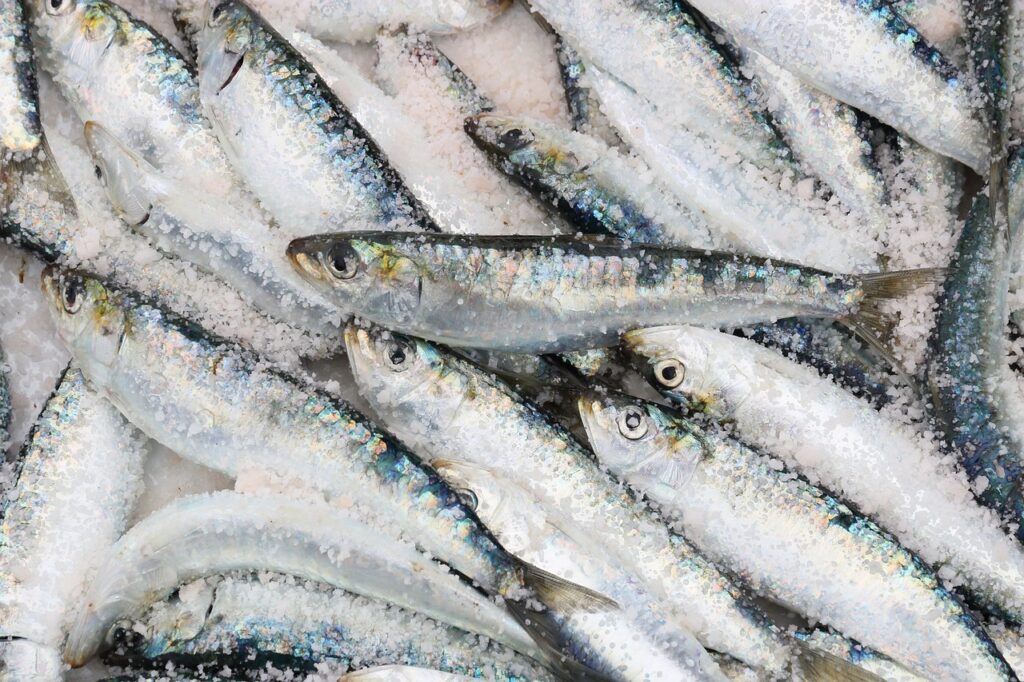
The common or European pilchard is a saltwater oily fish that belongs to the Clupeidae family. This animal´s body is elongated, with small teeth and is dark grey, blue and silver in its back. Its belly is white with silver tones and the fins are colourless.
The roasted sardine is very famous in the Galician cuisine, its campaign begins on May 31st and they are very requested on June 24th, the day of “San Juan” because, both in Chapela and in other coastal municipalities, they are taken to celebrate the typical day of “San Xoán” (in Galician language). Besides, in Chapela there is also a festival dedicated to this fish, the “Fiesta de la Sardina” (Pilchard´s Festival)
In Chapela, two fishing gears are used to fish for sardines: bottom trawling and purse seining. Bottom trawling, as its name suggests, consists of dragging a large net along the seabed so that the pilchards are caught in the net. Today, this technique is not so widely used as it can cause irreparable damage to other organisms on the sea bed, for example, corals. The other fishing gear, the purse seine, involves surrounding a shoal of pilchards with a large net, this net is closed and the pilchards are trapped inside.
Gallery
Location
- Town
- Chapela
- Municipality
- Redondela
- Province
- Pontevedra
- Country
- Spain
The asset
- Type
- Fish product
- Eco-destination
- Ría de Vigo
- Environment
- Maritim
- Relevance
- Regional
How to get there
- Access
- By sea By land
- Distance
- 0 km
The visit
- Accessible
- No
- Parking
- No
Coordinates
- Latitud
- 42.26801300
- Longitud
- -8.67487100