


Domaio. Rande Bridge
About this heritage
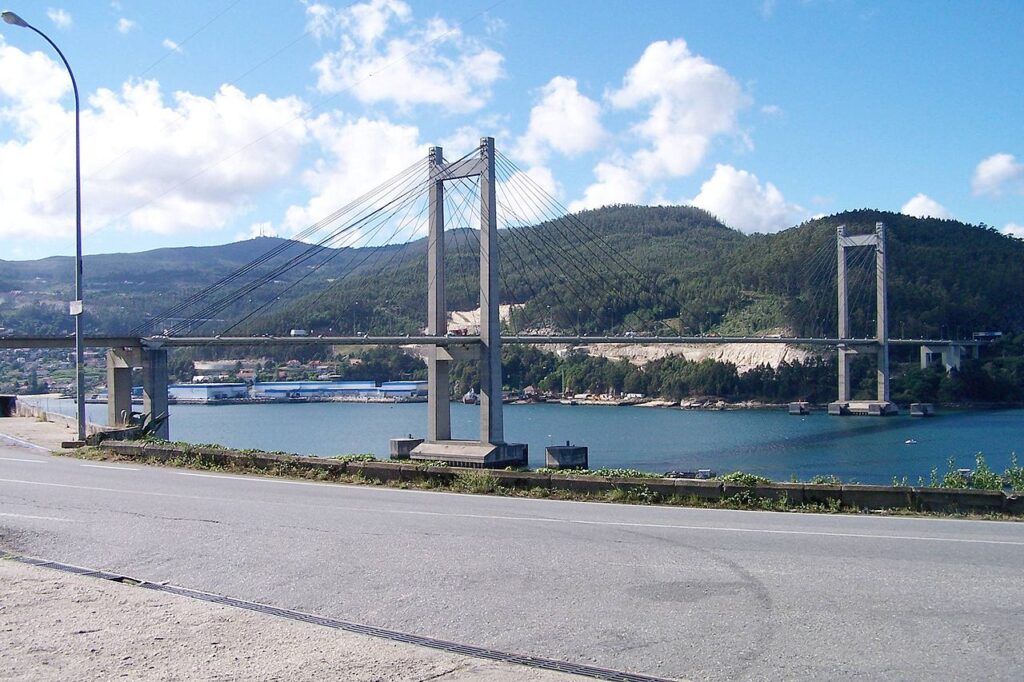
The majestic Rande Bridge was designed by the Italian engineer Fabrizio de Miranda and built in 1978, with four traffic lanes (2 in each drive direction) within the Vigo estuary. It is 1558 meters long and joins the borders of the strait that gives it its name: Rande.
Rande Bridge is among the most characteristics in Spain and one of the most modern and innovative engineering structures in the world in this kind of constructions; it was inaugurated in 1981, and every day about 50,000 vehicles cross it.
In order to cross it, it is necessary to access the Atlantic Highway on the Vigo-A Coruña section. The road is 45 meters above sea level and has stunning views of San Simón Island, Cíes Islands, and the Vigo estuary. Presently, and after many months of work, Rande Bridge underwent an extension resulting in three lanes in each direction of traffic.
This bridge is impressive both during the day and at night, there are several tour guides and experts, who recommend going to one of the viewpoints of Vigo to see the bridge under the darkness of the night.
At the foot of Rande Bridge begins the Domaio area, a town of the Moaña County, on the peninsula of Morrazo. Domaio has a harbor protected from the south winds by concrete blocks, which enable it to house 198 berths and 9 docks. It is on the north face of the Vigo estuary and occupies the hillside of Mount Lighthouse of Domaio (Faro de Domaio), the town has all the services, beaches such as the famous Domaio Beach and the Domaio Golf Club among other attractions.
To learn more
As previously mentioned, Domaio belongs to the Town Hall of Moaña, a county that belongs to the group of town councils that make up the peninsula of Morrazo, in harmony with Bueu, Cangas, and Marín offering its visitors endless opportunities to enjoy the most incredible landscapes, charming beaches, and its gastronomy prepared with fresh fish and seafood from the estuary.
However, if the natural wealth of the region in terms of coastal landscapes is at the highest level, its mountains offering spectacular landscapes are equally outstanding. As already mentioned, the night view of the Rande Bridge is another example.
Returning to Domaio and Moaña, which offer an important cultural heritage such as the Mámoas do Chan – burial mounds of stones – of Arquiña and its archaeological remains, the Museum of career crafts (das Carreiras), the Rosal Lordly house, the Church of Saint Martin (San Martiño), and the routes to the beaches of Vedeira, Meira, Domaio, O Con, and A Borna.
A special mention goes to the Domaio Lighthouse, which rises to a height of 636.20 meters and marks the highest point in the region. From this mountain, you have complete dominion of the Vigo and Pontevedra estuaries. The vegetation is dominated by oak and chestnut as a representation of the Atlantic forest, although other species have been gaining space with the help of man.
Monte de Domaio also has space for leisure, such as the area of Chan da Arquiña (Dolmen), where there is a megalithic monument with the same name, a mámoa (burial mound) with more than 5000 years, constituted of a polygonal chamber with eleven vertical stones and a five stone corridor.
To know it better
Domaio, a parish of Moaña, has a curious story about the Puente de Rande because it is at its feet. The Battle of Rande was an important naval battle that took place on October 23, 1702 in the Strait of Rande. The legend tells that when the Spanish galleons returned from America to the Vigo estuary packed with gold, silver, and jewels, the ship was attacked with all those valuables inside; another legend relates that the treasures had already been offloaded.
Thanks to this story, Jules Verne turned Captain Nemo into the first hunter of the Vigo estuary treasure. In fact, since then, hundreds of dives have been made in these waters in search of it.
Moaña is a county in the province of Pontevedra, on the coast of Morrazo. The latter has five town councils: Bueu, Cangas, Marín, Moaña, and Vilaboa. In the center of Moaña stands out the port, the main supplier of its market and of the different restaurants in the area. Furthermore, in this town, one can appreciate the typical houses of a seafaring district, of low height and varied colors.
Gallery
Location
- Town
- Domaio
- Municipality
- Moaña
- Province
- Pontevedra
- Country
- Spain
The asset
- Type
- Bridge
- Eco-destination
- Ría de Vigo
- Environment
- Rural
- Relevance
- International
How to get there
- Access
- By sea By land
- Distance
- 1 km
The visit
- Accessible
- No
- Parking
- No
Coordinates
- Latitud
- 42.29068000
- Longitud
- -8.66041000