


Pontevedra. Las Corrientes Bridge. O Burgo Bridge. Los Tirantes Bridge
About this heritage
Pontevedra is the city of bridges; these are symbols of proximity and union. All of them are of significant relevance even though we are going to highlight only three, Las Corrientes Bridge (the currents), O Burgo Bridge, and Los Tirantes Bridge (the suspenders or braces).
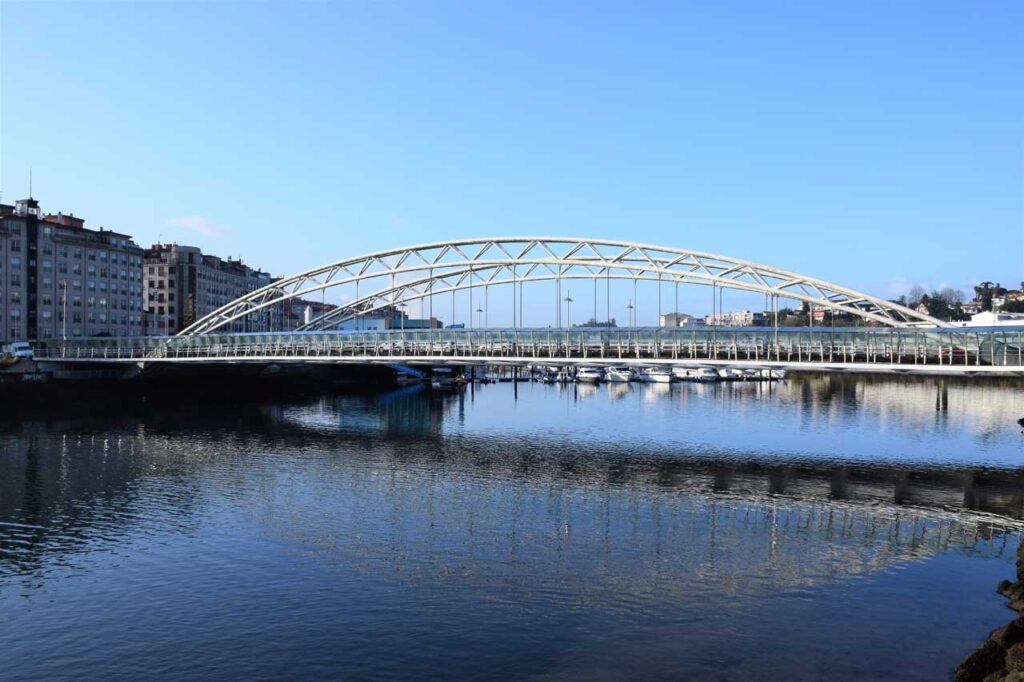
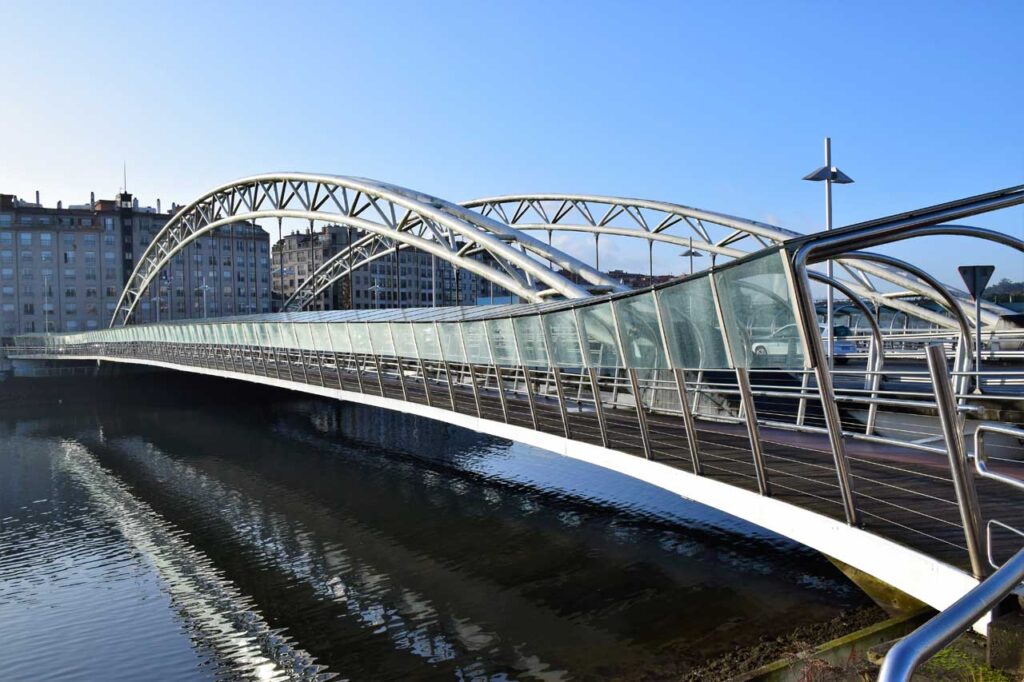
Las Corrientes Bridge is between the south and north banks of the Lérez River, opened to traffic in 2012. It is the seventh viaduct that joins both banks of the river (without including the pedestrian and railroad bridges), specially designed to ease the traffic of vehicles, walkers, and cyclists thanks to two walkways. A stroll to cross the Lérez River for visitors when arriving at Pontevedra city and enjoy the spectacular views.
The O Burgo Bridge is the first one joining the two banks of the Lérez River. Built by the Romans, it became one of their principal communication routes: the Roman Path XIX. It is the Kilometer "Zero" of the Pontevedra History. Rebuilt in the 12th century, it consists of eleven round arches reduced made of medieval masonry but modified due to later extensions. It is part of the mandatory passage of the Portuguese Way to Santiago de Compostela.
The bridge of the braces is among the thirty-three most unique in Spain, and is among the twenty-two most considered in the last century. It was opened in 1995 and is the creation of Leonardo Fernández Troyano and Javier Manterola, two great engineers associated with the Fernández Casado studio. These engineers have turned bridges into works of art throughout the Peninsula. This bridge represented the best image of Pontevedra in the 20th century
To learn more
Las Corrientes Bridge is the seventh bridge over the Lérez River in Pontevedra City, financed by the Regional Ministry of Territorial Policy and the Pontevedra Town Hall. It is a very unusual bridge next to the marina; its four lanes and modern design stand out, especially when arriving by the highway.
O Burgo Bridge is part of the history of Pontevedra. Its ancient Roman remains gave name to the town, and today, it is not only one of the symbols of the city, but also its heraldic emblem. The Roman troops built the primitive bridge to save the bed of the Lérez River on one of its mainland communication routes. During the Roman Empire, and therefore, for a few centuries, they maintained the communication infrastructure. However, little or nothing is known about this ancient bridge. Nobody has established its exact location, dimensions, or configuration.
Los Tirantes Bridge (the bridge of the braces) is the Pontevedra's urban bridge, inaugurated in 1995 to join the two ends of the Lérez River, and therefore, improving the communications and the traffic flow in the entire city. The Ministry of Public Work and Transport included this bridge in the list of "the thirty-three most unique bridges in Spain."
Structurally, the bridge has a total length between abutments of 125 meters without intermediate supports and has a sixty-three meter high reinforced concrete tower from which seventeen pairs of braces come out. The front ones hold the deck while the rear ones, supported on two concrete bases on the ground, act as counterweights that balanced the tower's stress.
To know it better
Apart from Pontevedra's old center, the distinctive bridges show the city over the Lérez River. Each of them has its style.
Inaugurated in 2012, Las Corrientes Bridge is a modern bridge, the seventh in the city, and serves traffic, pedestrians, and cyclists.
O Burgo Bridge is a mandatory route on the Saint James Way and was the first to join the two banks of the Lérez River in Pontevedra. Dating to Roman times and rebuilt in the 12th century, it is made up of eleven round arches.
Moreover, Los Tirantes Bridge, inaugurated in 1995, joins the two ends of the Lérez River. The Ministry of Public Work and Transport included this bridge in the list of "the thirty-three most unique bridges in Spain."
Located in the northwest of the Iberian Peninsula, Pontevedra is an administrative, monumental, tourist, and service city. One of art and history, it has a monumental area that, after Santiago de Compostela, is the most important in Galicia.
Gallery
Location
- Town
- Pontevedra
- Municipality
- Pontevedra
- Province
- Pontevedra
- Country
- Spain
The asset
- Type
- Bridge
- Eco-destination
- Ría de Pontevedra
- Environment
- urban
- Relevance
- Internacional
How to get there
- Access
- By sea By land
- Distance
- 0,080km
The visit
- Visitable
- Yes
- Accessible
- Sí
- Parking
- No
Coordinates
- Latitud
- 42.43589900
- Longitud
- -8.64397300