


Ponte de Porco
About this heritage
Ponte do Porco is a small core located at the entrance of the Miño municipality from the Paderne neighboring one. The name has its origin in the coat of arms of the House of Andrade and the boar's head carved in the 14th-century medieval bridge. Fernán Pérez de Andrade ordered the construction of the Ponte do Porco Bridge so that pilgrims, on their way to Santiago de Compostela, could cross the Lambre River as it passes through Miño. Its name also comes from a legend about an impossible love that runs throughout this municipality.
In 1978, the Royal Academy of Fine Arts dedicated a monument to the Andrade family in the locality's center. It is a calvary statue (cruceiro) composed of a cross atop a pig, representing the victory of good over evil. The native of Compostela, Alfonso Sanmartín, was the sculptor of this monument in 1962. He based it on the crosses placed by the Andrade family on the fief's principal buildings to identify their house.
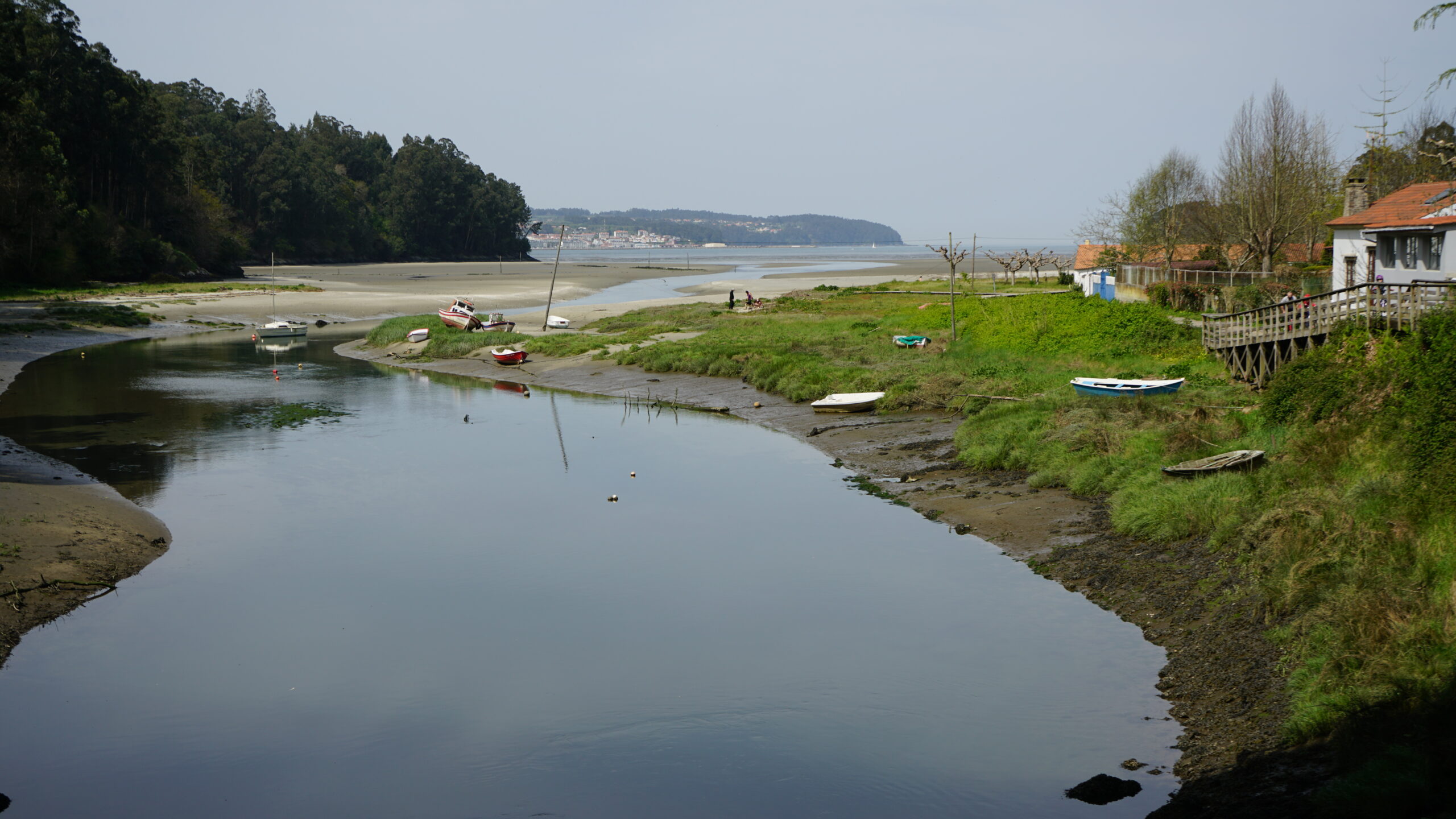
Right at the Lambre River's mouth in Ponte do the Porco surroundings, we can find the Alameda Beach. A rural area of approximately 450 meters in length and 50 meters average width, with a characteristic half-shell shape, white and fine sand, and a promenade. It is a protected zone of the Natura 2000 Network and included in the Betanzos-Mandeo natural area.
To learn more
Ponte do Porco Town is integrated into the Miño municipality and borders the Paderne Council. It is known for its famous bridge and beach and owns its name to the boar's head distinctive feature held by the house and the legacy of Fernán Pérez de Andrade O Boo.
Its beach is approximately 450 meters long with a characteristic half-shell shape and a promenade. Its sand is white and fine, surrounded by vegetation, a green stretch protected by the Natura 2000 Network, which is a European organization to preserve natural zones and incorporate Sites of Community Importance and Special Protection Areas for Birds. Its waters are calm with anchorage areas, where the Lambre River flows into the sea with low and high tide currents.
Ponte do Porco is a 14th-century medieval viaduct that connects with the town of Paderne with the Lambre River flowing underneath. Fernán Pérez de Andrade O Boo ordered its construction to link Betanzos and Pontedeume, extending it to Ferrol for commercial exchanges and to established relationships in the English Way to Santiago for the pilgrims. Nowadays, on top of this bridge lies another one built with the materials of the old one in 1862 by Queen Elisabeth II and currently used as a national road.
Legend has it that the Lord of Pontedeume, Nuno Freire de Andrade, had three children, two boys and a daughter named Tareixa. She was a particularly jovial young woman who enjoyed nature to the extent of sometimes behaving mischievous and absent-minded, for which, his father decided to entrust her safety to Roxin Roxal, a boy at his service who possessed great talents, gaining his trust and sympathy.
Since they spent so much time together, Tareixa and Roxin gradually fell in love, making the young man very happy, but as time passed by, he felt increasingly afflicted for not being able to shout from the hills his love for her. Therefore, during the hours apart from her, he sang beautiful love songs or watched, from the tower, the Andrade castle where his beloved lived.
Because of the loyalty and respect he had for Nuno, the boy was unable to confess his love to Tareixa, but when she realized his sadness, she stated her reciprocal love, empowering them to date. However, it was short-lived because as soon as Nuno found out, he ordered Roxin to stay away from her and remain in the castle permanently. Although Nuno felt a great affection for his servant, he could not permit him to marry his daughter since he was not from a noble family, and he had already offered his daughter's hand to Henrique Osorio, the descendant of a wealthy family with lineage. The boy fulfilled the orders out of loyalty for his lord Nuno, who rewarded him with a precious and luxurious dagger.
Soon after, Tareixa and Henrique married, making her increasingly unhappy and causing her to miss his beloved Roxin more and more. She often went to the tower of Pontedeume to observe from afar the castle where her only love remained.
In the meantime, Nuno learned that a huge wild boar was destroying and ruining the crops on his land and that several peasants had died trying to kill it, so he decided to give his son-in-law the task of organizing a hunt. Subsequently, Henrique asked his wife to accompany him since she was an expert in moving through these lands and skillful with weapons. After Tareixa agreed, they went hunting and quickly found the wild animal on the bridge of Fernán Pérez de Andrade, who built it to establish a beneficial communication between his lands, Pontedeume and Betanzos.
Once in front of the wild boar, Henrique threw an arrow, which only wounded the animal that angered by the pain attacked Tareixa killing her, after which it escaped severely hurt. Instead of protecting and helping his wife, Henrique threw himself into the river across the bridge's parapet to hide from the beast.
A few days later, they found the wild boar dead on the bridge with a dagger embedded, the same one Nuno had given to his servant. The lord of Pontedeume understood then with consternation and torment that if he had blessed the marriage between his daughter and Roxín, overlooking his lack of noble linage and accepting his simple commoner status, Roxín would have defended and even given his life for his beloved daughter, who would be alive.
To know it better
Miño is a coastal municipality located in the High Estuaries (Rías Altas) of Galicia, more specifically, in the Betanzos estuary within A Coruña Province. Miño borders Pontedeume to the north, Vilarmaior to the east, and Paderne and Irixoa municipalities to the south.
A town that attracts plenty of tourism for its five main beaches, namely Grande, La Ribera, La Alameda, Perbes, and Lago. Additionally, visitors can enjoy the passage of three rivers: Lambre with its mouth in Ponte do Porco, Baxoi that flows to its mouth at Grande beach, and Xarío that crosses the parishes of San Xoán de Vilanova and Perbes, flowing into the Grade beach.
Ponte do Porco is a small town into which the Lambre River flows, but above all, it is known for its bridge and the Alameda beach. This 1862 old bridge has a wild boar's head sculpted on one of its arches. According to legend, the town's name comes from Don Nuno Freire de Andrade's family history. Don Nuno developed a great affection and trust for a young servant and awarded him a silver dagger and the care of his daughter Tareixa, but they fell in love, and when Don Nuno found out, he separated them and decided to marry Tareixa to a nobleman called Don Henrique Osorio. This nobleman invited her to a hunt for a wild boar, in which he wounded the animal, causing it to attack and mortally wounded his wife while Don Henrique, afraid for his life, cowardly decided to jump off the bridge. A few days later, they found the dead boar (wild pork) on the bridge with the silver dagger. Hence, the name Ponte do Porco, the bridge of the Pork.
Gallery


Location
- Town
- Paderne
- Municipality
- Miño
- Province
- A Coruña
- Country
- Spain
The asset
- Type
- Bridge
- Eco-destination
- Rías de Ares y Betanzos
- Environment
- Rural
- Relevance
- Local
How to get there
- Access
- By sea
- Distance
- 2, 600 km
The visit
- Accessible
- No
- Parking
- No
- Signposted
- Yes
Coordinates
- Latitud
- 43.351873927174054
- Longitud
- -8.216020297699759