


Castros A Forca and Santa Trega, Castro and Phoenician Culture
About this heritage
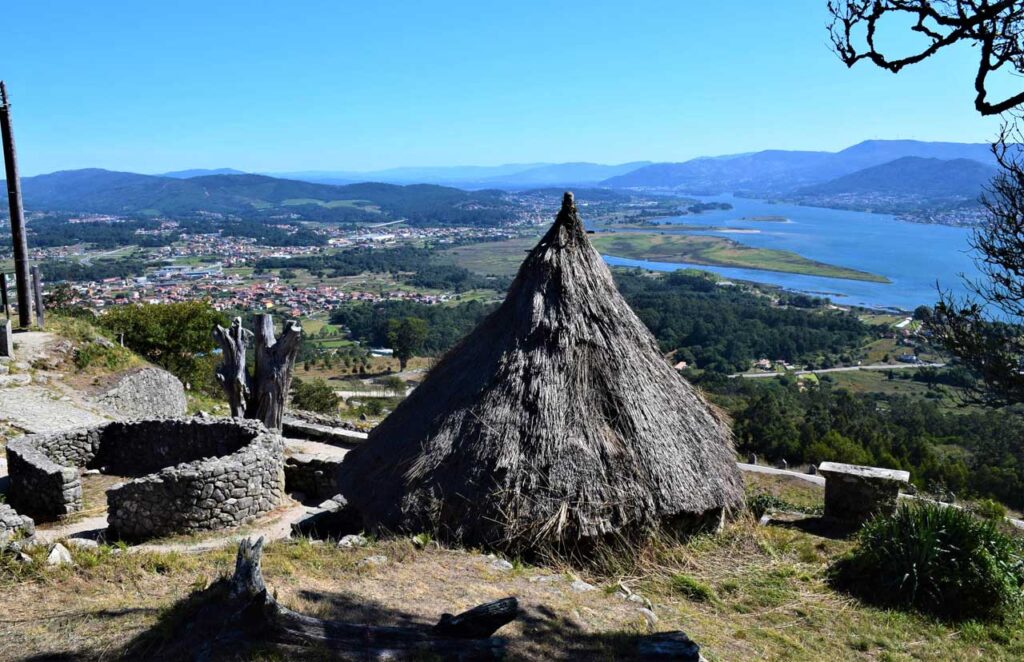
With its 20 hectares, Santa Trega is the largest oppidum in Galicia and one of the largest in the northwest. Oppidum (plural, oppida) is a Latin term that designates an elevated place, a hill or plateau, whose natural defenses have been reinforced by human intervention. The commercial importance of the area does not begin with the founding of the castro in the mid-2nd century BC, but dates back at least to the 4th century BC. At that time, the small castro of A Forca was established at the foot of Mount Santa Trega, which has yielded several Punic and Greek ceramics and is currently hidden by undergrowth. This castro, 80 meters above sea level, has an incomparable location, acting as a penetration route of this Atlantic path through the Miño river valley towards the interior of Galicia. Dated to a central moment of the castro culture mainly through imported ceramics, it is a clear example of the penetration of Punic-Gaditan traders into Galicia. The castro was abandoned around the 1st century BC. Midway up the same mountain stands the castro of Santa Trega, one of the most visited and best preserved in Galicia thanks to reconstruction work.
To learn more
The constructions of Santa Trega were organized in groups formed by several houses and storage rooms sharing a small common courtyard, often paved. They were grouped into small neighborhoods, separated by narrow streets. This urban planning was complemented by a complex network of rainwater drainage channels and cisterns distributed throughout the castro. Many of the huts feature an entrance vestibule of Mediterranean influence adapted to the characteristics of indigenous constructions. The houses were plastered and painted red, blue, or white. The jambs and lintels of some doors were richly decorated with geometric engravings, cylindrical blocks (swastikas) embedded in the walls, and with access points such as pedestals or moorings. Between 3,000 and 5,000 people lived here. Like other castros, the subsistence mode was quite autonomous. There was varied agriculture: wheat, barley, oats, millet, and broad beans, and livestock: cattle, sheep, goats, and pigs. Hunting, fishing, and shellfishing were complementary but equally important activities. The making of pottery, textiles, and tools, as well as trade, were other activities occupying the inhabitants. Various archaeological campaigns have found numerous remains confirming the intense commercial relationship the inhabitants of Santa Trega maintained with Mediterranean visitors. Among these remains stand out ceramic spindle whorls. The spindle whorl is a ceramic, metal, stone, or bone piece, among other possible materials, used as a counterweight placed on the vertical spindle for spinning, which also serves as a stop when placed at the lower part of the spindle, typical of Iron Age settlements from the Levant and southern peninsula, with characteristics foreign to the castro culture, and a fragment of a dark blue glass paste necklace, clearly imported from the southern peninsula. Although much is unknown about how the redistribution of materials externally functioned, there seems to have been some redistribution inland, as evidenced by Campanian ceramics found in the Pedra Moura castro, 25 linear kilometers from Santa Trega.
To know it better
The castros of A Forca and Santa Trega are located in A Guarda, on Mount Santa Tecla. The settlement that inhabited them developed the castro culture, whose main characteristic was the way of organizing to live. These are settlements known as castros, where circular stone constructions predominated, although oval and square ones also existed. The settlement of Castro de Santa Trega housed up to 5,000 people in the 1st century BC and was one of the largest in the northwestern peninsula. Additionally, it currently holds the status of "Bien de Interés Cultural" and "National Historic-Artistic Monument." The Castro de Santa Trega consists of rounded, oval, and some rectangular houses where inhabitants cultivated food. They also made pottery, jewelry, and tools, many of which can be seen in the museum. Besides the Castro de Santa Trega, the mount also hosts the Castro de A Forca, where people lived for over 200 years. It is currently hidden due to undergrowth, as it was abandoned in the 2nd century BC. While exploring the castros, one can seek out the more than 30 groups of petroglyphs existing in Santa Trega. These are different engravings found on rocks, including geometric shapes, spirals, or animal drawings.
Gallery
Location
- Town
- A Guarda
- Municipality
- A Guarda
- Province
- Pontevedra
- Country
- Spain
The asset
- Type
- Castro
- Eco-destination
- Río Miño
- Environment
- Rural
- Relevance
- International
How to get there
- Distance
- Distancia 5,2 km / 14 minutos en coche
The visit
- Visitable
- Yes
- Interpretation
- No
- Accessible
- No
- Parking
- Sí
- Signposted
- Yes
Coordinates
- Latitud
- 41.89257900
- Longitud
- -8.86969200