


Montealegre Castro
About this heritage
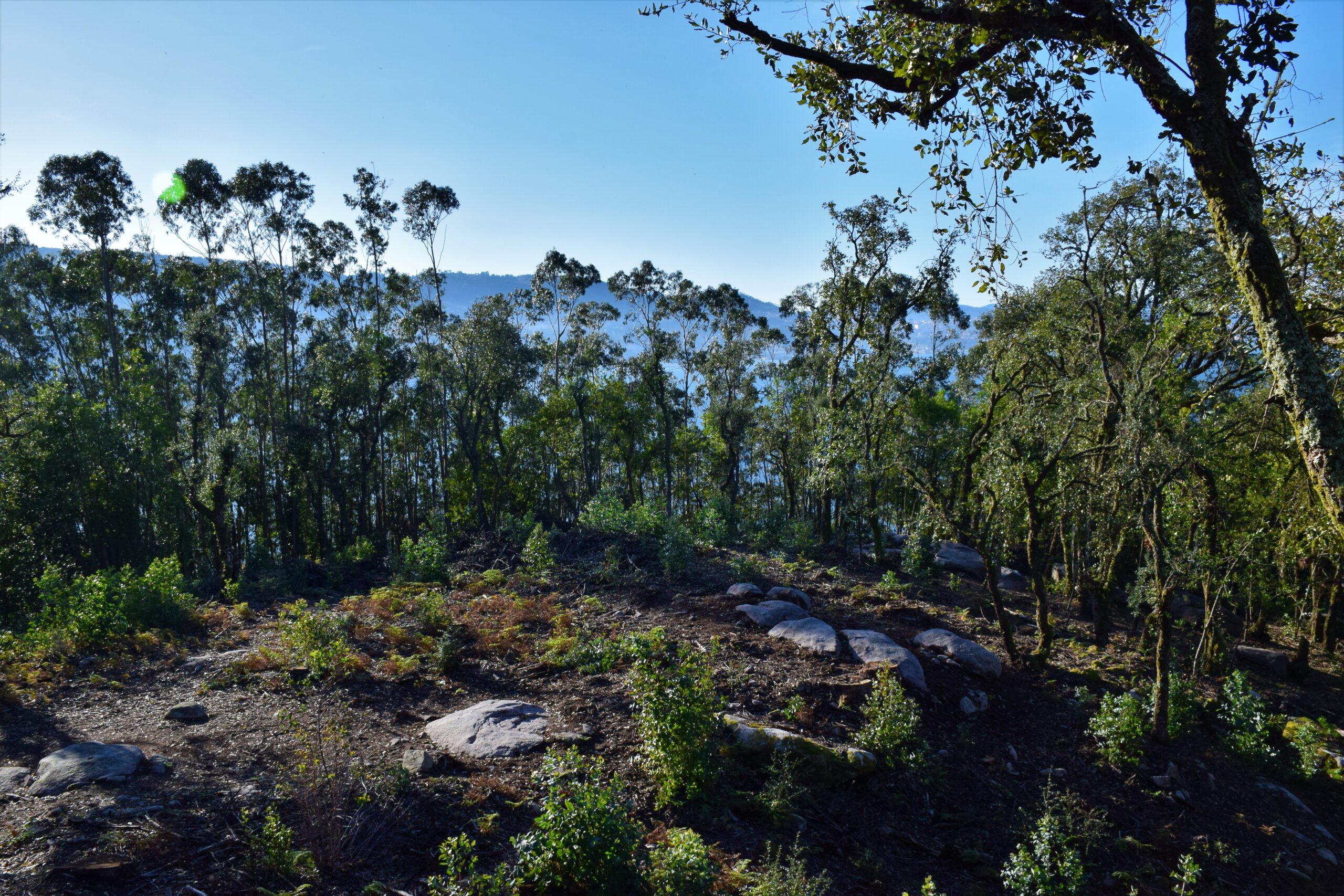
The Montealegre Castro, in Moaña, has provided an interesting set of Mediterranean imports, mainly from the mid-2nd century BC to the early 1st century AD. Located on the southern coast of the Morrazo peninsula, in the Vigo estuary, through which the AP-9 highway currently passes, connecting Portugal and A Coruña. The importance of this castro and the presence of imports may be due to its notable strategic position regarding this geographical feature, since although it is not directly bathed by the sea, it has easy access to the estuary. Its location is characteristic of the Early Iron Age: it occupies an elevated spur with wide visibility over the estuary and the surrounding valleys.
To learn more
The castro has a residential sector on the west slope and a large shell midden (conchero) on the east slope. The west slope shows an area that was intensely occupied for centuries. The best-preserved chronological period corresponds to the 2nd century BC to 1st century BC, that is, the late Second Iron Age. Due to the poor preservation of levels prior to the mid-2nd century BC, there are very few materials that can be securely dated before the end of the Second Punic War, although it is very likely that the glass paste eye bead found in the residential sector—colored ultramarine blue, Prussian blue, yellow, and white—and two amphora rims belong to this period. The best-preserved fragment corresponds to a model produced in the Strait area. This type of vessel, which has also appeared in other castros of the Rías Baixas, marks the horizon of the arrival of Punic navigators to the northwest, which can be dated to the mid-5th century BC. In addition to remains of Tudetan and Italic amphorae, and common pottery made in Baetica, a Punic tradition unguentarium and an askos stand out.
The Phoenicians lived in independent cities and, although they shared a series of unifying elements such as language, customs, religion, and culture, Phoenicia did not exist as a territorial entity and never constituted a unified state. Phoenician cities were often rivals due to commercial competition, and none imposed hegemony over the others. They were located on peninsulas, such as Byblos and Sidon, or on islands, as in the case of Tyre. Each possessed a territory on the mainland that allowed them to obtain agricultural and livestock products necessary for their subsistence. However, their economy was mainly based on industry and trade, especially maritime trade.
Politically, these city-states were hereditary monarchies. They were governed by a king assisted by a council of elders, representing the great families of the powerful mercantile social class. In fact, it was a regime halfway between monarchy and oligarchy, also counting on a large body of officials.
Unlike other neighboring cultures, the Phoenicians never had the ambition to conquer territories and subjugate other peoples to increase the power of their rulers. Therefore, they did not focus on military prowess. They based their defense on the location of their cities in hard-to-access places and the protection of their walls. Regarding their powerful Assyrian and Babylonian neighbors, they preferred to make pacts and become tributaries rather than fight.
To know it better
The Montealegre Castro, one of the largest in Galicia, is located on a hill in the parish of Domaio, in Moaña (Pontevedra). Due to its strategic location, it provides data on the interesting set of Mediterranean imports made in the 2nd century BC and 1st century AD.
At the beginning of the 20th century, it was excavated by Antón Losada Diéguez, among others. However, it was not until the 2000s, after various works to build the Morrazo Corridor, that a thorough archaeological excavation began to rescue the Castro, as it was about to disappear.
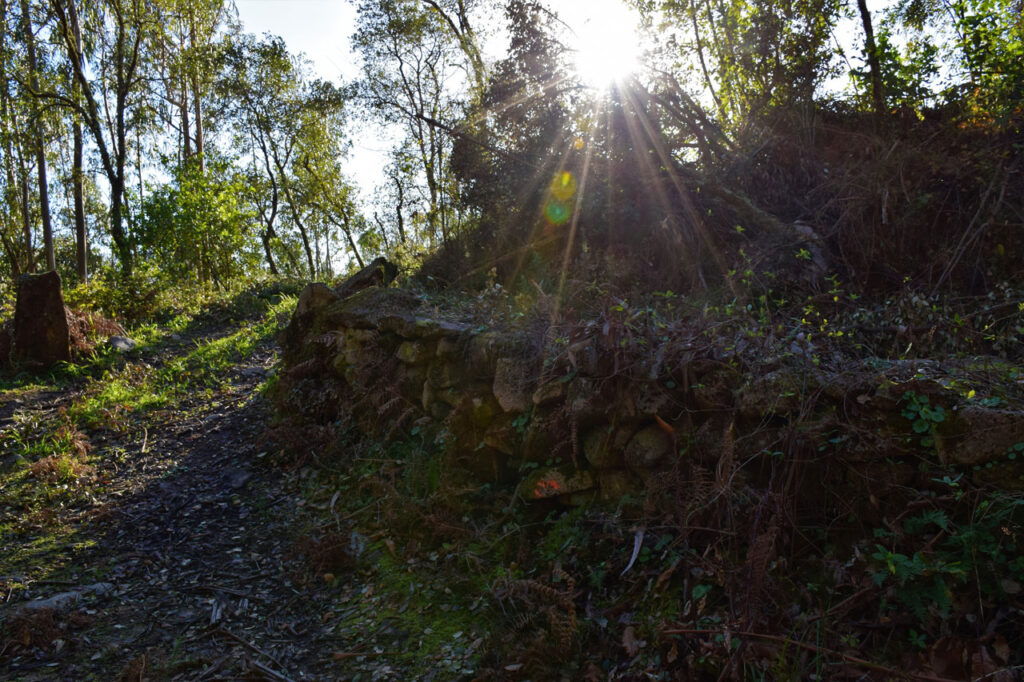
Currently, certain structures of the castro can be identified, such as the walls and some circular stone dwellings. Additionally, in 2016, following an archaeological excavation, an anthropomorphic granite sculpture (human-like), headless and about 60 centimeters tall, was found.
Gallery
Location
- Town
- Domaio
- Municipality
- Moaña
- Province
- Pontevedra
- Country
- Spain
The asset
- Type
- Castro
- Eco-destination
- Ría de Vigo
- Environment
- Rural
- Relevance
- National
How to get there
- Access
- By land
- Distance
- Distancia: 2,5 km / 4 minutos en coche
The visit
- Accessible
- No
- Parking
- No
Coordinates
- Latitud
- 42.29316500
- Longitud
- -8.67040700