
Baiona. Ramallosa´s bridge. Way of Saint James by the coast
About this heritage
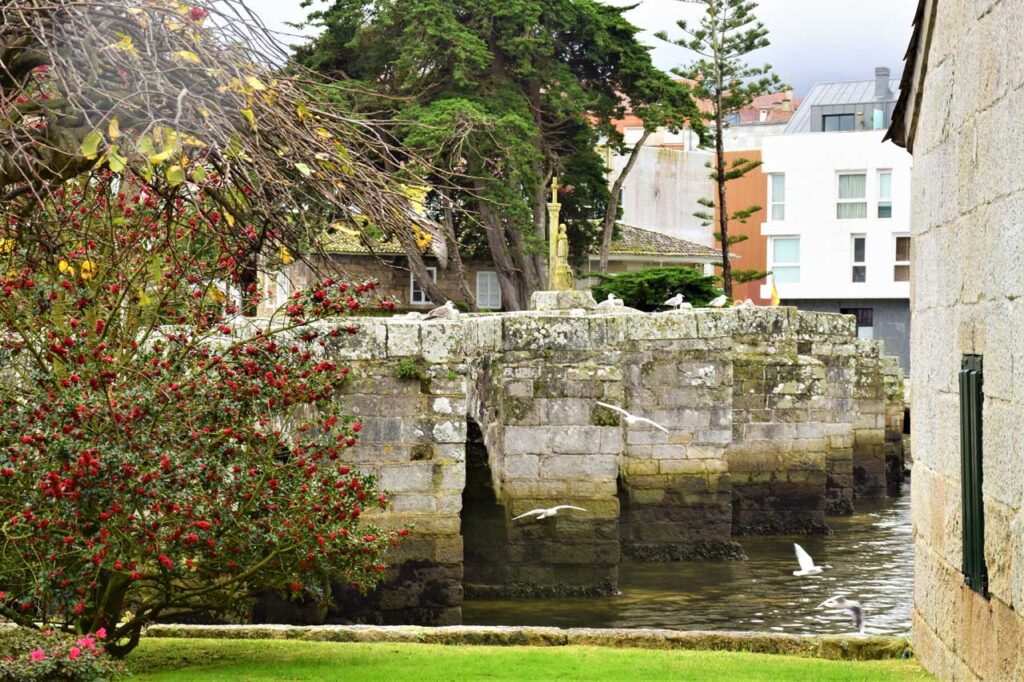
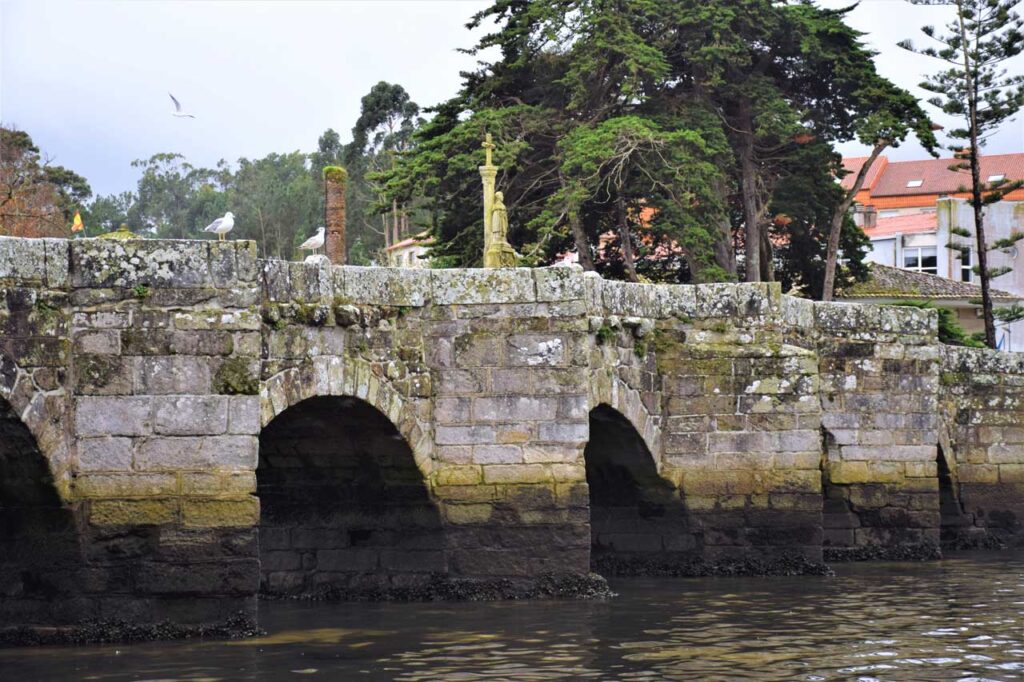
The Romanesque bridge of A Ramallosa, is a sample of the great cultural heritage offered by the City Council of Nigrán to its visitors. The bridge crosses the Miñor river linking both municipalities of Baiona and Nigrán. It represents the typical medieval style construction and it is possibly one of the most beautiful medieval bridges preserved in the Galician community.
It is supported by 10 “eyes” or openings with semi-circular arches, of which 8 belong to Baiona. It is believed that some of the pointed arches are like that due to the times in which must have undergone some repair.
In the middle of the bridge you can see a “Cruceiro” (Traditional stone cross) which has the saint patron of the sailors (Saint Telmo) in its base, recognized by history as the responsible of its construction.
The Portuguese - Saint James way begins in Galicia through the seafaring village of A Guarda after leaving behind the Miño river´s mouth, the route walks parallel to the coastline in a northern direction. From A Guarda to Oia passing by Silleiro and up to Baiona from where after contemplating different monuments like the beautiful fountain of O Pombal and crossing the Groba river, we will arrive at the end of the Baiona – A Ramallosa stage of 4,8 km and we start the next one, A Ramallosa – Nigrán of 4,2 km, both from the A Ramallosa´s bridge. From there: Nigrán, Vigo, Redondela, where the route links to the Portuguese - Saint James way.
To learn more
Returning to the Romanesque bridge of A Ramallosa, under it there is wayside shrine that represents souls in sorrow. Until a few decades ago, pregnant women celebrated fertility rites next to this bridge. According to tradition, pregnant woman who did not have viable children conjured her adverse fait by pouring water from the river on her belly. In order to be effective, the spell had to take place at midnight, and the first person to cross the bridge after the spell had to support the creature.
After crossing the medieval bridge of A Ramallosa, we are going to Panxón where we can take a break and contemplate the “Templo Votivo del Mar” (Catholic temple dedicated to the Saint Patron of the sea), constructed by Antonio Palacios between 1932 and 1937, what is preserved of the Visigoth church of the VII century, and the crowded América beach and its large sandy beach.
Nigrán is located in the south of the Pontevedra province. It is made up of seven parishes among which is “San Pedo de A Ramallosa”. A tourist municipality in which about 18.000 inhabitants had lived permanently, but it triplets its population in holidays season. It has a privileged location and it can be reached in different ways, as it has Vigo and its airport only 12 km away, and Santiago de Compostela within 100km.
To know it better
At the end of Nigrán we find the Romanesque bridge of A Ramallosa, which separates this municipality from that of Baiona. This path crosses the Miño river and is of medieval style. It has ten “eyes” with semi-circular arches, eight of which belong to the municipality of Baiona.
It was built in the 13th century and has been restored at the beginning of the 20th century. In the middle of the bridge , there is a “Cruceiro” (tradicional stone cross) with the image of Saint Telmo, patron of sailors.
Nigrán coast is also a transit area for pilgrims who choose to follow the way of Saint James along the southern coast of Galicia, also known as the Portuguese way.
Nigrán is a municipality located in the Pontevedra province. More specifically, this City Council is located in the Val Miñor region, in Vigo´s area of influence.
Galería
Location
- Locality
- A Ramallosa
- Municipality
- Nigrán
- Province
- Pontevedra
- Country
- Spain
The asset
- Type
- Roman bridge
- Eco-destination
- Ría de Vigo
- Environment
- Rural
- Relevance
- International
How to get there
- Access
- By sea By land
- Distance
- 3,500 km
The visit
- Accessible
- No
- Parking
- No
Coordinates
- Latitud
- 42.11552200
- Longitud
- -8.81258300