
Bueu. Mourisca Beach and Chan de Esqueiros
About this heritage
Within the Udra Cape Special Conservation Area (ZEC - Zona de Especial Conservación) of the Natura 2000 Network, there is a place called Chan de Esqueiros. This area was formerly used for livestock grazing, where the local shepherds took their herd grazing by taking advantage of the pasture and the scrub offered by the cape.
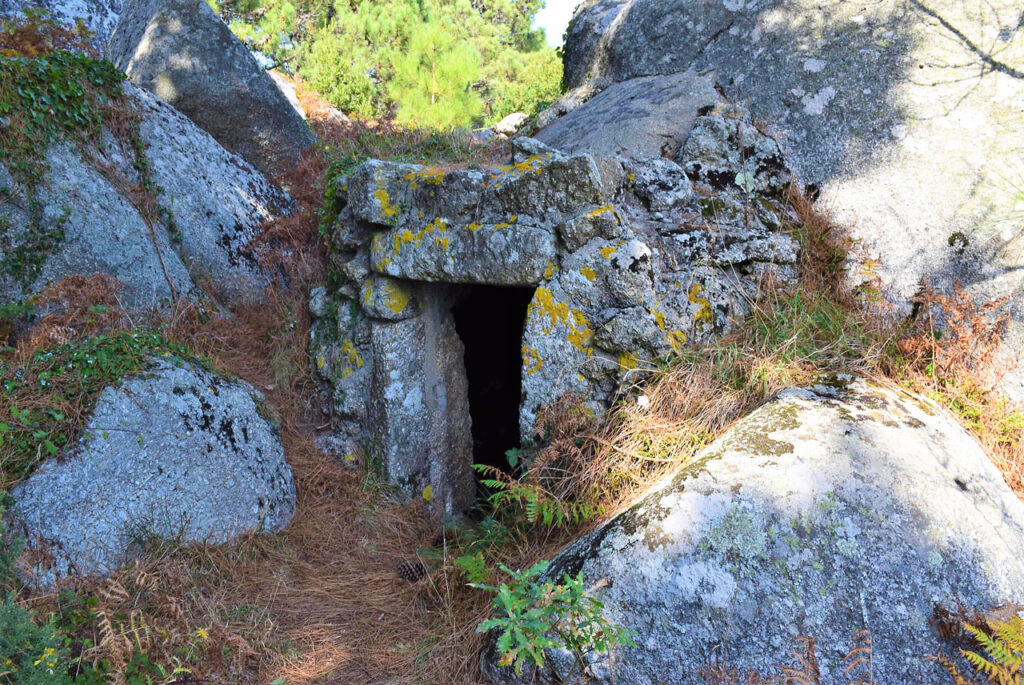
To spend the nights with the cattle, they built some huts (chozos). These constructions are one of the most primitive manifestations in these rural areas. They built them, using the morphology of the large rocks of the place, as a bivouac, to which they added a stone wall and a false vault cover made with big tiles.
Built at the end of the 19th century and used until the middle of the 20th century, these Chan de Esqueiros huts are fully protected as an Inventory Asset of Archaeological Deposit by the Department of Culture of the Bueu Town Hall..
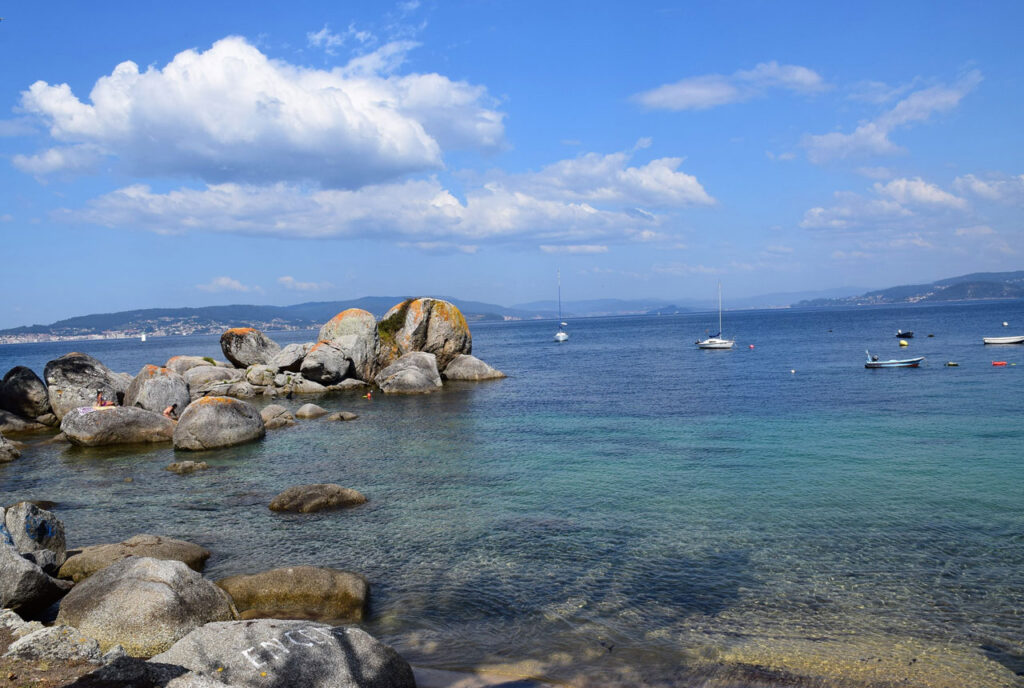
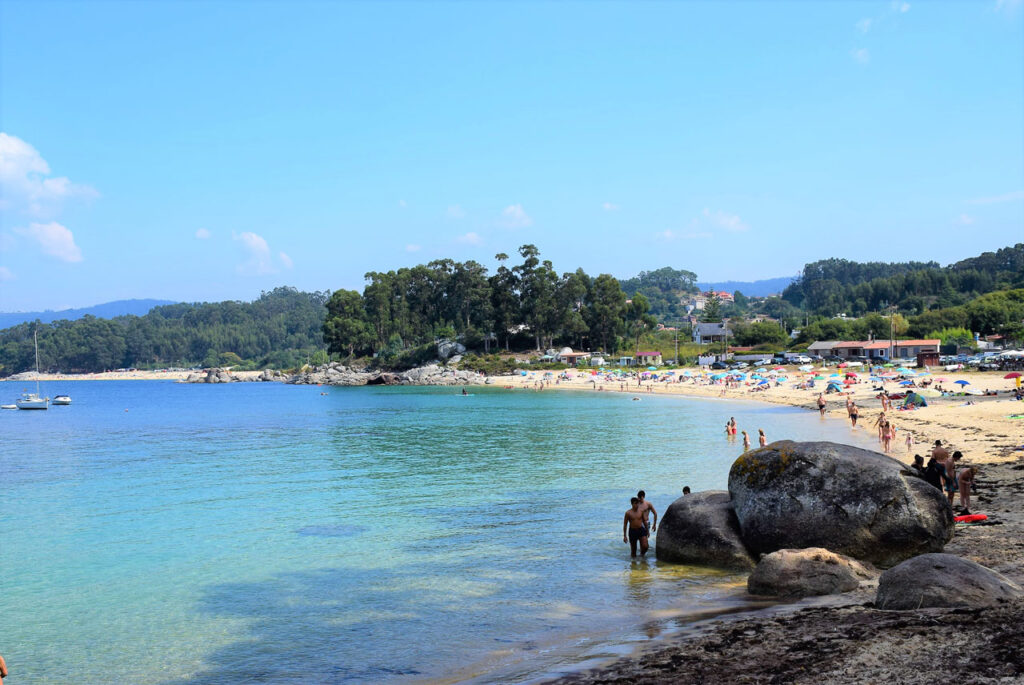
There are some beaches and small coves around the Cape in protected and less exposed areas. Mourisca beach is its larger beach, whereby walking along its sandy area, one can appreciate its seafaring past, which the remains of constructions, now renovated, of the old sailors' houses and some boats on the sand not taken away during the tide.
There is an old salting factory rebuilt by the architects Alicia Freire and Mauricio Sánchez-Bella to the left of the vicinity of this beach. Dated back to the late 19th century or the early 20th century, this factory has in its interior patio, almost intact, the "machos," which are large stones used as a press, and the "pias," pylons where the fish were salted.
Since today is private property, one can observe all the elements of this old factory interior from a portal, including a freshwater well in the courtyard.
To learn more
Bueu is renowned for its salting factories. At the end of the 19th century, the so-called "Catalan promoters" arrived and realized the production potential of this estuary; therefore, they settled down to set up numerous canning-type factories. Along the coast of the county, there were functioning about thirty factories.
However, this fame was longstanding, since Roman times, there were already such enclaves, where they salted fish for preservation, the so-called "Garum." In Bueu, there are remains of these factories, as well as ovens, in which they heated the amphoras used to transport precious merchandise to other parts of the Empire.
In Cabo Udra, there are also the remains of a wall of one of these old salting factories. However, a toponym of one of its beaches is also preserved, “Ancoradouro,” which means anchor and gold; hence, referring to the possibility for ships to moor or unload merchandise.
Another of the beaches around the Cape is Pedrón Cove, which has a tradition as a nudist beach. After following a path that crosses a small oak forest with the typical Galician flora and ends in a coastal pine forest, one can reach the cove. As in other parts of the cape, this is an excellent place for the ornithological observation of sea birds, such as the cormorants (Phalacrocorax sp.), which perch on the rocks with their wings wide open to dry in the wind and sun.
Following the path towards Bueu, one can reach a much smaller cove called Buceiro or Mediabril beach, and finally, get to Mourisca, the cape's larger beach.
To go around this cape and to contemplate its peculiarities, there is a trail called the "blue path." This path, signposted with blue and white marks, starts at Lagos beach, runs around the cape, and joins the coast until it reaches Agrelo beach in Bueu.
To know it better
Bueu town, in the Pontevedra province, stands out as a seaport with stunning beaches and landscapes. The Mourisca beach, in the Beluso parish, is bay shaped, with thick white sand, crystalline water, and surrounded by trees and huge rocks in the form of cliffs. It is also within the protected natural area of Cabo Udra. In short, a paradise.
In the surroundings of the beach, the Chan de Esqueiros huts stand out as late 19th-century typical constructions. They were shelters built between the holes in the rocks for the shepherds to sleep near their cattle. These huts are cataloged as a protected area by the Natura 2000 Network, as a Place of Community Importance (LIC), as a Special Protection Zone of Natural Values (ZEPVN), and as an Inventory Asset of Archaeological Deposit by the Department of Culture of the Bueu Town Hall.
Galería
Location
- Locality
- Beluso (Santa María)
- Municipality
- Bueu
- Province
- Pontevedra
- Country
- Spain
The asset
- Type
- Beach
- Eco-destination
- Ría de Pontevedra
- Environment
- Rural
- Relevance
- National
How to get there
- Access
- By sea By land
- Distance
- Distancia 4 km – 10 minutos en coche
The visit
- Accessible
- No
- Parking
- No
Coordinates
- Latitud
- 42.33749200
- Longitud
- -8.82300200