


Castle of The Moon (Castelo da Lúa)
About this heritage
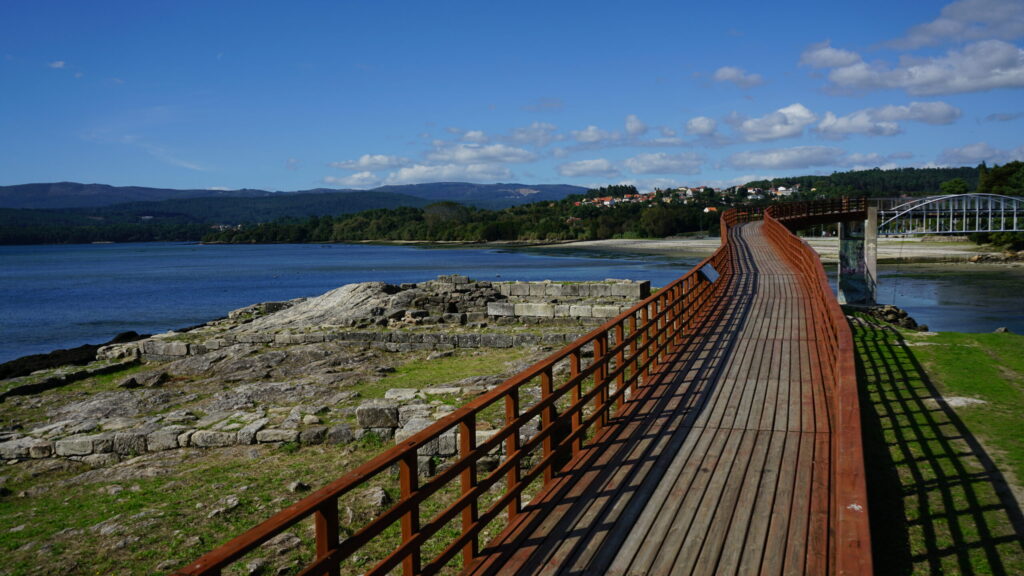
Castelo da Lúa (Castle of the Moon) is in a passing area, in the course of the promenade that links the urban area of Rianxo with Tower beach (La Torre) in the parish of Taragoña.
The mouth of the rivers Grande, Beluso, and Tea form the Rianxo Cove. The Tea River flows into Tower beach (La Torre).
Nowadays, the castle is composed of archaeological remains of a medieval fortress; visitors can see it by taking a walk along the promenade that runs next to it.
This 13th-century castle became part of the heritage of the Order of the Temple and then the archdiocese of Compostela. The Irish demolished it around 1465, and Sueiro Gomes de Soutomaior rebuilt it years later.
The royal governor Fernando de Acuña ordered its demolition in 1480. Since then and until 1532, they used their ruins as a prison. Until that year, its jurisdiction transferred to Archbishop Alonso II de Fonseca, the new lord of the area. Practically destroyed in 1600, they used the fortress' ruins to build the bell tower of the Church of Santa Comba of Rianxo in 1740, as well as different constructions in the region and surroundings.
The inhabitants of Rianxo have transmitted by word of mouth a legend about the castle. In the middle Ages, minstrels also narrated this legend. According to this legend, Knights of the Order of the Temple built this castle and became the owners. In one of their many battles with their feuding neighbors, a young woman was kidnapped, "whose cries can be heard like murmurs on the beach.” The woman was the daughter of a defeated feudal lord. In the same area of the castle, there was a knight hospitalized in severe condition, who had defended the honor of his defeated lord and the girl, with whom he was in love. The resistance and strength of the knight, together with the care of the maiden, gave him back his hope.
The condition of the prisoners had conquered the will of one of the Templars. On a cloudy evening, guided by the accomplice Templar, they went through one of the passages to the beach and fled in a boat. Then, the defenders of the castle were sighted and alerted, and at once, a group of archers tried to kill them. The knight received three arrows while covering the body of the lady. Then, a wave overturned the boat, and the woman threw herself into the water in despair.
The next day, the waves brought the bodies of the lovers to the shore, embraced. They were buried at the foot of one of the interior towers of the castle. Legend has it that, since then, every moonlit night, "a beam of its rays rested and watched over the burial of the lovers with its light," and, at nightfall, the red sun illuminated the coats of arms of the castle.
The ruins of this ancient castle, still today, preserve the magic of a love story truncated by the Templar knights.
To learn more
Castelo da Lúa (the Moon Castle) is on a small peninsula by the mouth of the Tea River, under a pedestrian bridge that leads to the Tower beach. Currently, there are few archaeological remains of what the castle was in its time of splendor. However, visitors can see its basic structure: the almost rectangular shape of the building with an outer wall that surrounded the whole, a pit on its south side excavated in the rocky area, and another inner wall that formed the weapons courtyard. Inside, there was a central tribute tower flanked by two bastions and the remains of other rooms.
It was built in the 13th century by Paio Gómez Chariño, the first lord of Rianxo, a Galician nobleman and poet, in compensation for his work in the conquest of Seville. The culminating period of the castle is related to the disputes between the Soutomaior family, as its lords, and the archiepiscopal power of Compostela. In 1426, the king demanded Paio Gómez de Soutomaior the demolition of the fortress for having built it without the permission of the archbishop of Santiago, an order that he ignored.
The building had a trapezoidal floor plan and an outer wall, reinforced on the south side with a pit and a second inner wall. Inside, there was the tribute tower with two side bastions. As in other coastal defensive places, it is logical that its construction was on top of an older defensive one. The fortress's purpose was to protect the coast from the continuous attacks of pirates and looters that had been devastating our coastline since the VII century.
In the 18th century, among the ruins, they created a popular ceramic workshop. With the fortress in ruins, they built a workshop made of typical ceramic that would function until the second half of the 18th century. The discovery of this ceramic workshop was a great novelty from the archaeological point of view.
The castle of the Moon appears for the first time in 1850, in an article by J.R. Figueiroa. In that article, there is an engraving of the castle's ruins. This engraving shows the Tribute Tower, the walls, and the entrance, which was already in ruins.
Its name (Castle of the Moon) was not the original one, but they started to call it like that in the middle of the 19th century in the mentioned article of J.R. Figueroa. Possibly, because of the connection with the last name of the lady of the castle, Xoana de Luna, wife of Marshal Don Sueiro, or because of her representation in one of the family's coats of arms.
Until the second half of the 19th century, it was still possible to observe a large part of the castle, such as its entrance arches, its walls, and its pits. In the 20th century, they used it as a quarry for various constructions in the area. Between 2001 and 2010, they conducted archaeological interventions of consolidation and cleaning that put the remains of the castle in the open. In 2007, during these works, they found an abundant number of ceramic material dated back from the 11th to 13th centuries, such as cooking pots, bowls, glasses, jars, bottles, flowerpots; they also found a total of eight coins.
Today, travelers can see the foundation of the original location. The visit is free of charge, and visitors can appreciate the remains of one of the amplest military fortresses in Galicia.
There is a romantic legend about the castle. It tells the story of two lovers who fled this castle by boat, and when discovered by the glare of the nightly moon, they found a tragic end.
To know it better
Located in the Barbanza Region, Rianxo is a municipality that borders the mouth of the Ulla River and forms the division between the provinces of Coruña and Pontevedra. Its name is associated with the famous song La Rianxeira and the Virgin of Guadalupe, its patron saint.
Near Tower beach are the remains of the Castelo da Lúa (Castle of the Moon). It is a medieval castle located at the mouth of the Tea River. It dated back to the 13th century. Around 1465, the Irish destroyed this fortification, later restored, and in 1480, demolished again. With the castle in ruins, they built popular pottery, meaning a workshop to make ceramic pieces. Thanks to it, pottery was established as the basis of crafts in Galicia during the 16th and 18th centuries.
Today, from Torre point, everyone can appreciate the ancient remains of the castle since the researchers began the archaeological work in the area during the first decade of the twenty-first century. From the remains found, they have concluded that the plant of the castle was almost rectangular and surrounded by cliffs.
The name Castelo da Lúa (Castle of the Moon) is not the original one, but it is known by that name, according to an article by J.R. Figueroa from 1850. Besides, a romantic legend relates this name to the story about a couple that while trying to escape by boat, the moonlight discovered them.
Location
- Town
- Si
- Municipality
- Rianxo
- Province
- A Coruña
- Country
- Spain
The asset
- Type
- Castle
- Eco-destination
- Ría de Arousa
- Environment
- Natural
- Relevance
- National
How to get there
- Access
- By sea
- Distance
- 3,7 km
The visit
- Visitable
- Yes
- Accessible
- No
- Parking
- No
- Signposted
- Yes
Coordinates
- Latitud
- 42.66292200
- Longitud
- -8.81493800