


Castro de Montealegre
About this heritage
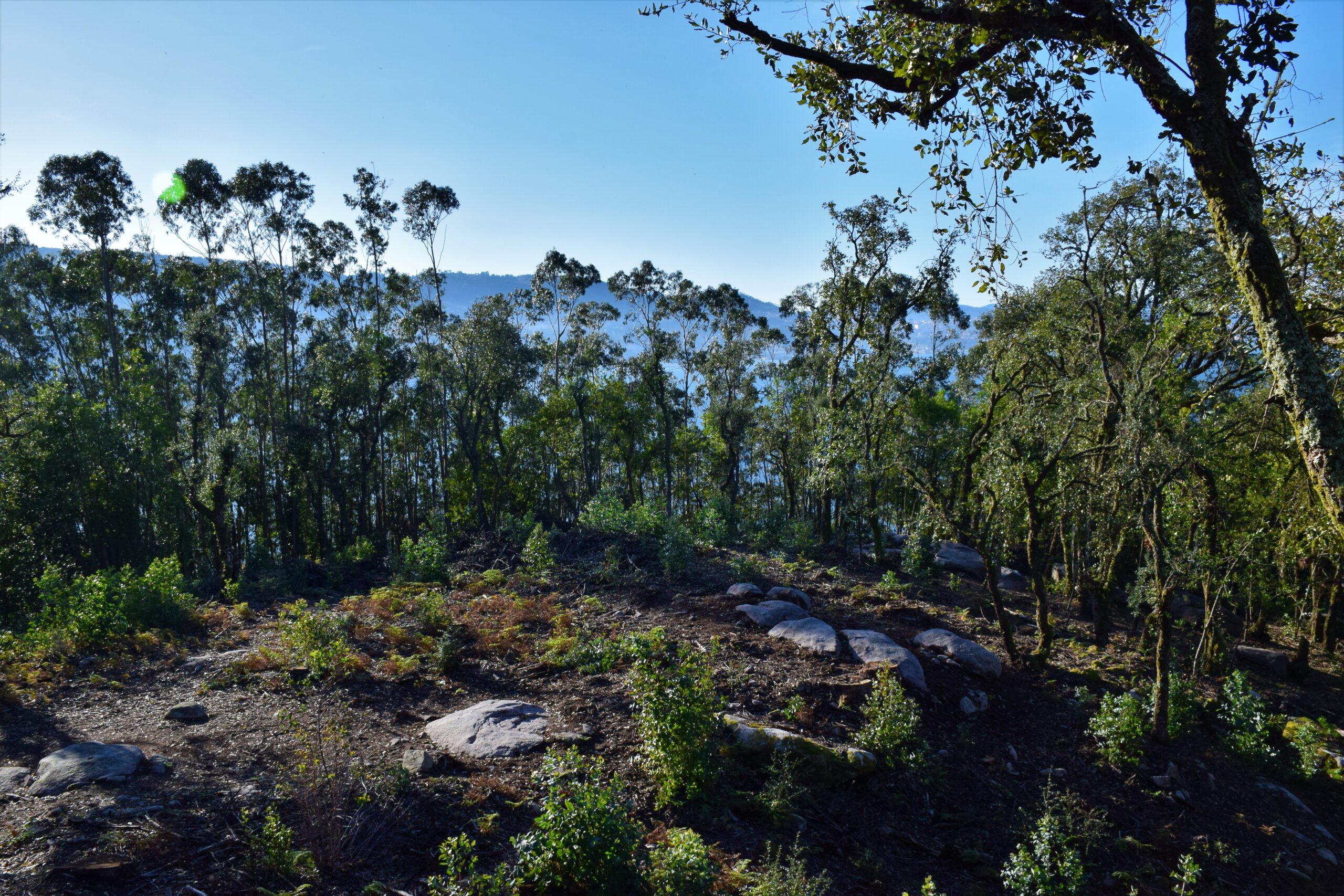
The Montealegre fortification, in Moaña, caters for an interesting set of Mediterranean importations, ranging mainly from the middle of the 2nd century B.C. to the beginning of the 1st century A.D. This fortification is located on the southern coast of the Morrazo peninsula, on the Vigo sea inlet, where the current AP-9 freeway connects Portugal with A Coruña. The importance of this fortification and the presence of importations may be due to its notable strategic position with respect to this landform as, although it is not directly brushed by sea waters, the inlet is easily accessible. Its location is characteristic of the Early Iron Age: it occupies an elevated embankment with ample visibility over the inlet and the surrounding valleys.
To learn more
The castro has a residential sector on the western slope and a large shell midden on the eastern slope. The western slope presents an area which was densely occupied for centuries. The chronological period best preserved is that which ranged from the 2nd century B.C., to the 1st century A.D. i.e. the period at the end of the Second Iron Age.
Given the poor conservation of the periods prior to the mid-2nd century BC, not many materials can be said to exist prior to the end of the Second Punic War, although it is very likely that this includes the glass eye bead located in the residential sector - ultramarine blue, Prussian blue, yellow and white coloured - and two amphora bases. The best- preserved fragment corresponds to a design manufactured in the area of the Strait. This type of container, which has also appeared in other fortifications of the Rías Baixas, marks the point in time of when the Punic navigators reached the northwest, which can be dated back to the middle of the 5th century B.C.
In addition to the Tudetan and Italic amphorae remains, and general pottery manufactured in Baetica, an unguentarium and an askos of Punic tradition, are the highlight.
The Phoenicians lived in independent cities and, although they had a number of agglutinating elements in common, such as language, habits, religion and culture, Fenicia did not exist as a territorial entity and never constituted a unified state. Phoenician cities were often confronted by commercial rivalries, and none of them imposed their hegemony over the others. They were located on peninsulas, such as Byblos and Sidon, or on islands, as in the case of Tyre. Each of them had a territory on dry land that allowed them to obtain the products of agriculture and livestock necessary for their subsistence. Its economy, however, was based above all on industry and commerce, especially maritime commerce.
Politically, these city-states were hereditary monarchies. They were governed by a king assisted by a council of elders, in which the large families of the powerful merchant social class were represented. In fact, it was a regime halfway between the monarchy and the oligarchy, which also had a large body of officials.
Unlike other neighboring cultures, the Phoenicians never had the ambition to conquer territories and subdue other villages in order to increase the power of their rulers. That's why they didn't worry about standing out in the military field. They based their defense on the location of their cities in places of difficult access and on the protection of their ramparts. And with respect to their powerful Assyrian and Babylonian neighbors, they preferred to fight, pact and become their contributors.
To know it better
The Montealegre castrum (ancient fortification), one of the largest in Galicia, is located on the mountain of the parish of Domaio, in Moaña (Pontevedra). Given its strategic location, it provides data on the interesting group of Mediterranean importations which took place in the 2nd century B.C., and 1st century A.D.
At the start of the 20th century, it was one of the sites, aside from others, excavated by Antón Losado Duíeguez. However, it was not until the first decade of the year 2000, after different works were carried out by the Corredor do Morrazo, when a serious archaeological excavation took place to recover the Castrum, as it was at the point of disappearing.
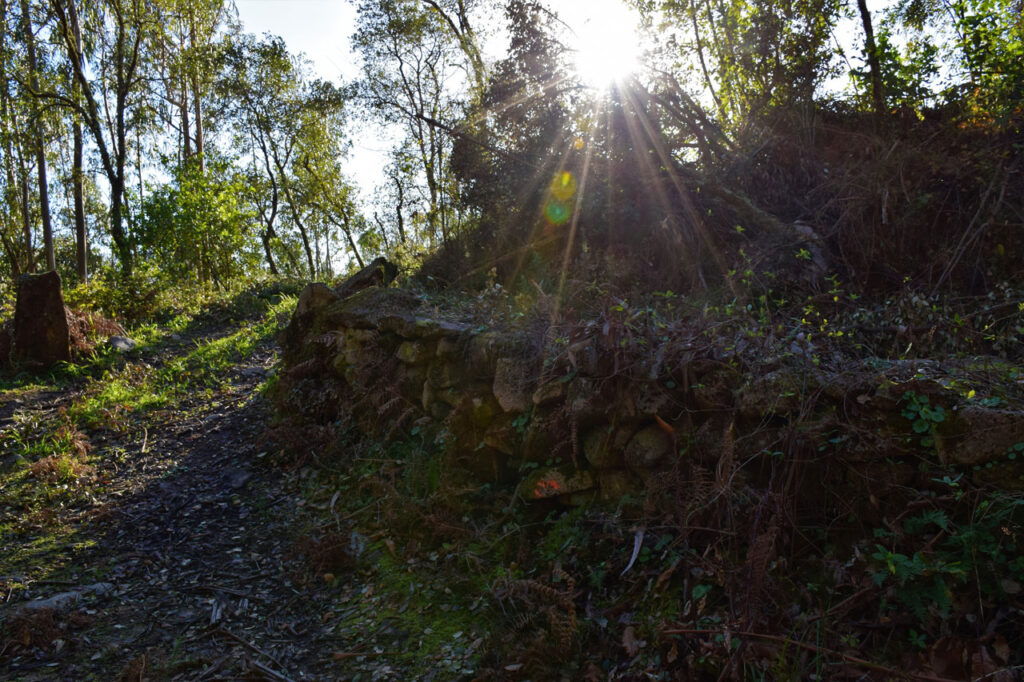
At present, certain structures of the castrum can be discerned, such as ramparts and one or other stone circular dwelling. Moreover, in 2016, pursuant to an archaeological excavation, a granite anthropomorphic sculpture (resembling a human), with no head and about 60 centimetres high, was discovered.
Gallery
Location
- Town
- Domaio
- Municipality
- Moaña
- Province
- Pontevedra
- Country
- Spain
The asset
- Type
- Castro
- Eco-destination
- Ría de Vigo
- Environment
- Rural
- Relevance
- National
How to get there
- Access
- By land
- Distance
- Distancia: 2,5 km / 4 minutos en coche
The visit
- Accessible
- No
- Parking
- No
Coordinates
- Latitud
- 42.29316500
- Longitud
- -8.67040700