
Cíes Islands. Rodas beach
About this heritage
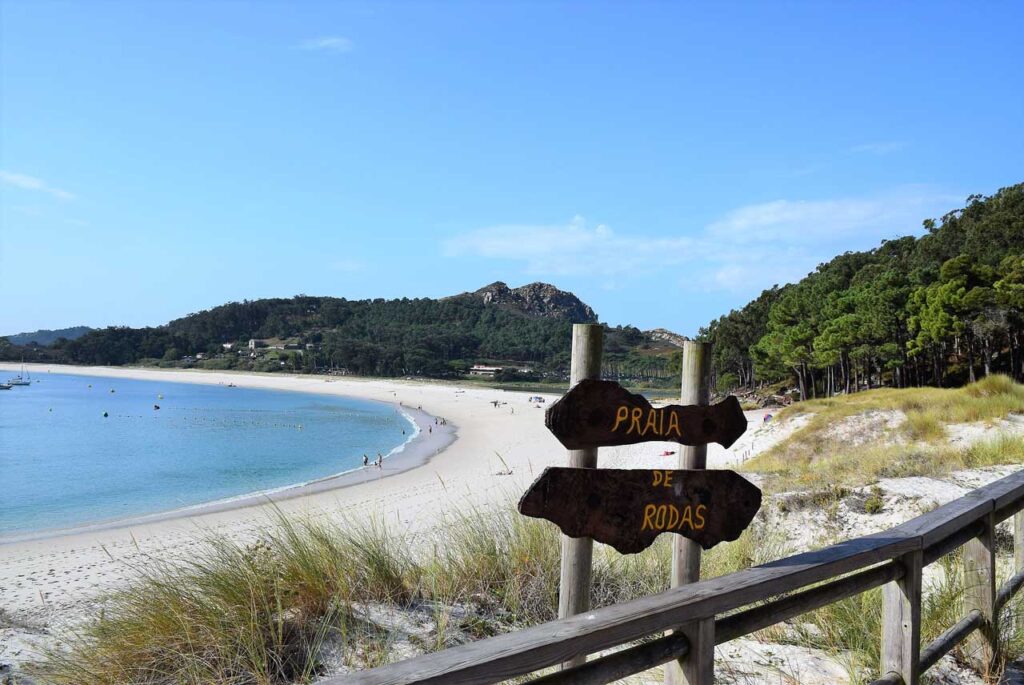
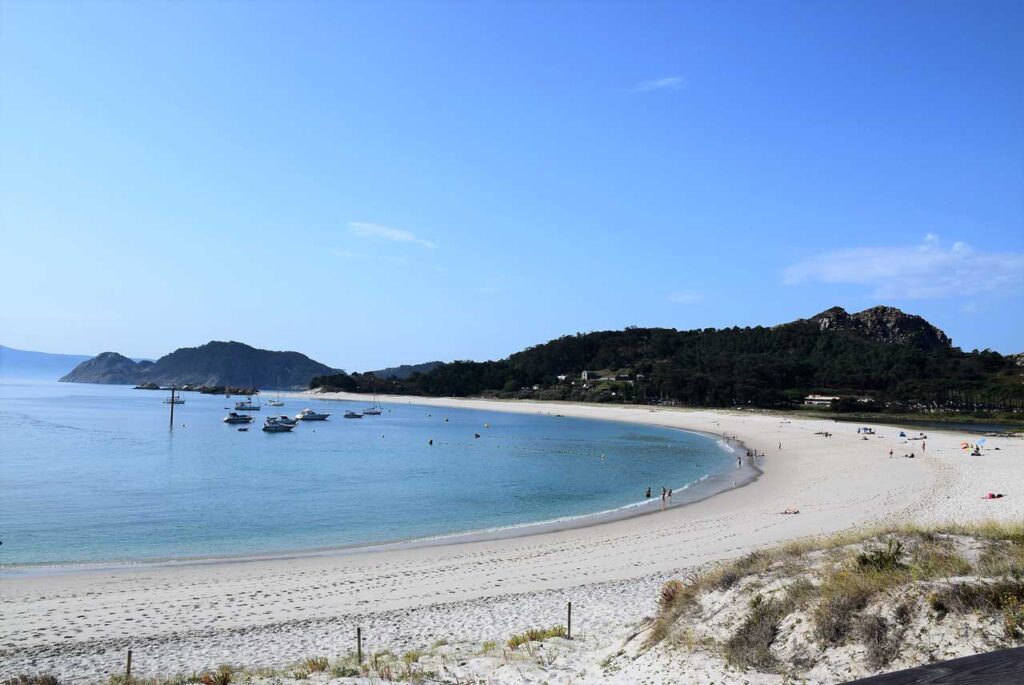
Rodas beach is located in the Cíes archipelago and connects in a natural way the northern island, also known as Monteagudo island, with the middle one, the Faro island. It was named by the British newspaper The Guardian as the best beach in the world, highlighting its characteristic thin white sand and crystal clear water. It is approximately one and a half kilometres long and 60 meters wide. It was catalogue with a blue flag in 2016. It is surrounded by the “Muxieiro” dune complex in the closest area to the pier and by dune ridges until “Punta das Vellas”.
This beach was formed due to the protective action of the islands on its east face against the waves and the strong sea currents, this created a sedimentation zone that over the years became the beach of Rodas and the dune complex that surrounds it. Due to the dock located at the top of Muxieiro the marine currents are modified in such a way that the sand deposit is much smaller in the northern part of Rodas and much larger in the southern part in Punta das Vellas.
One of the most impressive features of Rodas beach is the colour of its waters. They tend to be blue-green tones from the lightest to the darkest depending on the background, the wind and the colour of the sky at all times.
To learn more
The beach of Rodas, named by the British newspaper The Guardian as the best beach in the world, is located in the Cíes archipelago and links the northern island or Monteagudo with the middle island or the Faro. The most outstanding features of this beach are its fine white sand and crystal clear water in green-blue tones.
The colour of its waters is due to the fact that when the sunlight reaches the sea one part is reflected by the surface and the other enters the water column being absorbed gradually. The orange-red light is absorbed more quickly, while the blue one is the least absorbed and the one that penetrates to greater depth in clear waters reason why it will make them look blue.
Its fine white sand is found all over the beach, flanking it and forming dune ridges and the Muxieiro dune complex. In these sandy areas there are different types of vegetation that have to face the difficulties such as the high salinity of the environment, strong winds, wave splashes, very porous ground with a small capacity to retain water and nutrients and mobility of the sandy substrate among others. In the beach area stands out the sea rocket (Cakile maritima) accompanied by the sea sandwort (Honkenya peploides), and sea Knotgrass (Polygonum Maritimum). In the dune area the most characteristic are the marine grass (Elytrigia Juncea subsp. Boreali Atlanticus) and the European marram grass (Ammophila arenaria)
To know it better
Monteagudo island and Faro island share the Rodas beach, shaped like a half moon. This beach was declared the best beach in the world by the British Newspaper The Guardian. In addition, in 2015 Rodas was chosen among the 25 best beaches in Europe in the travel portal “Minube” among other 3.000 candidates.
This sandy beach has fine white sand and crystalline water, although to bath you have to be brave as the temperature is usually very low. To access the beach, it is necessary to arrive by private boat with the permission to anchor or in the boat of a shipping company. The journey from Vigo usually takes about half an hour.
The Cíes islands are located in Pontevedra´s province. They have nine beaches of fine white sand and crystal clear water.
Gallery
Location
- Town
- Vigo
- Municipality
- Vigo
- Province
- Pontevedra
- Country
- Spain
The asset
- Type
- Island
- Eco-destination
- Ría de Vigo
- Environment
- Natural
- Relevance
- International
How to get there
- Access
- By sea By land
- Distance
- 0 km
The visit
- Visitable
- Yes
- Accessible
- No
- Parking
- No
Coordinates
- Latitud
- 42.23068400
- Longitud
- -8.90404000