


Hot Springs Villa of Cortegada
About this heritage
Santa María de Cortegada is one of the most significant thermal villages in Galicia for the quality value of its hot springs. It has an area of 2.5 square kilometers with a population of barely half a thousand inhabitants.
The hot spring resort is on the left bank of the Miño River, next to the riverbed, where a little further upstream is the so-called Baños do Monte (Baths of the Mount), known since 1947. The resort is of recent reconstruction and equipped with advanced therapeutic facilities. Its waters are sulfurous-bicarbonate-fluoride, sodium, and lithiated with an average temperature of 26 degrees and recommended for treatments related to liver disorders, skin conditions, and digestive system issues.
The Baños do Monte preserve with no actual use the old bathhouse since it has a recently built new one. In this place, there is a ferruginous spring with water suitable to treat anemia cases and two more springs of oligometallic water used as a diuretic drink.
The quality of the hot springs that emerge in Cortegada gave the recognition of "public utility center" in the early nineteenth century. In that period, the so-called bathhouses were a place of rest and gathering for the high society of the time.
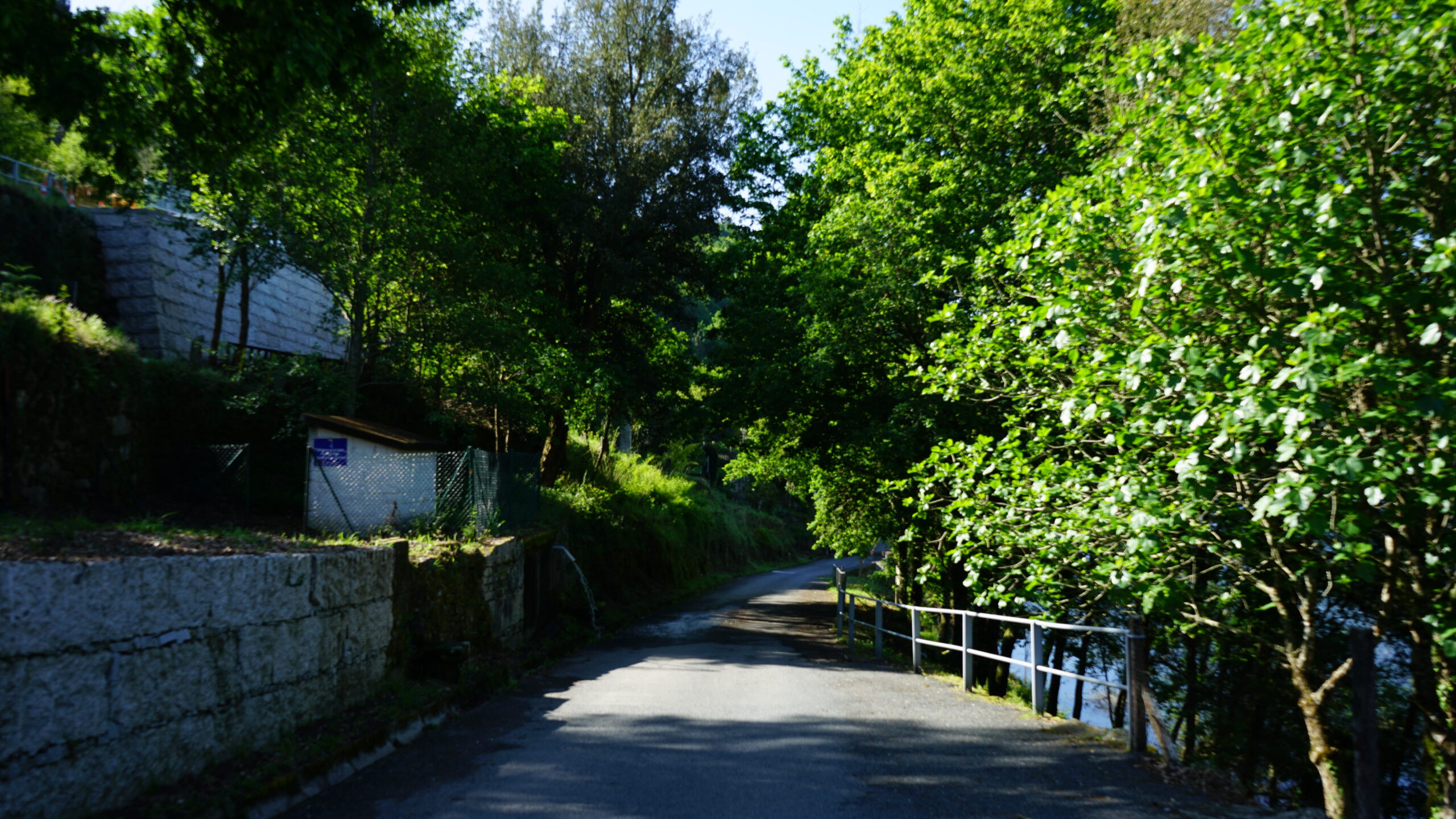
This thermal village boasts other natural treasures, such as its landscapes between rivers and mountains. Touring this enclave, we can enjoy its architectural heritage, including churches, chapels, lordly houses (Pazos), and fountains scattered throughout their parishes. It is worth noticing the San Benito Church of Cortegada, a Baroque style that hosts two pilgrimages in March and June since they attribute its saint the power to heal warts. Another sight that stands out is its atypical Calvary Statue (Cruceiro), and, near the old hot springs resort, we can enjoy, as well, the spectacular landscape offered by the viewpoint of O Coto da Pena over the Miño River.
To learn more
Cortegada is in the central valley of the Miño River in the south of the Ourense province, circa 20 kilometers from the frontier with Portugal. It borders A Arnoia to the north, Gomesende to the east, Pontedeva to the south, and Crecente to the west. Cortegada is also called Cortegada de Baños for its hot springs.
The hot springs of the Cortegada town became one of the first to have a bathhouse officially recognized as a "public utility center" in the early 19th century. Although the existing springs were well known, they did not use them until 1818. They were a place of rest and gathering for the wealthy people of the time.
The old building of the first hot spring resort underwent reconstruction not long ago by refurbishing its facilities with modern therapeutic installations. They captured the spring waters with a 6-meter deep borehole since the river flooded its old one after the construction of the Frieira reservoir in the 1960s.
The second resort is Baños do Monte, with waters already renowned since 1497, the year in which the monastery of Celanova aphorized a mountain and the baths of Cortegada.
The Baños do Monte preserve with no actual use the old bathhouse since it has a recently built new one, which is currently operational. In this place, there is a ferruginous spring with water suitable to treat anemia cases and two more springs of oligometallic water that have a good application as a drink for its diuretic properties. The waters of the baths have a similar composition and temperature to the resort waters since both arise from the same hot spring breach.
Located in a stunning valley, Cortegada has a small and charming historic center, where visitors can find the Town Hall, the Buenos Aires Square, and the Álvarez Brothers Street, with the oldest houses of the village and typical Galician façades. Cortegada is also famous for its gastronomy, with dishes predominantly from hunting and fishing.
To know it better
In the Frieira Reservoir area, located in the Ourense province, visitors can enjoy an idyllic landscape and learn about the history of its hot springs. This reservoir, built in the '70s, is responsible for retaining the waters of the Miño River as it passes through the municipality.
The Cortegada municipality, also known as Cortegada de Baños, is in Ourense near the Miño River and is well known for its hot springs. Located within the Ribeiro region, this area is navigable by small boats.
The history of this thermal village dates back to the 19th century. Many travelers from different parts of Spain and Portugal and farmers came to these hot springs for their therapeutic benefits of skin diseases, among others. Additionally, in 1816, Cortegada became one of the first towns to have a bathhouse officially recognized by the government of Ferdinand VII, regulating the operation of different thermal resorts and acquiring the name of "public utility center." Likewise, although the existing springs were well known, they did not use them until 1818.
Remodeled and equipped with modern facilities and services, currently, this resort provides the benefits of one of these springs. Its thermal club has three thermoludic pools: a dynamic pool to relax and recover body-mind through jets and waterfalls, underwater jets for leg joints, and a bubble bed pool. All this makes the area highly visited to enjoy these sulfurous, bicarbonate fluoridated, sodium, and lithiated waters with an average temperature of 26 degrees.
Gallery


Location
- Town
- Cortegada
- Municipality
- Cortegada
- Province
- Ourense
- Country
- Spain
The asset
- Type
- Thermal spa town
- Eco-destination
- Río Miño
- Environment
- Rural
- Relevance
- Local
How to get there
- Access
- By sea
- Distance
- 0,950 km
The visit
- Accessible
- Sí
- Parking
- Sí
- Signposted
- Yes
- Website
- balneariodecortegada.com/
Coordinates
- Latitud
- 42.20823905399786
- Longitud
- -8.169117734134993