


Natural Pools of the Pedras River
About this heritage
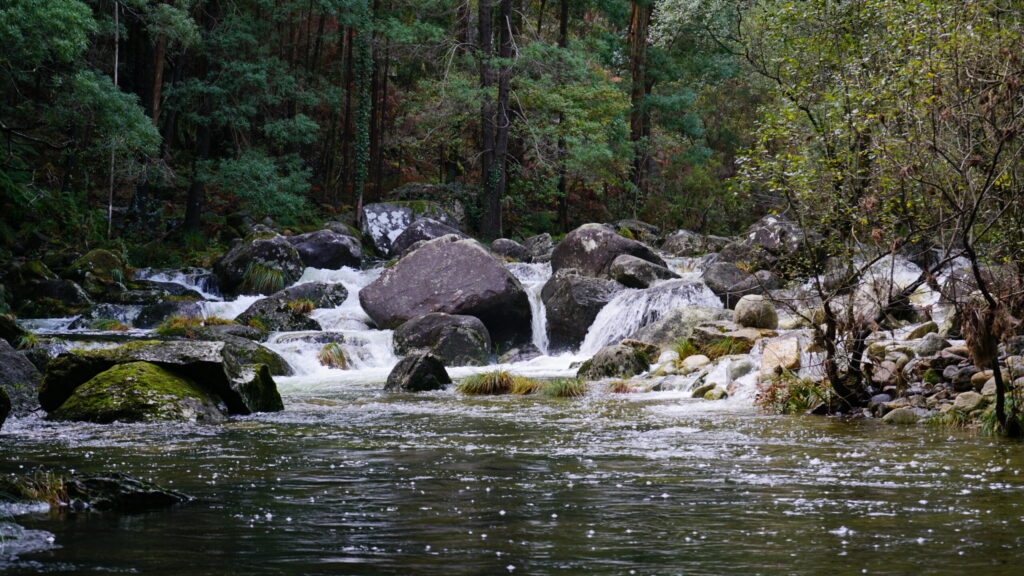
The Barbanza and San Xoán rivers run down the side of the Curota Mountain and converge to form the Pedras River, which flows into Pobra do Caramiñal. As it passes through the hillside, this river course has created, over time, small natural pools known as ponds (pozas). To access them, visitors need to walk about 2 kilometers on a path. Along the route, travelers can encounter some significant sites, such as the abandoned houses and mills of Aldea Vella, the factory of the Luz (light), and the remains of the Franciscan convent of Misarela.
It is a place full of tranquility and nature, of which visitors can hear legends such as that of San Amaro. According to this legend, he came to this location in a stone boat - today, a rock at the edge of the pools identifies it. Supernatural beings from the Galician mythology, the "Mouros," were chasing him, and providence arranged that as the saint went up the river, he placed pebbles to block the way of his persecutors; thus, giving rise to these natural pools.
There are many more Galician legends about stone boats than this, including the Our Lady of the Boat of Muxía, Saint Andrew of Teixido, and the Saint James Apostle in Padrón legends.
Another significant enclave worth visiting in the surroundings of this environment is the Viewpoint of Curotiña, located at 512 meters high. From there, travelers can admire a stunning panoramic view of the Arousa Estuary with its mussel rafts perfectly aligned and Sálvora Island protecting this estuary. On clear days, it is possible to see the Ons and Cíes Islands and Mount Santa Trega, almost on the border with Portugal.
To learn more
The natural pools of the Pedras River are in the Barbanza Mountain Ridge at the foot of the Curota Mountain. To access this place, travelers have to go to Aldea Vella, where there is an esplanade with an informative panel.
From there, a small route begins on paths that go across a variety of mills and abandoned houses.
A little further, there is the old Factory of the Luz (Light), a small hydroelectric power station/plant. In Galicia, the characteristic of the first power plants is the singularity and rareness of their installations, which allowed some to be part of the Catalogue of the Cultural Heritage of Galicia, holding the denomination of "factory of the light." This document also includes those existing in the city of Lugo, in the parish of Santa Cruz de Lesón, in Pobra do Caramiñal, and the Santiago de Compostela Powerhouse.
The route continues to a medieval stone bridge where the Barbanza and San Xoán rivers meet to form the Pedras River, which later flowed into Pobra do Caramiñal. In the Pedras River, there are many natural pools formed along the way, making the walk more attractive. Close to it, travelers can see the remains of the 14th-century Franciscan convent of San Xoán de A Misarela, of which only the foundations and some water channels remain.
The ascent of the route continues along the San Xoán River, becoming more challenging until it reaches Castelo, the almost flat meadows at the top of the Barbanza. The path continues along the river banks until finding the "curro" - circular enclosure covered in stone and with dirt ground to keep the wild horses - where the traditional Horses Festival called "Rapa das Bestas" was held some time ago.
To know it better
The municipality of Pobra do Caramiñal is in the province of Coruña in the Barbanza Region. A curious fact about its name is that the word "Caramiñal" comes from a plant, the Caramiña, which used to be easy to find on the Galicia coast long ago; nowadays, this species has few units left in this land.
This municipality is the birthplace of the Pedras River, which is in the Curota Mountain. Its course flows into the Arousa Estuary, forming a series of natural pools of great beauty for the enjoyment of visitors.
While visiting these natural pools in Pobra do Caramiñal, anyone can also take advantage of hiking on one of the two trails through these beautiful landscapes. In this enclave and its surroundings, travelers can admire, among other things, a medieval bridge and part of a Roman road that crossed the Barbanza re-gion from Boiro to Porto do Son.
On top of its natural charm, the Pedras River holds some mysticism. Legend has it that the saint Amaro came to this location in a stone boat chased by "Mouros," Supernatural beings from the Galician mytholo-gy, from whom he was trying to escape. Supposedly, the rocks found in the river are the pebbles he placed along the river course to hinder the passage of his persecutors and prevent them from catching him; these rocks gave rise to these natural pools.
Location
- Town
- Si
- Municipality
- A Pobra do Caramiñal
- Province
- A Coruña
- Country
- Spain
The asset
- Type
- River
- Eco-destination
- Ría de Arousa
- Environment
- Natural
- Relevance
- Local
How to get there
- Access
- By sea
- Distance
- 4,3 km
The visit
- Visitable
- Yes
- Accessible
- No
- Parking
- No
- Website
- apobra.com/rutas/sende2.html
Coordinates
- Latitud
- 42.63131200
- Longitud
- -8.94956500