


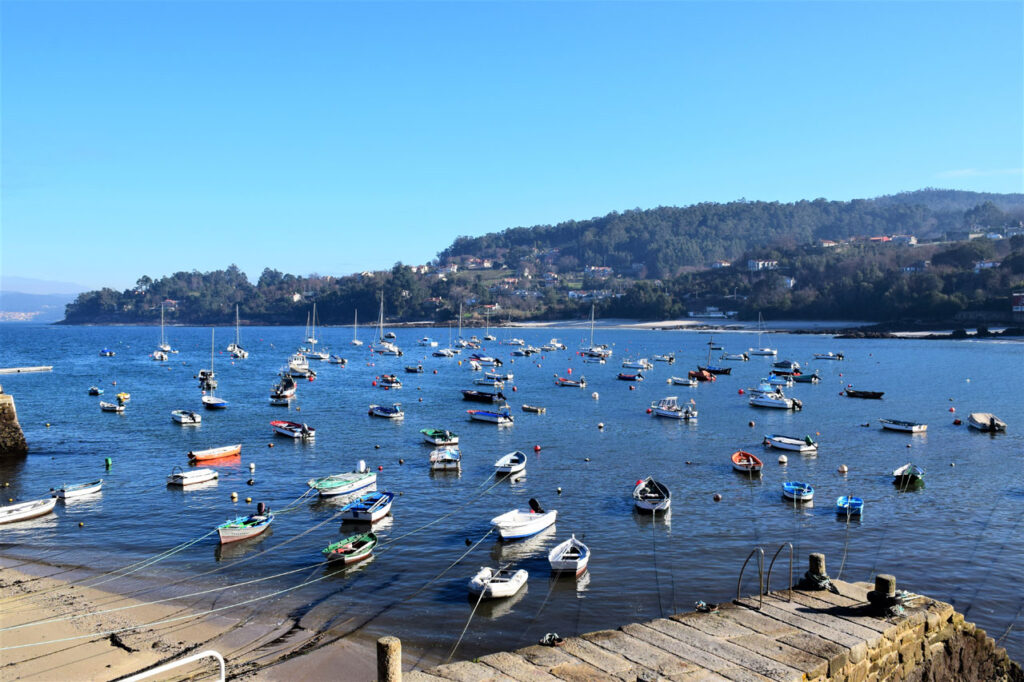
Port of Aguete (Marín)
About this heritage
Marin is the land of ancient fortifications. The fortifications found in A Subidá, in the town of Mogor; Castelo Barbudo, and O Castelo, in the town of Ardán, are some of these, to which the supposed castro settlements of Pedreiras, Penizas, Sobareiro and Castro, could be added. Amongst these, the A Subidá stands out as one of the best preserved of the castro settlements in Marin, despite having suffered multiple aggressions over time.
To learn more
The A Subidá castro is a fairly Romanised castro settlement, of estimated existence between the 1st and 4th centuries A.C. Its economy was strongly centered on a solid agricultural and livestock basis, enhanced by hunting, fishing and shellfishing.
The estimated surface area was estimated to be about 3 or 4 hectares. It has a small oval-shaped acropolis, with two rocky ledges located at the northern and southern ends of this domain. Bibliography at times refers to these rocky ledges as forming part of the fortification, serving a similar purpose as that of the medieval "towers".
At the end of the 19th century it still preserved parts of its double-walled enclosure, and at the beginning of the 20th century, some of the circular dwellings were still standing. The wealth of materials was such that there was practically no need to excavate to find the remains. Several bronze-age petroglyphs also appeared on the site. Another factor that ranks this fortification important, is the fact that several middens were also discovered there (piles composed mainly of shells and other matter).
The castro dwellings extend mainly along the eastern slope, under which lay the remains of a midden, although the area has suffered from quarrying stone extraction and other minor works, such as the installation of an underground water tank. This slope was surveyed in the early 1980’s and again in 2011, and several dwelling structures were restored. Some of the bronze items found in the fortification, can be seen at the Provincial Museum of
To know it better
The Port of Aguete is located in Marin, on the extreme west side of the Aguete beach, bordering with Cape Aguete or Chilreu, on the Pontevedra Estuary.
This port was initially used by the Phoenicians as a transit and stopover point during their trading along the Galician route.
In addition, in Marín, we should mention the ruins that ratify the existence of different castro settlements. The Castro de Subidá (which comes from the Latin civitatem and which means city) or Castro da Porteliña, is situated on the hillside of Monte da Portela. This castro settlement was occupied from the 9th century B.C. until the 2nd century A.D. Today, circular dwellings built between the 1st century B.C. and the 1st century A.D. have been discovered. In addition, we can also find some petroglyphs from the Bronze Age; that is to say, drawings and engravings on the stones of circular, quadrangular and elliptical combinations.
Gallery
Location
- Town
- Marín
- Municipality
- Marín
- Province
- Pontevedra
- Country
- Spain
The asset
- Type
- Port
- Eco-destination
- Ría de Pontevedra
- Environment
- Rural
- Relevance
- International
How to get there
- Access
- By sea By land
- Distance
- 0 km
The visit
- Visitable
- Yes
- Accessible
- No
- Parking
- No
Coordinates
- Latitud
- 42.37525500
- Longitud
- -8.73641700