


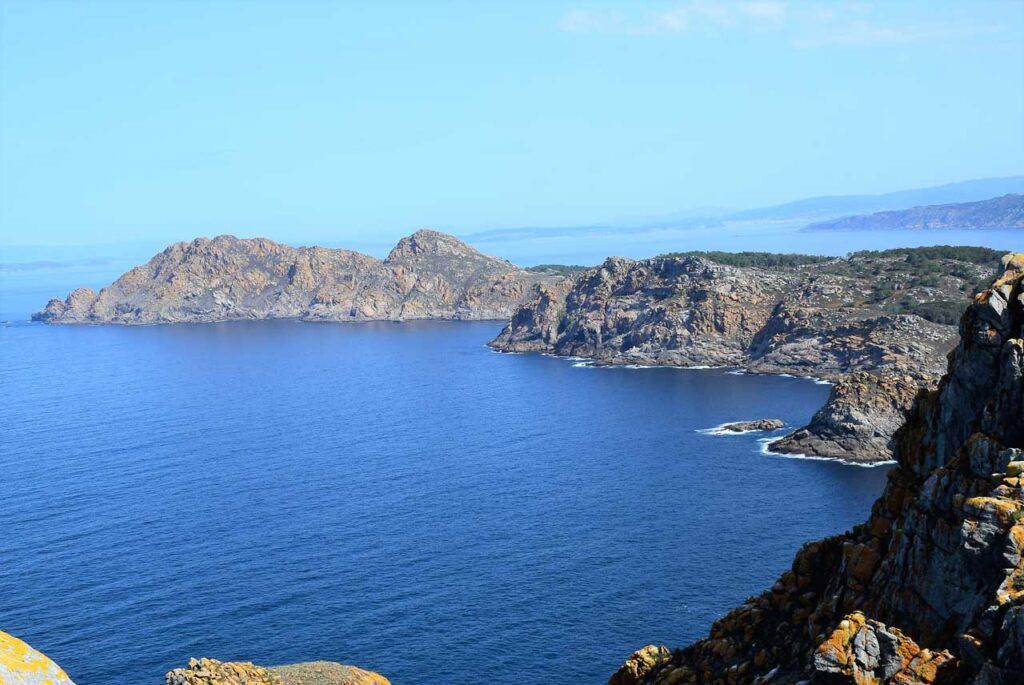
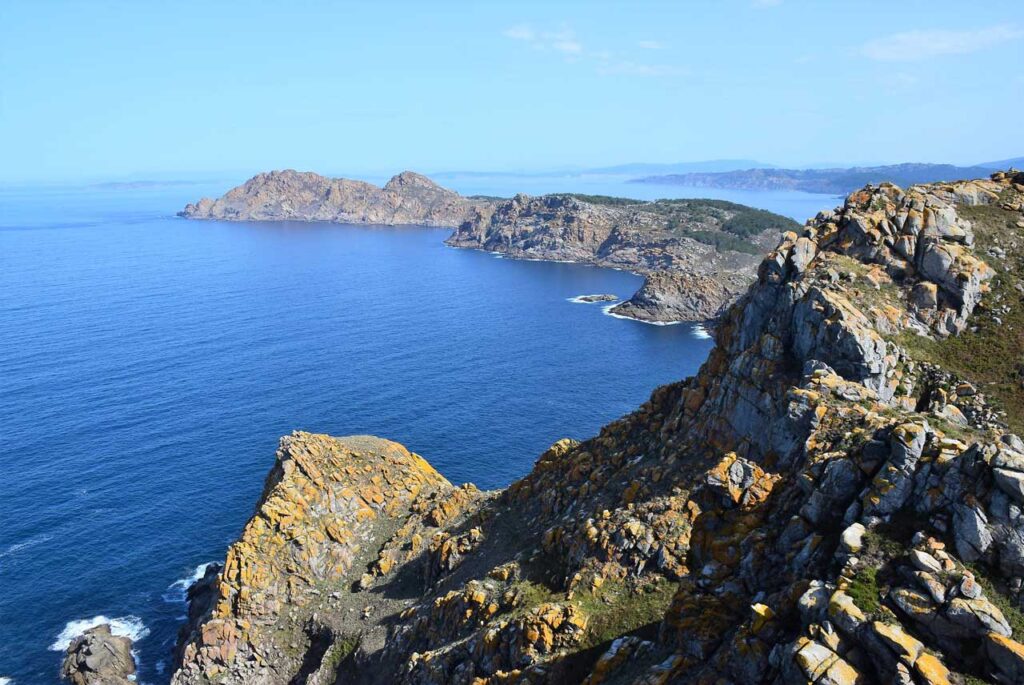
South Cíes islands. Views from the cliffs above the sea.
About this heritage
Cíes archipelago is made up of the North Island or Monteagudo, the Middle Island or Faro, and the south island or San Martiño. One of the characteristics of the Cíes archipelago is that its western face is formed by cliffs, partly because it is the face that faces the open sea and receives the blows of the waves and the entry of the wind. The best areas of the archipelago from which the cliffs can be contemplated are from the Cíes Lighthouse or from the South island or San Martiño.
In the cliff areas, due to the collision of the waves the few existing soils in that area have a high salinity. In addition, in these areas the wind blows very strongly so it is very difficult for plant species to grow, the ones that grow there take a cushioned form. Bird´s excrements that nest on the cliffs have. A significant influence on the growth of plants in these areas since they enrich the soil with fertilizing substances.
In the lower areas of the cliffs and close to the sea is the sea fennel (Crithmum maritimum). In higher areas there are sea campion (Silene uniflora) and orchard grass (Dactylis glomerata). At the top of the cliff is the coastal scrub area, less influenced by sea spray, where mainly endemic Galician-Portuguese subspecies of gorse (Ulex europaeus subsp. Latebracteatus).
To learn more
Cliffs are one of the main features of the Cíes archipelago. The west side of the archipelago is formed by cliffs where few plant species are settled and their growth is limited due to the strong wind and the strong waves they support. In addition to plant species, different bird species that choose the cliffs as places to establish their nest can also be seen on the cliffs.
Given the importance of birds in the archipelago, it was declared an Special Bird Protection Area (ZEPA) by the Spanish Government and the European Community. The archipelago is also a place where birds rest or hibernate during their migratory journeys.
Some of the bird species that breed on the Cíes islands are the yellow-legged gulls (Larus cachinnans) and the European shag (Phalacrocorax aristotelis), this two species are the most common in the islands. The lesser black-backed gull (Larus fuscus) and the storm-petrel (Hydrobates pelagicos) also breed there, and furthermore there are only a few of this species that can be found in the Iberian peninsula. Other bigger bird species as the northen gannet (Morus bassanus), northern goshawk (Accipiter gentilis), black-throated loon (Gavia arctica) and the peregrine falcon (Falco peregrinus) can also be seen in some seasons of the year. The manx shearwater(Puffinus puffinus), black headed gull (Larus radibundus) and the common murre (Uria aalge) are other species that can be seen.
To know it better
Cíes islands archipelago has spectacular views of the Atlantic Ocean. It was declared a Natural Park in 1980 and a National Park in 2002 along with Ons, Sálvora, and Cortegada islands. In the Peito´s Lighthouse Route, on the island of Monteagudo, there is a beautiful viewpoint overlooking the Costa da Vela, Cabo Home, Ons island, O Morrazo, O Salnés, Barbanza, and O Galiñeiro.
Cíes islands, in the province of Pontevedra have nine beaches of white fine sand and crystal-clear waters. Triangular in shape, San Martiño island is ne of the widest of Cíes. Nowadays we can observe remains of our Galician history such as the San Martiño hermitage or the pieces of the “Muíño do Limpiño” (Limpiño´s mill) and reach the highest point of the South island, the Pereira mountain.
Gallery
Location
- Town
- Vigo
- Municipality
- Vigo
- Province
- Pontevedra
- Country
- Spain
The asset
- Type
- Island
- Eco-destination
- Ría de Vigo
- Environment
- Natural
- Relevance
- International
How to get there
- Access
- By sea By land
- Distance
- 0 km
The visit
- Visitable
- Yes
- Accessible
- No
- Parking
- No
Coordinates
- Latitud
- 42.197804
- Longitud
- -8.895474