
Submarine. Aldán Estuary. Udra Cape and cliffs. Nature Classroom

About this heritage
The Aldán Estuary is between the two large estuaries of Vigo and Pontevedra, within the O Morrazo peninsula. Delimited by Couso Point and Udra Cape, it has a small fishing port and aquaculture auxiliaries. Walking towards it, one can complete the seafront promenade, which borders the beach and to which one can observe the seafaring village of this fishers' borough along with centenary Galician granaries (hórreos). Highlight the Parish Church of San Ciprián with neoclassical traces and its crenelated tower.
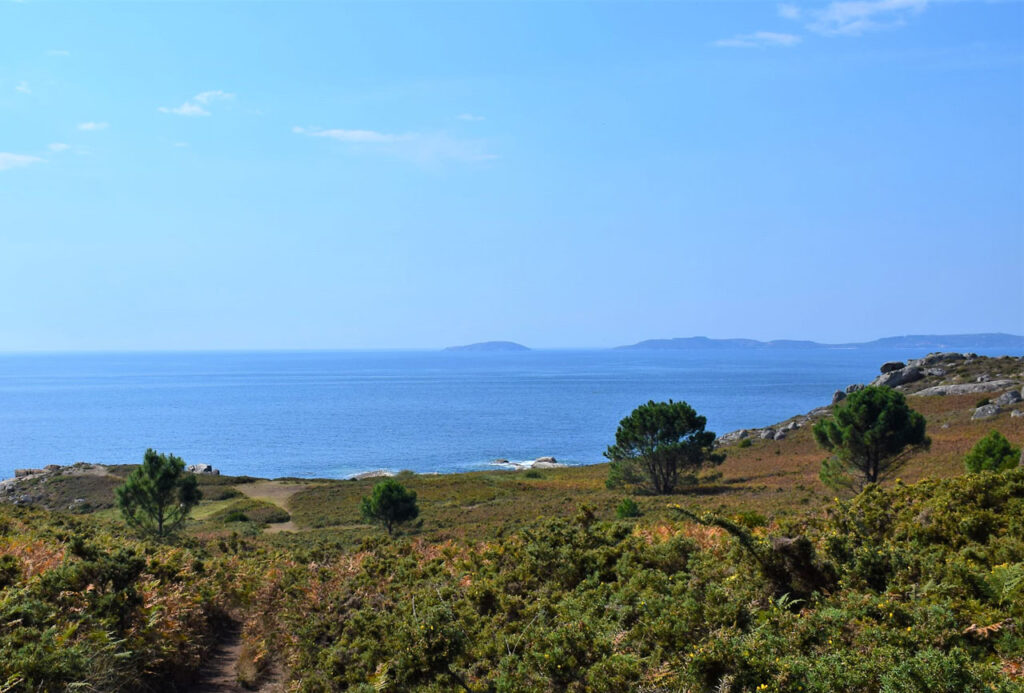
Going along the coast towards Bueu is Udra cape, a natural enclave in the Beluso region, declared a Special Conservation Zone (ZEC) for its natural values.
The Cape constitutes a landscape, which stands out for its unique geological formations of granite materials, more particularly, those with feldspathic mega-crystals belonging to a series known as "Sanxenxo-Bueu granodiorites." This type of crystals is up to eight centimeters in size, seen as rectangular shapes of opaque white in the rocks.
The passage of time has eroded these rocks, creating rounded formations and capricious shapes, such as boluses, circular cavities called alveoli or stone basins (pías), the beaches of boulders, and those formed by deposition of thinner materials displaced by the current.
The flora in the Udra Cape is characterized because, in such a relatively small space, there is a wide range of plant landscapes. The most protected areas have Atlantic or Irish Ivy (Hedera hibernica), laurels (Laurus nobilis), and oaks (Quercus sp.). Moreover, in the area most exposed to the sea, the vegetation is typical of cliffs, such as sea thrift (namorar; Armeria sp.) or Rock samphire or sea fennel (Crithmum maritimum). High above dominates the coastal scrub with gorse (Ulex europaeus latebracteatus) as well as the flax-leaved daphne (torvisco; Daphne gnidium) or osyris (Osyris alba).
Among the most characteristic species of its fauna is the ocellated lizard (Timon lepidus) that shares the space with other animals like the common buzzard (Buteo buteo), the peregrine falcon (Falco peregrinus), the European nightjar (Caprimulgus europaeus). Moreover, there are marine birds, such as the yellow-legged gull (Larus michaelis) and the European shag (Phalacrocorax aristotelis), as well as other highly oceanic migratory birds such as the northern gannet (Morus bassanus).
In the Udra Cape is the Nature Classroom, which displays exhibits with explanations about the distinct species of this environment. The classroom is in a curious enclave, where formerly, one could find the Military Artillery J-2 barracks built in the '30s. These barracks were rehabilitated to be energy self-sufficient, for which they installed photovoltaic and thermal-solar panels, a pellet boiler, and a windmill. Over the years, these facilities ceased to operate because of the lack of maintenance.
To walk around this cape and be able to contemplate its peculiarities, there is a footpath signposted with blue and white marks called the blue path, which starts at the Lagos beach, goes around the cape, and joins the coastal walkway until reaching the Agrelo beach in Bueu.
To learn more
The Udra Cape is a natural enclave in the Beluso area. From Niño do Corvo Point to the perimeter of the Udra Cape, the area has about 623 hectares, declared as a Special Conservation Zone (ZEC) belonging to the Natura 2000 Network.
Because of its important seabed, both terrestrial areas and coastal zones are protected. According to their substratum, several types of seabeds are distinguished, namely rocky, sandy, and maërl bottoms. These ones formed by calcareous algae (Lithotamnion corallioides), red algae (Lithotamnion calcareum), or gravel bottoms from mollusks' shells remains of mainly bivalves and gastropods.
The rocky areas mainly populated by organisms capable of surviving the onslaught of the waves and the turbulence of the water, which erodes and shapes the coast. This area is oxygen saturated and has an extensive amount of organic matter. These organisms have developed several elements of adaptation, for instance, protective elements like shells, in the case of periwinkles or mussels to prevent being crushed by the sea, as well as anchoring ones, which in the case of algae or mussels aim to avoid being dragged by the currents.
Need special mention, the seabed formed by the brown algae (Laminaria sp.). It is a genus of brown algae characterized by large, leathery sheets arranged in a webbed manner. This seaweed has a large flat leaf shape, supported by a long petiole attached to underwater rocks by employing some type of roots called rhizoids.
They form an exceptional submarine forest with a copious diversity of species. The created environment gives rise to multiple habitats where species can hide from their predators. While some live in the algae's upperparts, others rest on the shades projected onto the seabed.
On the coasts of Bueu and Ons, there is a long tradition of octopus fishing, where the “San Martiño” brotherhood of Bueu created the collective brand “Polbo das Rías” from their artisanal fishing, which identifies and guarantees the octopus catch and quality to the consumers.
In Bueu, the octopus gastronomic festival is held at the beginning of August, where one can taste in different ways this cephalopod.
To know it better
Aldán is a small estuary located between the Pontevedra and Vigo estuaries, both in the Pontevedra province. The Udra cape in Bueu is at the southern end of the Pontevedra estuary, sharing the entrance with the Aldán estuary and with stunning views of the Ons Island.
Moreover, in the Udra Cape, there still are the remarkable ruins of military barracks known as Artillery J2. These barracks were part of a defensive system to palliate the attacks from the last century. The Udra Cape is an area of rocks and cliffs, where its underwater habitat stands out. Declared a Special Area of Conservation and part of the Natura 2000 Network as a protected area in Europe, it has a Nature Classroom with the main objective to learn more about the natural, cultural, marine, and terrestrial resources of this Cape achieved thanks to its held educational activities.
Gallery
Location
- Town
- Beluso (Santa María)
- Municipality
- Bueu
- Province
- Pontevedra
- Country
- Spain
The asset
- Type
- Cape
- Eco-destination
- Ría de Pontevedra
- Environment
- Natural
- Relevance
- International
How to get there
- Access
- By sea By land
- Distance
- Distancia 5 km – 15 minutos en coche
The visit
- Accessible
- No
- Parking
- No
Coordinates
- Latitud
- 42.33969000
- Longitud
- -8.83443200