


The Dune System of the Corrubedo Natural Park, the lagoons of Carregal and Vixán. The Great Dune
About this heritage
The entire Natural Park belongs to the municipality of Ribeira, Coruña. It is an area included in Places of Community Importance (PCI) (Lugares de Importancia Comunitaria,LIC), along with Sálvora Island (Ribeira), and extends along the coastline of the Porto do Son municipality. It has a total area of 99,625 hectares, of which 9,265 are classified as PCI.
Declared Natural Park on June 5, 1992, it is a space of extraordinary biodiversity of fauna and flora, favored by the two lagoons and the mobile dune.
The Dune System of the Corrubedo Natural Park and its Carregal and Vixán lagoons became a Ramsar site (Wetlands of International Importance), and they belong to the Natura 2000 Network as well.
It is an exquisite example of a coastal lagoon-sandbar system, with a broad dune system in an advanced state of evolution, and of exceptional natural and scenery value. It constitutes the best and most extensive representation of this type of environment in northwest Spain, housing a magnificent variety of habitats in an excellent state of conservation and limited space.
The starting point to visit the natural park is the Casa da Costa (The Coast House) or the Visitors Reception Center, located in O Vilar. It also has another building called the Galician Coastal Ecosystem Interpretation Center (GCEIC; Spanish: CIELGA), designed as a museum to promote the natural, geological, and historical affairs for which this park deserves to be known.
The park has two lagoons: one is seawater and the other freshwater, with extensive linked marshes and wetlands of International Importance. The waters of the modest Muiño stream feed Vixán, the freshwater lagoon, which is subject to seasonal fluctuations of its flow. Carregal, the seawater lagoon, communicates with the ocean by dividing in two the long beach in front of reefs called Pedras da Ferreira. Through this sea channel, the tides circulate, becoming one of the central points of the Corrubedo System.
The specialized vegetation of the dune system is linked to a unique floral display with vegetation typical of the marshes, making the park a botanical paradise. The same applies to its fauna, which has diverse habitats with many possibilities, such as the communities of birds associated with the aquatic environment, either seawater or freshwater.
The extensive flooded areas constitute wetlands of international importance in the migratory patterns of birds that, in this case, nest there. The Vixán lagoon has a bird observatory.
Specialists interested in unique endemic plants and others of precious value consider the Corrubedo Natural Park a botanical paradise. It is one of the most visited Natural Parks in Galicia and Spain, with almost 300,000 people a year, thanks to its excellent natural representation of the coastal ecosystems.
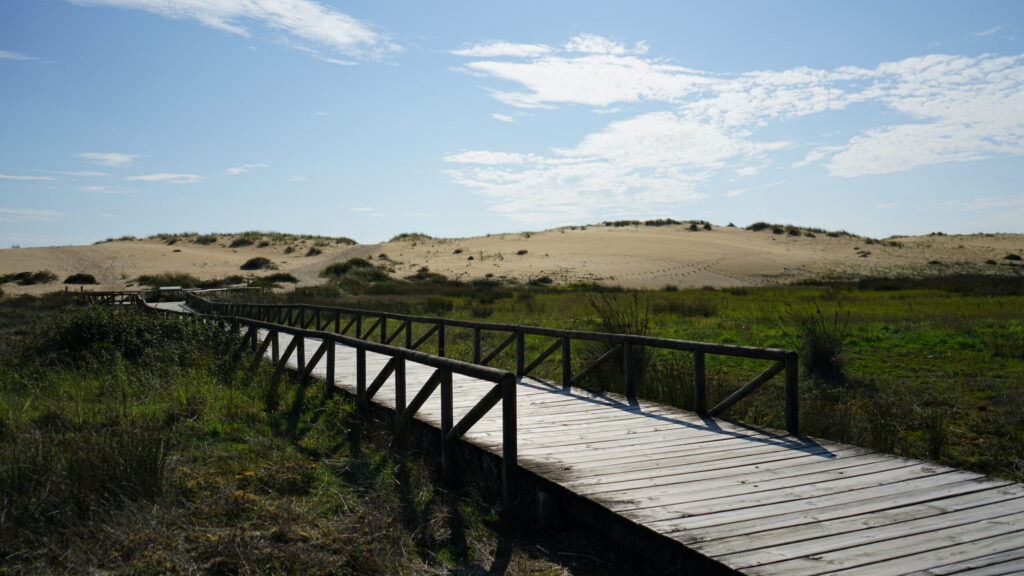
The broad mobile dune is the park's most outstanding attraction. It is more than a kilometer long, approximately 250 meters wide, and around 20 meters high.
In the park's surroundings are the pre-Roman fortress (Castro) of the city viewpoint, the Pedra da Rá (the Stone of the Frog), and the Axeitos dolmen (megalithic tomb).
To learn more
The Dunes geological system - whose official name is the Dune System of the Corrubedo Natural Park, Lagoons of Carregal, and Vixán - was formed between 12,000 to 15,000 years ago in the Quaternary era. At that time, mammoths and mastodons disappeared, and when anatomically modern humans developed.
Erosion and the accumulation of sand by the wind created a sandy barrier that closed the original bay, forming a mass of dammed water progressively filled by sediments brought by the wind and rivers, losing its depth and giving rise to the current Carregal wetland. Consequently, it connected to the sea through small channels, forming what today is a semi-enclosed coastal lagoon. Subjected to the water level fluctuations due to the tides and rains, its more shallow bottoms of silt and sand evolved to the current marsh, which is populated by plants that adapt to the periodic floods, tidal flats (mudflats), and water and soil salinity changes.
There are 247 taxa of plants (scientific classification group) represented in this natural park. Many of these species adapt to the great aridity and instability of sandy substrates, such as the milk thistle (Silybum marianum) or the Ammophila that fixes the beach embankment. Others adapt to permanent waterlogging, like reeds (wetland grass-like plants), specifically, the giant reed (Arundo donax). Other emblematic aquatic species are the ranunculus, as are the halophyte species, such as salicornia. Others are endemic to the northwest of the peninsula, of which some are vulnerable or in danger of extinction, such as the common threesquare (Schoenoplectus pungens) or the paxarinhos (Linaria arenaria).
Both in sandbanks and the wetlands, there are considerable variations in the ecological factors that limit or favor certain species. In the dunes are some vegetation lines that depend on the sand accumulation levels, the salinity, and the wind action. In the periphery of the area, pine forests grow beside some indigenous trees, such as European oaks (Spanish: carballos).
Highlighted the area for its important fauna since we can find 70% of the species of amphibians and reptiles in Galicia, of which the ornithofauna stands out. In recent years, the wintering waterbirds census estimates an average of 2,300 individuals from more than 35 species. Some of them as scarce as the Kentish plover, called "píllara das dunas," that arrives in spring to nest among the sandbanks, being one of the species that most benefit from the protection of the area and that coexists on the beach and the mudflats with other plovers, sandpipers, oystercatchers, curlews, and godwits. Probably, Corrubedo has the best population of these small waders in the entire Galicia. On top of that, mallards (ducks), pochards, coots, moorhens, herons, teals, and grebes share this aquatic habitat as well, and it is not uncommon to see other sea birds passing through, such as cormorants, northern gannets, blackbirds, and shearwaters.
In the park, there are ten species of amphibians. Among them, it is worth mentioning the extremely rare Iberian spadefoot toad, the Iberian green frog, or the Iberian painted frog. As for reptiles, there are about 14 species from the Grass snake, the Iberian emerald lizard, the salamander to the Seoane's viper, which is endemic to Galicia.
As for mammals, the most common species are otters, which live in the upper parts of the marshes, and foxes, which have a large number of burrows in the park. There are also southwestern water voles and hedgehogs.
The Dune System of the Corrubedo Natural Park, lagoons of Carregal and Vixán offers diverse ecosystems:
The long semicircular sandbank, which covers 4 kilometers of beaches, presents significant differences. The closest area to Corrubedo, formed by the Ladeira Beach and Da Ferreira Dunes, has fine sand and less pronounced currents than in those of the southern beaches. Behind the mouth of the Carregal lagoon are the beaches of Vilar and Anquieira, with highly dangerous rip currents.
Behind the beaches, we find the dune ridge with the largest mobile dune in Galicia, which gives its name to the park. It is approximately 1 kilometer long, 20 meters high, and about 250 or 300 meters wide. The vegetation that holds it presents valuable and scarce species, including some endemic ones.
At the end of the 19th century, experts documented that the dune was more than 60 meters high. Without vegetation to contain it, it advances through the plain at a speed of two or three centimeters each year. As a whole, the dune displacement occurs facing the interior in a northeastern direction.
The physical environment in which the Natural Park is evolving includes a coast where the inlet of the park is not very rough, with large areas of sedimentary-origin beaches. The Aeolian transport of these deposits allowed the development of coastal dune ridges, often semi-stabilized by halophyte vegetation. The intense wind activity served the formation of this unique mobile dune.
To know it better
The Natural Park occupies nearly 1,000 hectares, formed by the dunes, Corrubedo beach, the freshwater lagoon of Vixán, and the seawater lagoon of Carregal, in which anyone can observe species such as birds and otters.
The pre-Roman fortress of the city (Castro de A Cidá) is in the municipality of Ribeira in the province of Coruña, more specifically, between the parishes of San Xián de Artes and San Paio de Carreira.
To talk about Castros, one has to travel back to the Bronze Age, to the 7th century BC, and imagine what life was like thousands of years ago. These fortifications were the villages where the Celts lived. Their shape could vary from oval to circular, and they used to be in elevated areas.
This military settlement, located on Mount Cidá or Cibdá, was inhabited from the sixth century BC to the first century AD. All its constructions deteriorated over the years until their discovery in 1924, which led to the beginning of archaeological works and excavations by 1932. In 2014, another series of diggings near the summit revealed approximately fifteen houses from the Castro era and a more modern structure.
On the same mountain, and close to the Castro, we can find the viewpoint of Pedra da Rá (Stone of the Frog) since the 1980s. Its name comes from the frog-shaped design, showed on the rock at its viewpoint, from where one can enjoy the views of the Atlantic Ocean and a large part of the Natural Park, which integrates a broad area of Corrubedo.
Location
- Town
- Corrubedo
- Municipality
- Ribeira
- Province
- A Coruña
- Country
- Spain
The asset
- Type
- Natural Park
- Eco-destination
- Ría de Arousa
- Environment
- Natural
- Relevance
- International
How to get there
- Access
- By sea By land
- Port
- Puerto de Aguiño
- Distance
- 3,2 km
The visit
- Visitable
- Yes
- Accessible
- No
- Parking
- Sí
- Signposted
- Yes
Coordinates
- Latitud
- 42.58444200
- Longitud
- -9.04483400