
The Virgin of the Rock
About this heritage
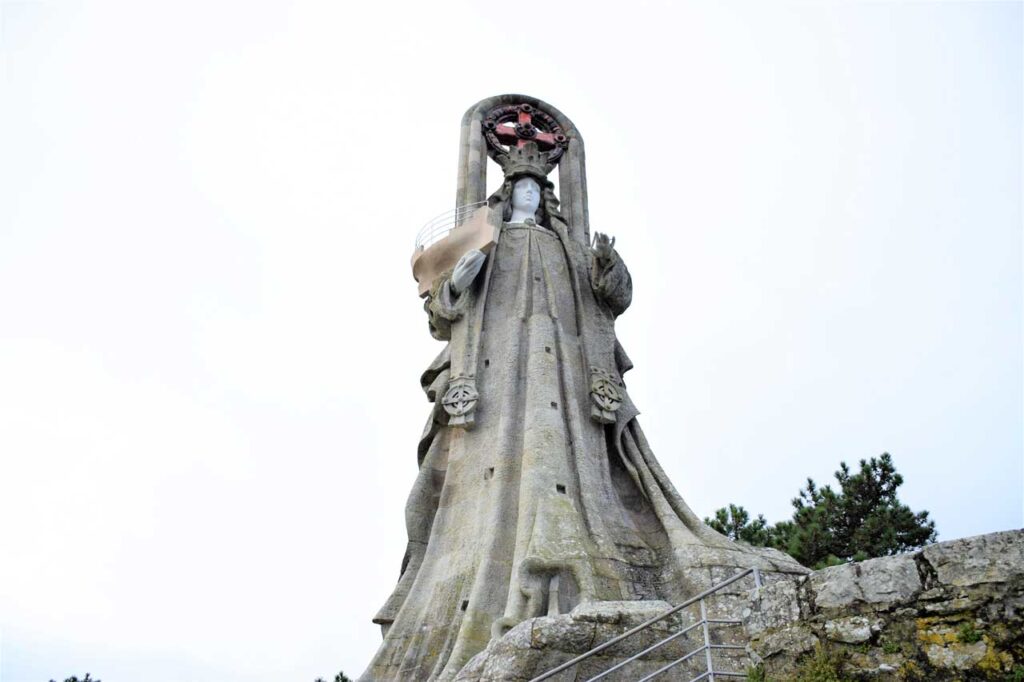
The Virgen of the Rock is on top of Mount Sansón, 100 meters above sea level. It is a striking monument, with its 15 meters, since it can be seen from the sea and other several points of Baiona.
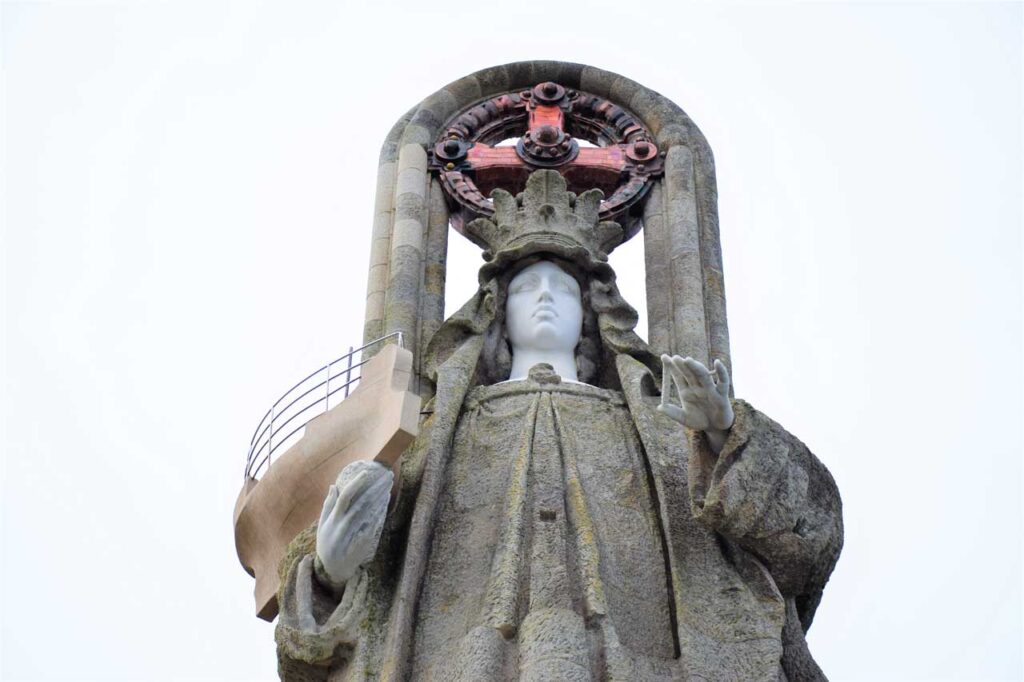
The sculpture represents the sailor's devotion to their patron saint, the Virgen of the Carmen. It is a magnificent monument built in granite on the rocks of Mount Samson. The architect of this work was the famous Antonio Palacios, a native of Porriño. The whole figure is granite except for his face, neck, hands, and cross, which are made of marble and the crown's cross of porcelain. The Virgin has on her lap a boat with a viewpoint, which is accessed by a door in the northern end that leads to the interior of the Virgin. In addition, the viewpoint can be accessed through a spiral staircase, in which as you climb it, you can read several verses written on some of its tiles. The verses correspond to the prayers of the Holy Mary and the one to finish the Rosary,
From this viewpoint of the boat, you can see in greater detail the face of the Virgin, as well as her crown and porcelain cross. Moreover, you can enjoy unsurpassable views: the open sea reaching the coast, the breakwaters area, the beach of Shells (A Cuncheira), the fortress of Monterreal in the peninsula of Mount Boi, and the Baiona Villa with its historical-artistic areas, the Estelas Islands, Monteferro mount, and Cíes islands protecting the Vigo estuary.
To learn more
The place where the Virgin of the Rock is located was known as Mount Saint Roch (Roque), which is now Mount Sansón. Antonio Palacios, a native of Porriño, carried out the work of this monument.
The first stone was laid on September 18, 1910. The construction lasted about 20 years, being inaugurated and blessed on September 14, 1930.
The fundraising for this construction lasted years; it was done through the realization of several events in Santiago, Vigo, Baiona, Caldas of Reis, and other districts. Queen Victoria, Alfonso XIII's wife, held a party at the Royal Theater in Madrid to collect funds for the monument.
At first instance, the builders wanted this monument to serve as a reference point for sailors, and there is no doubt that its purpose was a success. From the viewpoint next to the Virgin of the Rock, you can enjoy unsurpassable views: the open sea reaching the coast, the breakwaters area, the beach of Shells (A Cuncheira), the fortress of Monterreal in the peninsula of Mount Boi, and the Baiona Villa with its historical-artistic areas, the Estelas Islands, Monteferro mount, and Cíes islands protecting the Vigo estuary.
It is probably the most famous monument in the county because of its peculiar conception. The work, which was inaugurated in 1930, is 15 meters high and represents the Virgin holding in her right hand a viewing-boat, which can be accessed by an interior spiral staircase made of stone. The Virgin's face and hands are made of white marble - the work of Ángel García - and her crown was built in porcelain.
Next to the monument, a recreational park was later built called Mercedes of the Stairs; it has a small forest area, equipped with a parking area, and the Via Crucis (the Ways/Stations of the Cross), some benches, and tables made of stone. In this location, every August's last Sunday is celebrate the popular procession dedicated to the Virgin.
To know it better
The Virgin of the Rock, in Galician "Virxe da Rocha," is a well-known monument in the Baiona County, located in the formerly known as Mount of Saint Roch (Roque). This town hall is located in the province of Pontevedra.
The construction of the image began on September 18, 1910, and was done in granite on the rocks of the current Mount Samson. The architect of the work was one of the most famous of the twentieth century, Antonio Palacios, a native of Porriño, and its inauguration took place on September 14, 1930.
The statue of around 15 meters high represents the Virgin. Her face and hands are the work of Ángel García, and they are made of white marble.
At the northern end of the art piece, there is a door, through which you can see the inside of the monument, paying the corresponding ticket. Upon entering, one access a spiral-shaped staircase decorated with verses from the Holy Mary. Then, we can find a door of small height, from which we can appreciate up close the face of the Virgin, her crown, and the cross, as well as a small viewpoint towards the Atlantic Ocean. In addition, you can also see her right arm, which holds a viewing-boat and her left hand making the blessing gesture.
Gallery
Location
- Town
- Baiona
- Municipality
- Baiona
- Province
- Pontevedra
- Country
- Spain
The asset
- Type
- Monument
- Eco-destination
- Ría de Vigo
- Environment
- Natural
- Relevance
- International
How to get there
- Access
- By sea By land
- Distance
- 1.4 km, está a 17 minutos caminando
The visit
- Visitable
- Yes
- Accessible
- No
- Parking
- No
Coordinates
- Latitud
- 42.12104900
- Longitud
- -8.85844900