


Valga Church
About this heritage
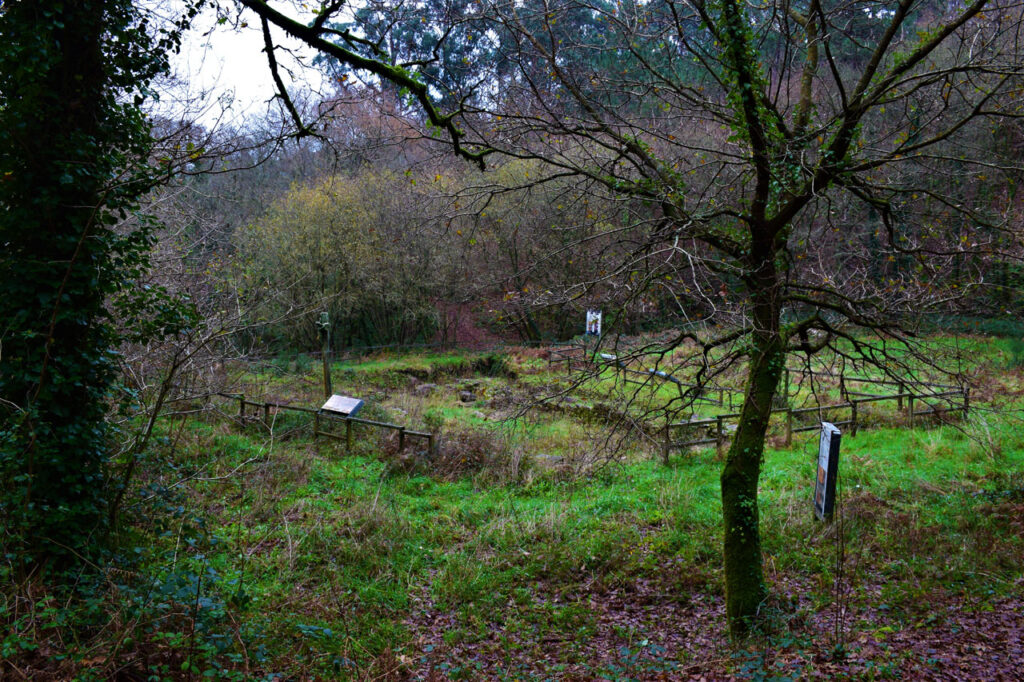
Within the parish of Cordeiro, in Valga County, relatively recent excavations (2010) have revealed the existence of a primitive church, which turned out to be the remains of the church and monastery of Santa Comba de Louro.
The presence of these high medieval structures was known thanks to old documents, which were dismantled in the eighteenth century to build the current church of Santa Comba de Cordeiro.
The deposit site is located in the lower part of a small valley, near the Balleas area, and surrounded by a stream to the east. It consists of the foundations of a rectangular shape construction. The place is fenced, signposted, and conditioned.
The dating of these finds allows an occupational sequence that would go from the fourth to the eighteenth centuries. The oldest remains of this necropolis would be the Roman origin tombs. It is worth mentioning, a late Roman oven used for the manufacture of glass or metals, a stone cross, and other remains of medieval origin.
The existence of a high medieval monastery is also well known, which has been blended with the most modern church, although several tombs could belong to this period. At the beginning of the 12th century, this monastery became a female Benedictine monastery and later became a priory of regular canons of Saint Augustine.
The historical-artistic complex of Valga County includes the Vella Church of Santa Comba de Louro with its Museum of History, the petroglyph of the Pedra da Serpe, the bridge of the Souto, the two Mouros market and the Artisan Christmas Nativity Scene with figures in motion.
To learn more
Within the Cordeiro area in Valga County, the remains of the church and monastery of Santa Comba de Louro were found. The excavations directed by Emilio Ramil González are relatively recent, from 2010, where five archaeological levels can be described.
The first would be from the late Roman period, where the wall and funerary structures, as well as industry, were found. Noteworthy is the paleo-Christian tombs and a locally produced industrial oven, possibly used for the manufacture of glass or metals. Other materials recovered were remains of tiles and bricks from this period and imitations of ceramics, such as "terra sigilata;" glass; metals, such as bronzes and iron; and rubble.
From the 5th century onwards, the second level of occupation took place. It has been documented, the construction of a small rectangular basilica church on the previous level. The chronology of this basilica would be between the end of the Roman Empire, throughout the Germanic period, until the beginning of the repopulation of the eighth century.
Tombs made of stone were recovered, and along with the previous materials (tiles and bricks) would be placed inside the main nave.
The third level corresponds to the high medieval period, between the Early Middle Ages and the Late Middle Ages. The previous church suffered a fire sometime between the 8th and 9th centuries because abundant remains of charcoal were found throughout the church plan. Another church was built taking advantage of the façades and the sidewalls, possibly, due to the demand as the location's population increased. Associated with the temple were recovered twenty-six stone slab tombs, a corbel (ménsula, "canzorro") from a cornice, and part of a capital (capitel) ornamentation as well as medieval ceramics, bronze coins, and some medals.
Between the beginning of the middle Ages and the beginning of the Modern Age in the 16th century, the church became a parish church. A chapel was added, which conserved an altar and a sacristy. A monolithic sarcophagus is located out of place.
The last archaeological level dates from the beginning of the 18th century, in 1730. The dismantling of the church for its transferring to its current location is documented in the spot of the Santa Comba de Louro church in the county of the same name. It is a baroque collegiate church with sculptures of significant artistic value. It consists of a single nave without a transept and a bell tower next to the façade. The current location is 500 meters from the old one, and it was finished in 1733.
To know it better
The Church of San Miguel de Valga is a neoclassical style building built in the year 1750, XVIII century. It has a Latin cross floor plan with a single nave, apse, and a side chapel. This church has undergone several reforms, and the columns and the lintel of the main door are no longer preserved.
Its stone façade conveys a lintel-molded door, a square gable window, lateral pilasters recast in pinnacles, and a bell tower. The church also has a statue of Saint James (Santiago) and a cemetery. It is a pilgrims' passageway on the Way to Saint James.
Valga is a County in the Pontevedra province that has less than seven thousand inhabitants. Its territory limits to the north with the Dodro and Pontecesures Counties and to the south with Catoira and Caldas de Reis.
Gallery
Location
- Town
- San Miguel
- Municipality
- Valga
- Province
- Pontevedra
- Country
- Spain
The asset
- Type
- Church
- Eco-destination
- Ría de Arousa
- Environment
- Rural
- Relevance
- National
How to get there
- Access
- By land
- Distance
- Distancia 4,6 km / 8 minutos en coche
The visit
- Accessible
- No
- Parking
- No
Coordinates
- Latitud
- 42.69465300
- Longitud
- -8.63853100