


Vilanova Cerveira´s historical centre and history. Castle
About this heritage
Vilanova de Cerveira is a town located in the northern region of Portugal that belongs to Viana do Castelo´s district. It borders Tomiño from which it is separated by the Miño river.
Until a few years ago, both regions were connected by a ferry that crossed from Goián´s parish (in Galicia) to Vilanova de Cerveira´s banks. It was a mean of transport widely used by the locals on both shores, especially on Saturdays when the weekly village fair was, and still is, held. Nowadays there is a bridge that links both banks.
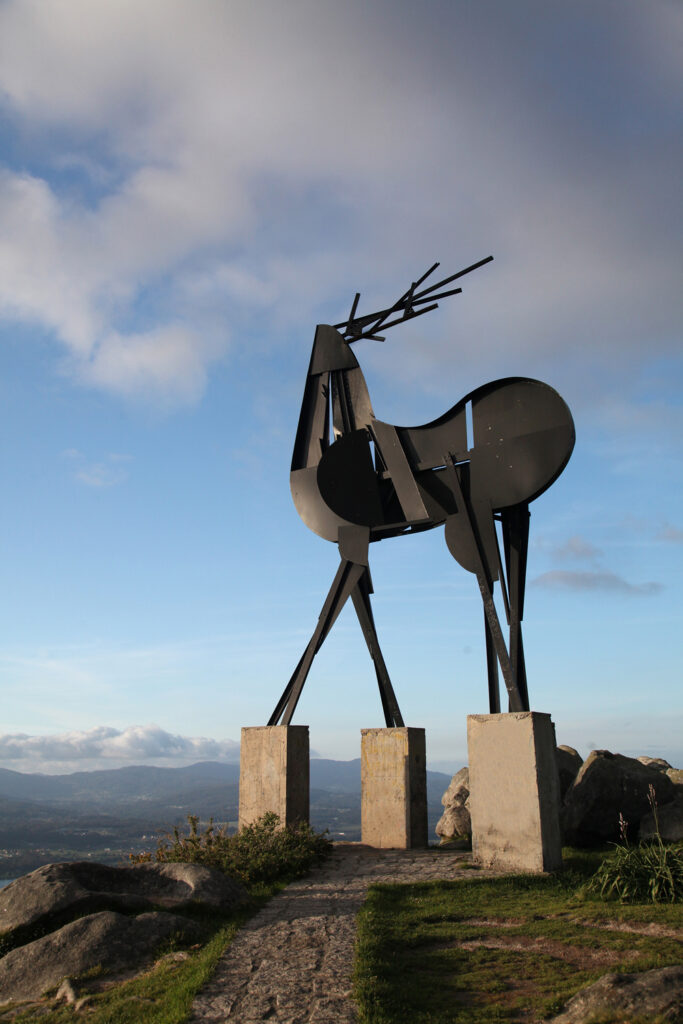
The origin of Vilanova de Cerveira´s name is not very clear, but it seems to have two possible explanations. Some authors defend that it could be derived from the great deer colony that existed in the region and others that it comes from their first lord, João Nunes de Cerveira, who had land for these sites in the time of King D. Sancho I. At the top of the Senhora da Encarnação mountain there is a sculpture in the shape of a deer by José Rodrigues and it is visible from all points of the municipality.
The medieval castle that is preserved today, comes from the reign of D. Dinís that in 1317 attracted 100 inhabitants with the purpose of strengthening an urban network and for this purpose granted a foral letter to the village. The construction took advantage of the existing natural wall at one point of the river as a location to better ensure control over it. It had successive modifications and is currently a hotel establishment named Pousada de Don Dinís.
Inside this walled enclosure, the old Casa da Cámara, the 16th century pelourinho and the Misericórdia Church are preserved. Along Direita street you can see a Visigoth arch that belongs to the medieval palace of the Governors.
The city continued to grow behind the walls of this fortress where the Igleja Matriz or San Cipriano church and the 16th century fountain are located in the centre. It is composed of three naves, two bell towers, a choir and an altarpiece presbytery, in baroque style, designed by the master Veríssimo Barbosa.
To learn more
The cities of Cerveira, Valença, Monçao and Melgaço, have many aspects in common for being borders with Galicia on the southern bank of the Miño. They all have important defensive constructions such as forts and watchtowers that derived from the military strategy due to their location and relationship with the neighbouring country. The river played different roles throughout history in relation to Northern Portugal and Galicia. A separation factor in certain historical stages, it becomes in others a powerful element of union, between the Portuguese and Galician peoples.
There are five fortified areas facing each other on both sides of the Miño River: A Guarda y Caminha; Vilanova de Cerveira and Goián; Valença and Tui; Salvaterra with Monçao; and finally Fornelos with Melgaço.
Between Vilanova de Cerveira and Goian there were the fortifications, on the Galician side, of San Lorenzo, Correas Tower, Conception fort and Tower of the Mice. Medos Fortress in Estas and the Tebra Towers, located in the further inland. On the Portuguese side, the castle and fortifications of Vilanova de Cerveira, the Fort of San Francisco and the Watchtower of Lovelhe.
The oldest information about its defence dates from the reign of D. Sancho II - in a foral of 1229 - and it is believed that, at that time, the castle would only be a defensive tower. Everything points to the fact that the primitive construction of the castle took place during the reign of D. Afonso III, as the obligation to contribute through a tribute to the construction and repair of the walls is documented. However, nothing remains of the original construction.
The medieval castle that is preserved today, comes from the reign of D. Dinís that in 1317 attracted 100 inhabitants with the purpose of strengthening an urban network and for this purpose granted a foral letter to the village. The construction took advantage of the existing natural wall at one point of the river as a location to better ensure control over it. It had successive modifications and is currently a hotel establishment named Pousada de Don Dinís.
The general layout of the fortress confirms this Dionysian dating of the project. It has an oval floor plan -typical of Gothic fortified buildings-, with stone mating walls crowned by battlements and surrounded by a wall. The walled enclosure is reinforced by eight quadrangular towers, five of them on the south wall, the most vulnerable to attacks. This chronology is confirmed by the presence of the coat of arms of D. Dinis on a Gothic portal, as well as by the remains of the matacanes or roofs that allowed for vertical shooting on the possible aggressors.
There are two gates joined by Direita street: to the south, facing the fairgrounds, the Puerta de la Vila (Village´s door) or Nuestra Señora de la Ayuda (Our Lady of Help) and to the north, a small gate, a veritable “gate of treachery";, leading to the riverbank.
This castle had an important support in the Miño river´s defence during the War of Restoration of the Independence of Portugal (1640-1668). In 1650 the Chapel of Nuestra Señora de la Ayuda was erected, a work that crowns the main entrance of the medieval enclosure.
Between 1660 and 1667, the modern fortification was built according to the project of the Land Master General Francisco de Azevedo, according to the standards of the French school of bastioned architecture of the 17th century. At the same time, Nuestra Señora de la Concepción Fortress was built on the Galician side of the Miño river
Its layout forms a star-shaped polygon with 4 entire bastions (San Miguel, Espírito Santo, Concepción and Almas), one half-bastion (Santa Cruz Bastion), 3 strongholds on the river side and a bakery in front of the San Miguel Bastion. The square had 4 doors: the door of the Campaign (to the north, next to the Chapel of San Antonio), the door behind the Church (to the east), the Nova (to the south, next to the Chapel of San Gonzaga) and the door of Rio to the west.
To know it better
Located in the north of Portugal, in Viana do Castelo´s district, Vila Nova de Cerveira is also known as Cerveira. The origin of the municipality´s name may derive from a large colony of deer (hence Cerveira), or, on the other hand, it is also believed that it may refer to the first lord of Cerveira who was in this area in the time of King D. Sancho I.
This municipality has been inhabited since the Middle Ages and has become a historic town. Its old town, the stately homes with coats of arms and its cobbled streets are particularly noteworthy.
It is very interesting to visit its 15th century castle, built on an earlier construction. It has an oval floor plan, typical of the Gothic style, with walls and eight square towers, where you can see the remains of two matacanes or roofs and the remains of the Homage. Another construction worth visiting is the 16th century Igreja Matriz o São Cipriano church, located in the Plaça da Liberdade (Liberty square
Gallery
Location
- Town
- Vilanova de Cerveira
- Municipality
- Vilanova de Cerveira
- Province
- Distrito de Viana do Castelo
- Country
- Portugal
The asset
- Type
- Old town
- Eco-destination
- Río Miño
- Environment
- urban
- Relevance
- Internacional
How to get there
- Access
- By sea By land
- Distance
- 0,300km
The visit
- Visitable
- Yes
- Accessible
- Sí
- Parking
- Sí
- Signposted
- Yes
- Website
- cm-vncerveira.pt/
Coordinates
- Latitud
- 41.94042800
- Longitud
- -8.74504000