
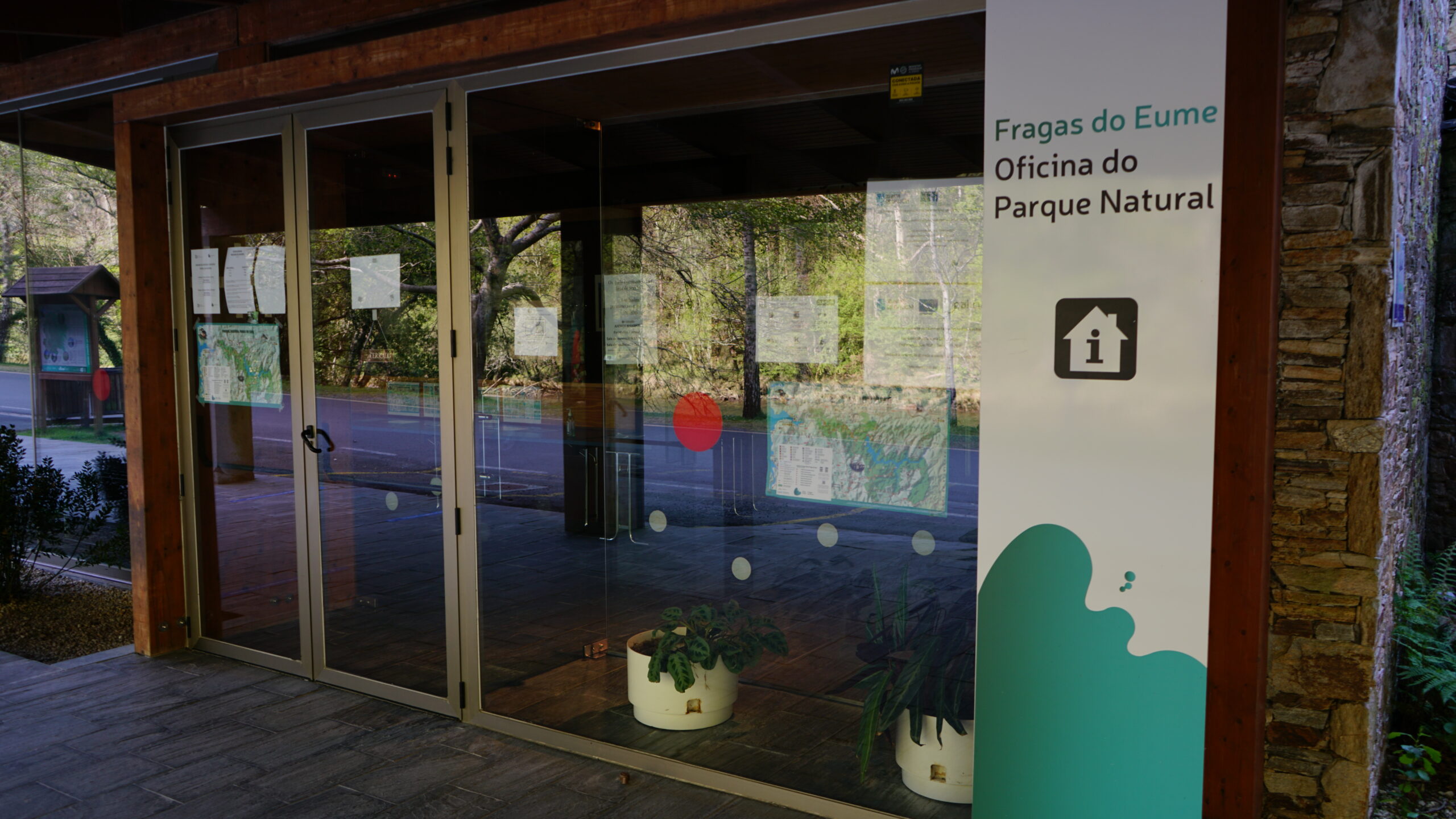
Woodland (Fragas) of Eume. Interpretation Center
About this heritage
The Natural Park of Fragas del Eume is one of the best-preserved Atlantic riverside forests in Europe, declared as such on July 30, 1997.
A "fraga" (woodland) is a thicket of trees, whose branches always give an interior of veiled light, which keeps the humidity and temperature almost always constant.
The park covers an area of 9000 hectares located, from east to west, between the towns of As Pontes de García Rodríguez, Monfero, A Capela, Cabanas, and Pontedeume, and has a population of few hundred people within its perimeter.
The Eume River has sculpted the landscape, running its roughly hundred kilometers course and flowing through its mysterious hills, delighting with backwaters, waterfalls, and fountains, those who appreciate such exuberance. Oaks, sweet chestnuts, European ashes, black poplars, black alders, common hazels, bay laurels, common hollies, strawberry trees, and other wild ones form a blanket of a thousand shades of green, a spectacular view of the forest for those enjoying this scenery from the Monastery or for those adventure-seekers experiencing the trails among the shadows of this jungle.
The best place to contemplate the meanders of the Eume River and the Xestoso valley is the viewpoint of A Carboeira, which one can reach by taking the Os Cerqueiros route from Monfero in the Portela de Montelongo.
The humid and shady banks have preserved a large collection of lichens, mosses, and other 28 species of ferns that are one of the jewels of the forests, which regulate the climate, as the Eume one with relics of the Tertiary Period.
In the Fragas Del Eume, there are copious traces of the significant presence of megalithic culture. It is home to 103 species of birds, 41 species of mammals, and 8 species of fish, as well as endemic species of invertebrates and reptiles, such as the Iberian frog.
The woodland (fragas) of Eume was included in the Natura 2000 Network at a European Union level under the Council Directive 92/43/EEC of May 21, 1992, related to the conservation of natural habitats and of wild fauna and flora (Habitats Directive). Their objective is to safeguard the most relevant natural areas of Europe, as a Site of Community Importance (SCI), and within the Special Areas of Conservation (SAC).
The park has two hanging bridges over the Eume River, the Fornelos and the Cal Grande, located on the Ventureira-Caaveiro-Cal Grande route.
The fragas have four access points, of which the fifteen-minute ascend to the Caaveiro Monastery is the most transited destination. Other accesses are from the Cabanas to As Pontes de García Rodríguez road with a detour in As Neves, which leads to Gunxel with the Sesín mills and, on the same Cabanas-As Pontes road, right at the Goente detour, access the Eume dam.
In the summer season, there are restrictions for the passage of vehicles, but the entrance is free of charge and includes a guided visit, generally, in shifts of 45 minutes.
To learn more
The Fragas (woodland) of Eume is one of the most outstanding forests in Europe for its preservation state. Born from an intricate valley of tectonic origin, this woodland (fragas) has rich fauna and flora, making it one of the most extensive and unique forest in Europe.
With an area of 9000 hectares and a population of 500 people, it provides an almost virgin forest that runs along the Eume River. This forest cover looks like a triangle, located between the municipalities of As Pontes de Garcia Rodriguez, Cabanas, A Capela, Monfero, and Pontedeume, all within the A Coruña Province.
In this Natural Park is the Caaveiro monastery, an old convent with centuries of history that holds the most spectacular view of the fragas. Additionally, the Interpretation Center of the fragas of Eume is a perfect spot to plan the route to the park. It has the latest and most innovative technology, and it is a place to park the car and start the tour on foot.
The natural park combines diverse types of European temperate deciduous Atlantic forest, such as oak groves of multiple species, such as sweet chestnuts, European ashes, common hazels, and silver birches, besides field elms, bay laurels, and common hawthorns. On the ground, there are ferns, small bryony flowers, lichens, and mushrooms. In the higher areas, the protagonists coexisting are varying types of bushes, making a natural space included in the European Union's Habitats Directive to ensure conservation. All of these create an ecosystem where animals take shelter.
A hundred distinct species of flora grow among the trees, settling anywhere, such as in cracks, on the ground, or like fungi feeding on the wood, making it an endemic area of exceptional ecological value.
The fauna of amphibians and reptiles has characteristics of an endemic habitat, comprising thirteen diverse species of amphibians and ten species of reptiles. In this area are ten taxa with a different degree of endemism, a population of the gold-striped salamander, and the Iberian newt and the Iberian frog both endemic to the peninsula.
The woodland (Fragas) of Eume is the most remarkable facility, due to its richness, for mammal fauna. Among the species representative of mountain areas stand out the marten, the wolf, the roe deer, the wild boar, the common genet, the European badger, and the Eurasian water shrew. The latter and the otter are included in the Habitats Directive. Other carnivores of great importance in the area are the wild cat, the European polecat, and the Beech marten. The wolf is present in higher zones.
The existence of several refuges signifies a life of a bat population composed of approximately 15 species. Nowadays, the roe deer and wild boar are present in the woodland (fragas) after decades of being critically endangered, likewise with the hare in the high areas. Deer that flee captivity have procreated in natural areas.
On top of that, there are more than a hundred known species of resident birds, including different nesting birds of prey. Among the eight fish species, it is worth noticing the presence of two vulnerable species, the northern straight-mouth nase of northwestern Iberian endemism and the brown trout.
The invertebrate fauna is diverse and unique; for instance, among the terrestrial mollusks, two species included in the European Union's Habitats Directive stand out, the snail and the slug, and among the insects, stand out the protected endemic species, such as the stag beetle.
The Natural Park's climate is of oceanic influence with a thermal regime that is mild and scarce and of Mediterranean character in the coastal zone. Within its climate, there is a wide variety of microclimates caused by the characteristics and structure of the woodland (fragas).
Its orographic features did not allow for human settlements; however, in the surroundings of this Natural Park, where the relief smoothly descends towards the sea, it was propitious. Therefore, in the surroundings of the park, preserved mamoas, or tumuli, and forts (Castros) are evidence of human presence since prehistoric times in the Eume Region. They have found numerous forts (Castros) and the torcs of Centroña and San Martiño do Porto. In contrast, traces of Romanization are more visible on the coast.
To know it better
Pontedeume is a Galician municipality located in the A Coruña Province. The municipality comprises the parishes of Ombre, Nogueirosa, O Vilar, and Pontedeume.
The Eume River flows through this town to, subsequently, enter into the Atlantic Ocean. Therefore, according to history, Pontedeume receives its name for being the municipality that gave birth to this river.
Approximately seven kilometers from the municipality and following the Eume River, we find the Woodland (Fragas) of Eume Natural Park, one of the best-preserved Atlantic riverside forests in Europe with an area of 9,125 hectares. Declared a Natural Park in 1997, the fragas accompany the Eume River as it crosses through this area.
The "fragas" (woodland) are a thicket of trees, whose branches always give an interior of veiled light, making these areas of similar characteristics, such as humidity, freshness, and temperature, which tend to be almost constant. Besides providing a unique experience with nature, the journey through this woodland also offers an adventure to discover historical relics and numerous vulnerable and endangered species of animals and plants. The dominant tree in the fragas may be the English oak (carballo) or Pyrenean oak (melojo), but one can encounter many species, such as sweet chestnuts, common hollies, common hawthorns, and bay laurels, among others.
The Interpretation Center proposes routes and information on the Fragas of Eume. There are diverse routes on foot or by bus, a free service offered by the Interpretation Center itself.
Gallery


Location
- Town
- Pontedeume
- Municipality
- Pontedeume
- Province
- A Coruña
- Country
- Spain
The asset
- Type
- Fraga
- Eco-destination
- Rías de Ares y Betanzos
- Environment
- Natural
- Relevance
- National
How to get there
- Access
- By sea
- Distance
- 6,000 km
The visit
- Visitable
- Yes
- Interpretation
- Yes
- Accessible
- No
- Parking
- Sí
- Signposted
- Yes
Coordinates
- Latitud
- 43.42835218575342
- Longitud
- -8.128374739289546