
Ons – O Grove Complex
About this heritage
The Ons-O Grove Special Area of Conservation (SAC) Complex is a large natural area situated around the O Grove peninsula, including the Vao inlet, the Guidoiros islets, the southern part of the Arousa island, the Umia river estuary and the Ons island.
This area is protected under different regional bodies: Areas of Special Protection of Natural Values (ZEPVN), national (Maritime Terrestrial National Park of the Atlantic Islands of Galicia), European, Special Protection Area for Birds (ZEPA Illa de Ons and ZEC Ons-O Grove Complex).
It occupies a total surface area of 7,607 ha, allocated between the municipalities of Bueu, Cambados, A Illa de Arousa, Meaño, O Grove, Ribadumia and Sanxenxo.
It integrates a rich variety of ecosystems with characteristics that constitute a selection of the most outstanding habitats along the Galician coastline. The marine and coastal habitats constitute the largest group; coastal habitats with halophytic vegetation, the coastal lagoons; maritime and continental dunes, being considered as a priority group
In terms of fauna, there are two priority species: the common sea turtle (Caretta caretta) and the green sea turtle (Chelonia mydas). With regards to the flora, the Rumex rupestris stands out.
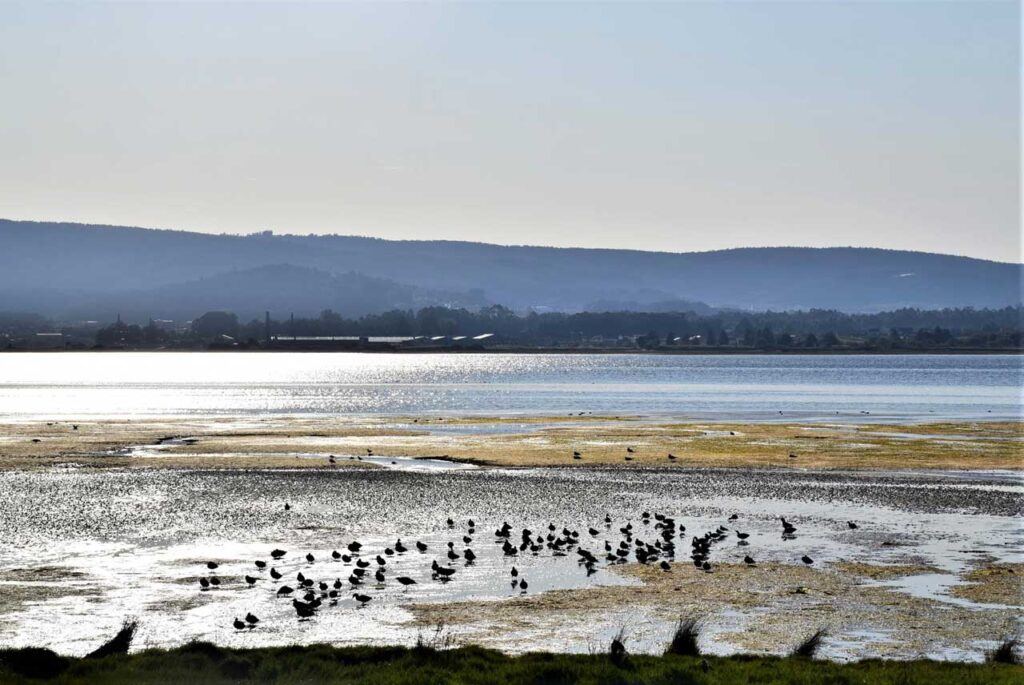
Millions of waterfowl choose this place as one of the main wintering areas on the west coast of the peninsula. The number of wintering waterfowl rises to fifteen thousand, including an average of almost four thousand anatidae and ten thousand waders. The colonies of Grey Plover (Pluvialis squatarola), Bar-tailed Godwit (Limosa lapponica), Eurasian Spoonbill (Platalea leuorodia) and Oystercatcher (Haematopus ostralegus) are the highlight.
The SEO considers this to in fact be one of the most important wintering and transit places for waterfowl on the north coast of the Iberian Peninsula.
The isthmus of A Lanzada, besides connecting O Grove with the continent, is the point of union of two ecosystems of rich marine biodiversity. On the one hand, the protected area reaches the Ons archipelago with a large extension of marine waters. The great diversity of sea beds gives it a high ecological value and of great attraction, both for its spectacular submerged landscapes and for its wealth of fauna and flora.
Marine mammals such as the porpoise (Phocoena phocoena), the dolphin (Delphinus delphis) and the bottlenose dolphin (Tursiops truncatus) are commonly seen in this area.
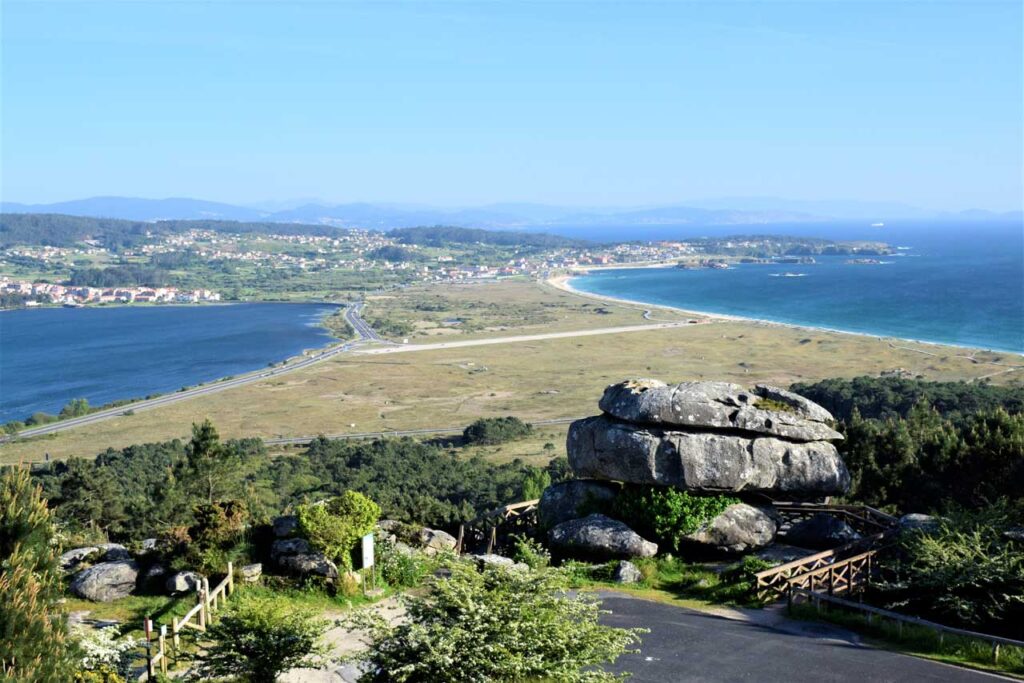
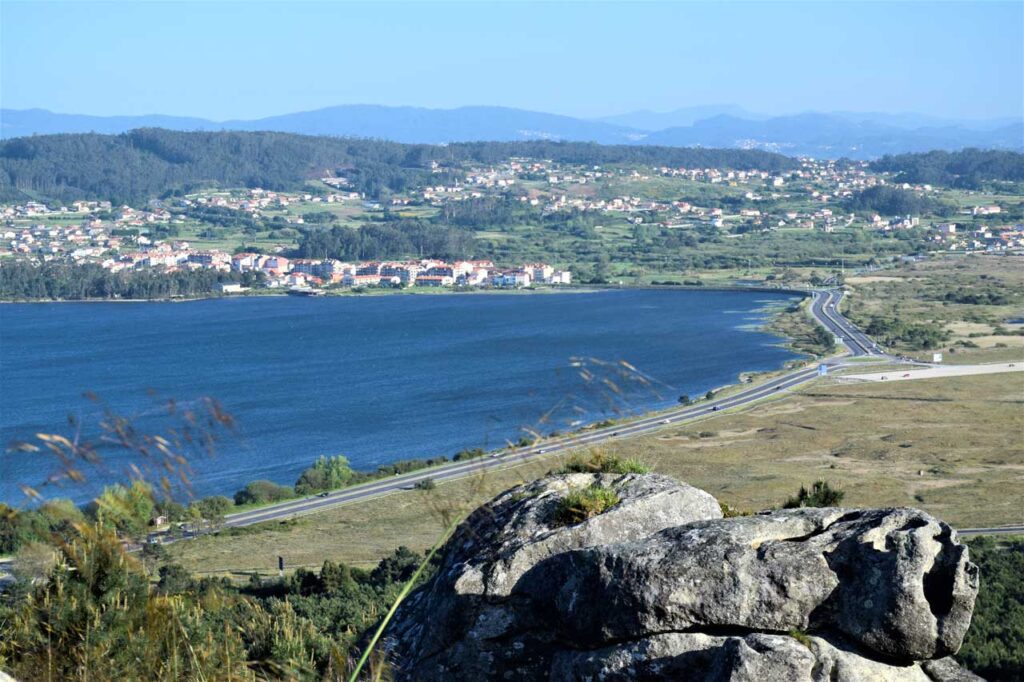
On the inner side, there is a great plain that is covered when the tide rises and exposed at low tide. It is known as the cove of O Vao and is the location of the island of A Toxa and the beaches of O Grove. The sandy and muddy seabed and meadows of marine vegetation, draw attention.
To learn more
A part of this area was declared Special Area for the Protection of Birds (ZEPA) Umia-Grove intertidal complex, La Lanzada, Punta Carreirón and Laguna Bodeira, occupying 2,813 ha. And also with the internationally important wetland status RAMSAR.
While the other part was included in the ZEPA Island of Ons of 924 ha, also including the island of Onza, the waters surrounding the archipelago, as well as the waters surrounding the insular territories, and all the islets in the vicinity. The Ons archipelago also forms part of the Maritime Terrestrial National Park of the Atlantic Islands of Galicia and was recently declared a Marine Protected Area under the OSPAR joint agreement with the rest of the archipelagos of Cíes, Sálvora and Cortegada.
The Ons Island SPA is a place of great interest for bird migration. Numerous ornithological species can be observed such as the European Storm-petrel (Hydrobates pelagicus), the Red-billed Chough (Pyrrhocorax pyrrhocorax), the Tufted Cormorant (Phalacrocorax aristotelis), and the Caspian Gull (Larus cachinnans).
The Bodeira lagoon forms part of the aforementioned areas, but its characteristics deserve a special mention. It is the only freshwater coastal lagoon in the province of Pontevedra and this singularity is an attraction for the ornithological fauna that lives in the surrounding areas.
At the highest point of this area, situated at an altitude of 159 m, lies Mount Siradella, from where you can enjoy the best views of the surroundings. This is also the location of the Nature Interpretation Centre of Monte Siradella, where you can find information about migrating birds, the movement of tides, the bone remains of cetaceans and information about the paths and routes that surround this natural space.
To know it better
The Ons Complex, located in the municipality of O Grove, is located between the Pontevedra estuary and the south of the Arousa estuary. This place, in addition to connecting this town with the continent, is a protected place that contains different islands, rocks, dunes, beaches, lagoons and bays. In short, it is a wonder for human beings to enjoy nature.
Its natural wealth is a paradise and allows thousands of birds to frequent the area. It is therefore of vital importance that humans respect the habitat of the species without disturbing them and without bringing dogs to the area, as they could cause damage to both the animals and the place itself.
The beach of A Lanzada, with a large wooden promenade, is also part of this Ons-O Grove Complex. It is part of the Natura 2000 Network and fights for the conservation of the different species of animals and plants present in the area.
Gallery
Location
- Town
- O Grove
- Municipality
- O Grove
- Province
- Pontevedra
- Country
- Spain
The asset
- Type
- Island
- Eco-destination
- Ría de Arousa
- Environment
- Natural
- Relevance
- National
How to get there
- Access
- By sea
- Distance
- 19,94 km del puerto de O Grove a la isla de Ons
The visit
- Visitable
- Yes
- Interpretation
- Panels and brochures
- Accessible
- No
- Parking
- No
- Signposted
- Yes
Coordinates
- Latitud
- 42.38023100
- Longitud
- -8.93682000