


Tui and Phoenician trade
About this heritage
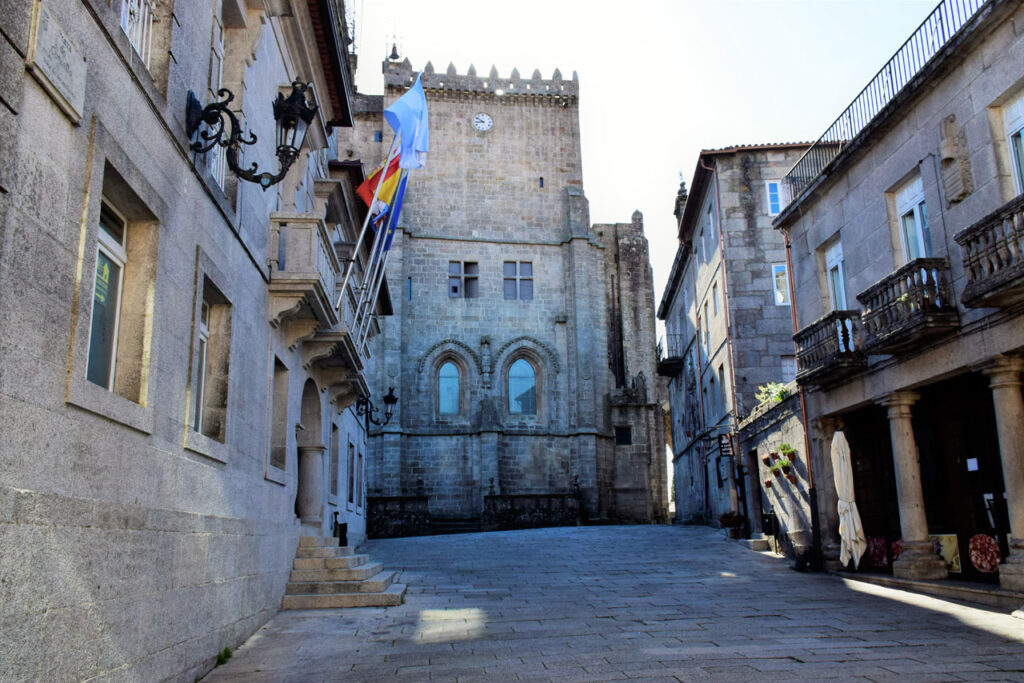
Tui has been declared an historical-artistic site. The fertile valley of the Miño was a welcome for human settlements to inhabit the Tudense territory since ancient times. Remains from the Palaeolithic period (20,000 B.C.) from the Neolithic period (5,000 B.C.) such as the Carrasqueira (Páramos) axe or megalithic monuments (Anta - Areas), are preserved in the fluvial terraces of the Miño and Louro rivers. The introduction of metallurgy (4,000 B.C.) left evidence such as the bronze helmet and the axes of Caldelas, which are displayed in the Diocesan Museum of Tui and the Randufe cave engravings.
There is evidence of the presence of three fortified settlements in Tui: the Arraial castrum (castro), located between San Bartolomeu and Santa Eufemia; the de la Granxa castrum (castro), in Santa Eufemia, and the possible presence of a third, buried under the current historical centre, an hypothesis based mainly on the appropriate topographical conformation for this type of settlement, along with its identification as the Castellum Tyde of Pliny pliniano. In the first two cases, they are configured from a single fortified enclosure based on defensive structures composed of a moat and a parapet, a surface with moderate dimensions of 95 by 80 meters and 150 by 90 meters, respectively.
Galicia is a community with a very important historic trajectory with regards to the mining activity, which dates back to ancient times, and Tui was the heart of alluvial gold mining, since the Phoenician era. According to Pliny, the fact that the Grovii established their most important city here, Castellum Tyde, is sufficient proof of this.
To learn more
The Phoenicians were outstanding navigators and merchants. Their specialisation in certain manufactures enabled them to engage in highly profitable trade with neighbouring kingdoms and overseas. The Phoenicians provided cedar wood, fabrics (including the famous purple ones), carved ivory, furniture made of hard wood, pendants, bowls and jars made of gold and silver, and in general, valuable handcrafts. Besides this, they exchanged silver, lead and tin that they obtained in Spain, wheat and linen from Egypt, balsams and honey from Israel, horses and mules from Anatolia, ivory and slaves from Africa, oil and cereals from Greece.
Metals were their primary target on the Atlantic route. They were the maritime transmitters of the new metal, revolutionary both in war and in the countryside: iron, which was used for the first time in the Hittite country. The Phoenicians also went in search of tin, an indispensable material for making bronze by alloying it with copper, reaching the Cassiterides Islands.
Tin could be found only 30 kilometers off the Galician coast. In addition, the area of the Rías Baixas had a fluvial route, the river Miño, to enter the interior, and the estuaries had extraordinary natural ports to be able to anchor and trade with the indigenous communities. According to Herodotus, the Phoenicians lit bonfires on the beaches and left the goods there to exchange their products. It is difficult to know if this is the case, although Punic and Neopunic ceramics from the 6th to 1st centuries BC have been found on the fossil beaches of O Arenal in Vigo.
Trade between the Phoenicians and the peninsular northwest intensified after the First Punic War (264-241 B.C.). The loss of some Mediterranean territories and the Roman irruption as a new power, forced the Phoenician merchants to look for other destinations where they could obtain raw materials in exchange for their products. It was in this search that the mercantile routes were established bringing to the northwest an abundant number of materials and objects of Mediterranean origin.
To know it better
Thanks to the different investigations, we have been able to learn that the Tui region was inhabited since way back. The town, which is located in the province of Pontevedra was, up until 1833, one on the seven capitals of the ancient kingdom of Galicia. Furthermore, Tui is located only a few kilometres from our neighbouring country, Portugal. The Miño river, the longest river in Galicia, marks a natural boundary between this town and the Portuguese town of Valença do Minho.
Moreover, as one of its main places of interest, Tui has the Aloya mountain, which was declared a National Park in 1978. Prehistoric and Roman remains can be found there, such as the Alto dos Cubos ancient fortification. It has different hiking routes where you can get an idea of how the dwellings were distributed. The ancient inhabitants that lived here were devoted solely to agriculture, fishing and stockbreeding, although the Phoenicians were great traders. The Phoenecian’s particular production comprised cedar wood, fabric (among others were the famous purple coloured one), carved ivory, hardwood furniture, pendants, gold and silver bowls and jugs. Metals were the fundamental objective of the Atlantic route. Not in vain, iron, which was considered the new revolutionary metal in wars and on the fields, was distributed by sea.
The Phoenician Maritime trade extended even further via land and, initially, prior to currency, was used as barter for the purchase of merchandise. This consisted in the exchange of some products for others.
Gallery
Location
- Town
- Tui
- Municipality
- Tui
- Province
- Pontevedra
- Country
- Spain
The asset
- Type
- City
- Eco-destination
- Río Miño
- Environment
- Urban
- Relevance
- International
How to get there
- Access
- By land
- Distance
- Distancia 0 km
The visit
- Visitable
- Yes
- Accessible
- No
- Parking
- Sí
- Signposted
- Yes
Coordinates
- Latitud
- 42.04607200
- Longitud
- -8.64444800