


A Lanzada Ancient Fortification and Galician context
About this heritage
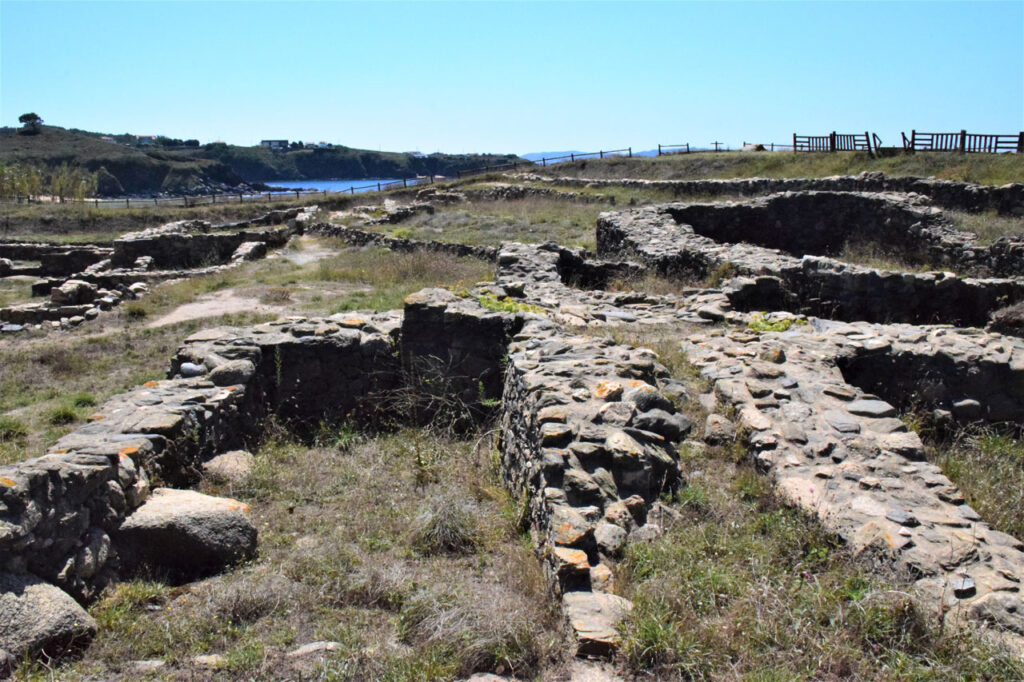
The advantage of the location of the A Lanzada fortification, situated on a rocky ledge between the wide beaches in the municipality of Sanxenxo, is that it overlooks both the access to the Arousa sea inlet and an important strip of the Atlantic outer coast and adjacent islands. This is a unique site on the northwest peninsula within the Iron Age as, although there is indication of circular structures, typical to Galicia, the site was partially converted to a salt fish and sauce plant, in the 3rd century A.C. It was one of the grandest Galician oppida, a trading enclave with the Mediterranean.
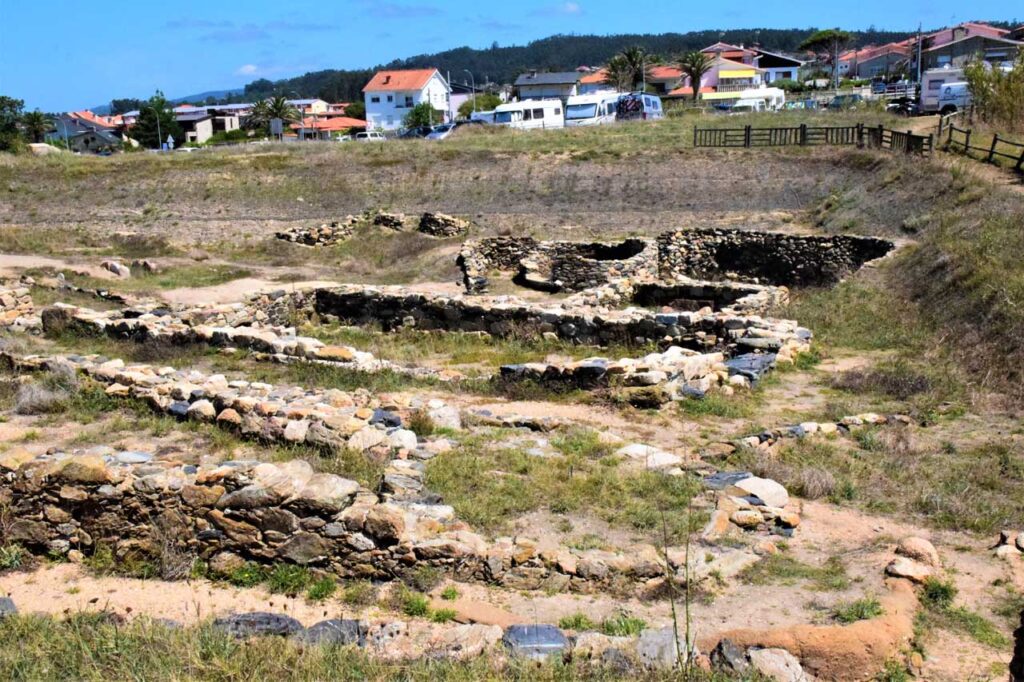
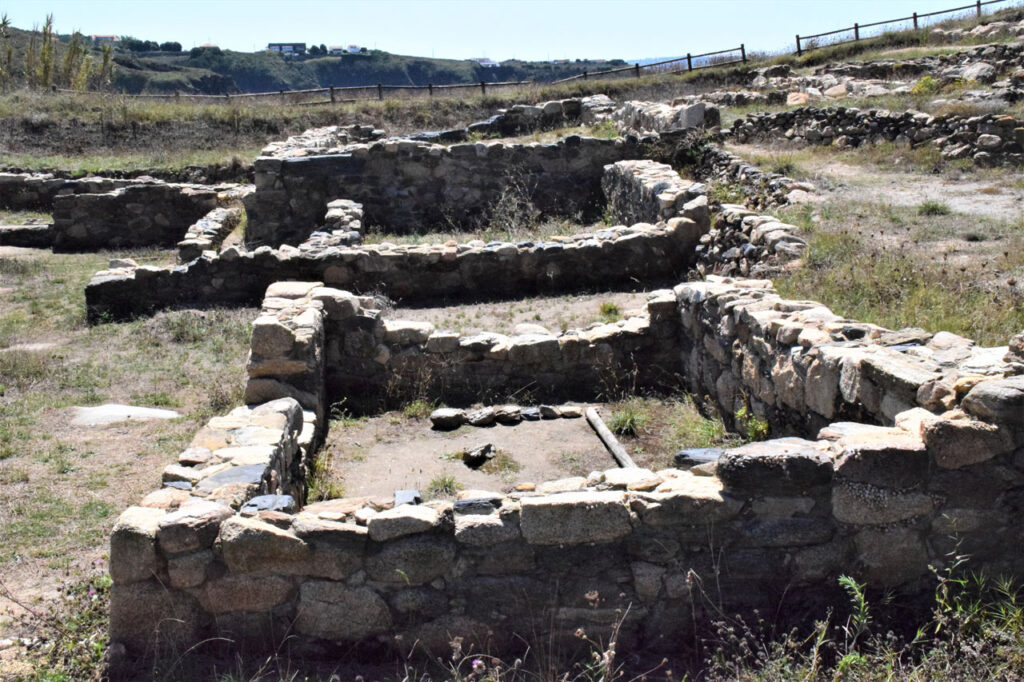
The A Lanzada ancient fortification is unique within the castro settlements, given its lack of defensive elements and its non-location on a hill, but rather at the foot of the beach. This fortification has a pre-Roman salt fish plant. Connected to this plant is an apsidal structure with a surrounding pavement of red clay and an “opus africum” side wall, completely new elements in the Galician architectural tradition and with clear links to the south of the peninsula. Associated to these structures is a perfectly demarked neonatal burial ground, dating back to the first half of the 1st century A.C., which partially reveals a similarity to Punic funerary practices. This necropolis is an exception in the castro culture.
To learn more
The remains of Iberian-Punic amphorae, identical to those discovered in Cerro Macareno (Seville), and others, provisionally associated with different Punic shapes from the 4th century B.C., were also found. Red varnish dishes, similar to those of Castillo de Doña Blanca and Cerro Macareno have been found as well, also in similarity to those of the 4th century B.C., although those found in A Lanzada, are of different substance and craftmanship. This could indicate a local imitation of Mediterranean pottery. These findings show an increase in imports from the Portuguese coast and the south-west coast of Andalusia between the 4th and 3rd centuries B.C. Of particular value are the scent phial and fusiform ceramic unguentarium (kept in the museum of Pontevedra), as we are looking at two objects, foreign to the castro tradition.
The communities that the Phoenicians found when they arrived in the northwest at the end of the 5th century. A.C. were in the process of change. Precisely this period marks the change between the First and Second Iron Age in the area. Until then, the northwest had been characterised by considerable cultural homogeneity: predominantly small fortifications (castros), with little monumental architecture of circular shape and fortifications with a predominance of terraces, ditches and embankments. The occupation of the territory was not very dense, and the settlements were located in elevated locations. From the end of the 5th century BC onwards, many of these settlements were abandoned and the number of settlements at the valley bed multiplied, with complex defense mechanisms and, at least on the coast, they were characterised by a monumental stone structure and a very dense occupation, although they remained small (2 hectares) at least until the 2nd century BC.
In contrast to the south of the peninsula, the northwest was in no way "Mediterranean". The Punics maintained trade relations, but without establishing colonies or permanent settlements. The closest thing to a permanent settlement were the worship spaces identified in Punta do Muiño do Vento and the island of Toralla (Vigo). However, there is evidence of influence in some Castro's settlements of the southern coast, where metallurgies and elements of religious culture were adopted due to possible ideological transfer through the Punic places of worship in the town.
The first emporiums with Punic presence were established in familiar places for the merchants coming from the south. These landscapes are similar to the Punic Mediterranean world and the area of the Strait of Gibraltar: islands close to the coast, capes flanking inlets, good natural harbours and river mouths that act as gateways to the interior. A first feature of this first Punic trade is its concentration on the coast. Apparently, the Emporiums monopolised the vast majority of imports and acted as intermediaries between inland metal producers and merchants on the coast, following the classical model that seems to be found in different parts of European protohistoric geography. The involvement of the Galicians in the Second Punic War as soldiers in the service of Carthage demonstrates that the interactions between the communities of the northwest and the Punic navigators had created close ties.
From the second half of the 2nd century B.C. and most strongly from the year 125 B.C. was when the exchange with the Mediterranean world reappears vigorously, as evidenced by the appearance of a large number of remains in numerous locations. It was in this late Punic period that the oppida appeared, large castros that became an asset to trade and particularly encouraged the importation of large amphorae, the contents of which were used for banquets sponsored by the large elites leading the oppida.
Wine plays a key role in the political economy of the oppida and undoubtedly acted as a boost for trade from the second century BC. Wine was one of the products traded by the Phoenicians, who planted vineyards in all their colonies and around their factories in North Africa, including Carthage, which later inherited all Phoenician power, as in the Iberian Peninsula, France and Italy.
To know it better
The A Lanzada ancient fortification is located in Noalla (Sanxenxo), not very far from the sea, and dates back to the 7th century B.C. The ruins of a medieval fortress, known as the Lanzada Tower, can be seen here. At the opposite end is the chapel of Nuestra Señora de A Lanzada, which was built on part of the ruins of the ancient fortification.
This is a singular site within the Iron Age. Although circular structures existed, and part of the materials were produced by the inhabitants, this was partially transformed into a salting factory.
Moreover, this strategic region contributed to increasing commerce, given that products arrived from different parts of the Mediterranean, materials from Egypt, Turkey and Tunisia. From A Lanzada, these were distributed to other settlements of the Galician Rias Baixas.
Gallery
Location
- Town
- La Lanzada
- Municipality
- O Grove
- Province
- Pontevedra
- Country
- Spain
The asset
- Type
- Castro
- Eco-destination
- Ría de Arousa
- Environment
- Natural
- Relevance
- International
How to get there
- Access
- By sea By land
- Distance
- Distancia: 9,1 KM / 13 minutos en coche
The visit
- Visitable
- Yes
- Interpretation
- Yes
- Accessible
- Sí
- Parking
- Sí
- Signposted
- Yes
Coordinates
- Latitud
- 42.42914800
- Longitud
- -8.87494400