


O Castro Site
About this heritage
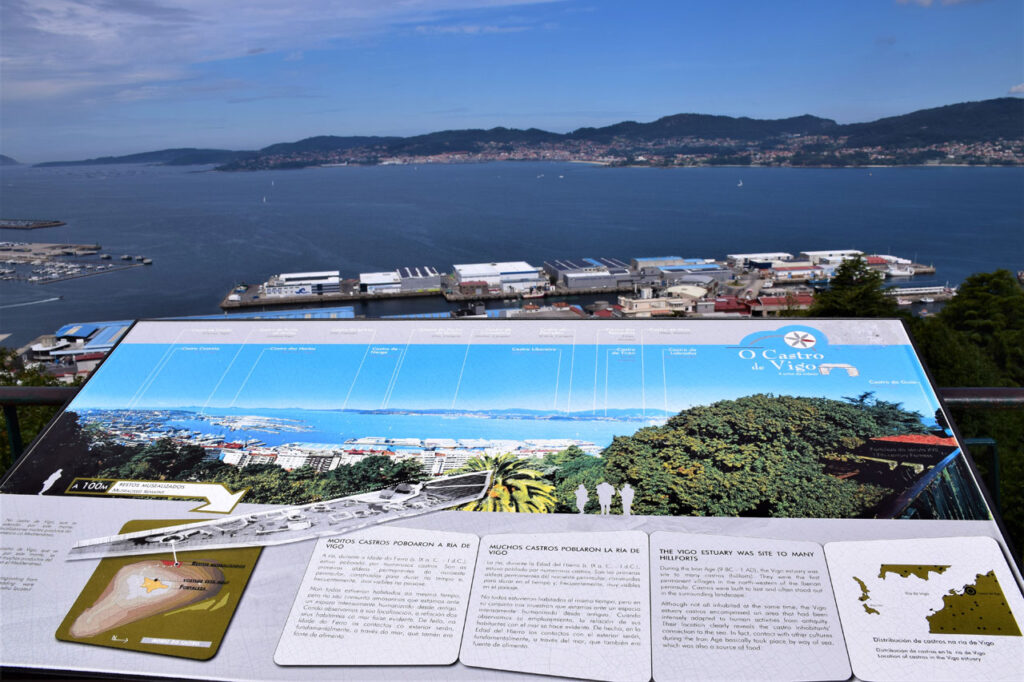
The O Castro site is part of a large Iron Age fortification that occupied the entire mountain of O Castro. According to archaeological data, it was inhabited between the 3rd century B.C. and the 3rd century A.D., when its inhabitants moved to the coastal area of present-day Vigo. It was one of the first places to be occupied in the city.
O Castro de Vigo was an extensive and highly populated fortification. As in other fortifications, its inhabitants’ subsistence was based on agriculture, livestock, harvesting, fishing and shell fishing., It was possibly an oppida, a large settlement that would be a social, economic and political centre.
The site presents archaeological remains, as well as a recreation with several dwellings set in the first century A.D., its moment of highest splendour.
To learn more
The Phoenicians were polytheists and each city had its own pantheon, with the omnipresence of female deities such as Astarte or Tanit, who embodied the principles of fertility and prosperity, well established in Mediterranean culture through the figure of the Great Mother Goddess. The interchangeable character of the goddesses also extends to the names of the masculine gods such as Baal (in masculine) and Baalat (in feminine), which also means "lord" and "lord", respectively. Baal is revered as the god of mountains and high places, storms, springs and rivers.
When the Phoenicians chose a promontory, a peninsula or an island to locate the port and the zone of commercial trade, they consulted the oracle, building a temple in the zone to sanctify it. This was necessary to carry out the relevant oaths in any commercial exchange and to be able to carry out rituals and offerings to ask for protection along the journeys. These also served as a neutral space for transactions.
The alphabet is the most important cultural contribution of the Phoenicians. The excavations at Ra's Samra have revealed the existence of an alphabet that used cuneiform signs, of Mesopotamian origin, to write in Semitic language, a direct and immediate precedent of the Phoenician of the classical period. The inscription of King Ahiram of Byblos shows that in the 13th century B.C., Phoenician writing had already reached its almost definitive form and in the first centuries of the first millennium there are several evidences of inscriptions with the complete system of 22 symbols. This alphabet was later adopted by the Greeks, with adjustments, and from these it passed to the Romans.
To know it better
The O Castro mountain in Vigo (Pontevedra) is one of the principal green areas of the city, with approximately 300,000 inhabitants. Different species of trees and plants can be explored here, as well as taking a walk through the ancient castle of Santa Maria de Castro. Furthermore, the archaeological site of O Castro is located where the city of Vigo settled, between the 2nd century B.C., and the 2rd century A.D.
Thanks to the reconstruction of three castra edifices of one of the most extensive villages of Galicia, we can imagine how its inhabitants lived 2,000 years ago. The castro culture merged with the Roman culture, creating what is known as the Galician-Roman culture. These were generally circular constructions, and their roofs were made from branches, mud and twigs.
Gallery
Location
- Town
- Vigo
- Municipality
- Vigo
- Province
- Pontevedra
- Country
- Spain
The asset
- Type
- Site
- Eco-destination
- Ría de Vigo
- Environment
- Urban
- Relevance
- International
How to get there
- Access
- By sea By land
- Distance
- 3,2 km / 8 minutos en coche
The visit
- Schedule
- Abierto festivos: Sí / Horarios: Visita libre
- Visitable
- Yes
- Interpretation
- Yes
- Accessible
- No
- Parking
- Sí
- Signposted
- Yes
Coordinates
- Latitud
- 42.22994400
- Longitud
- -8.72603000