


Roman Port and Ships. Mouros Market
About this heritage
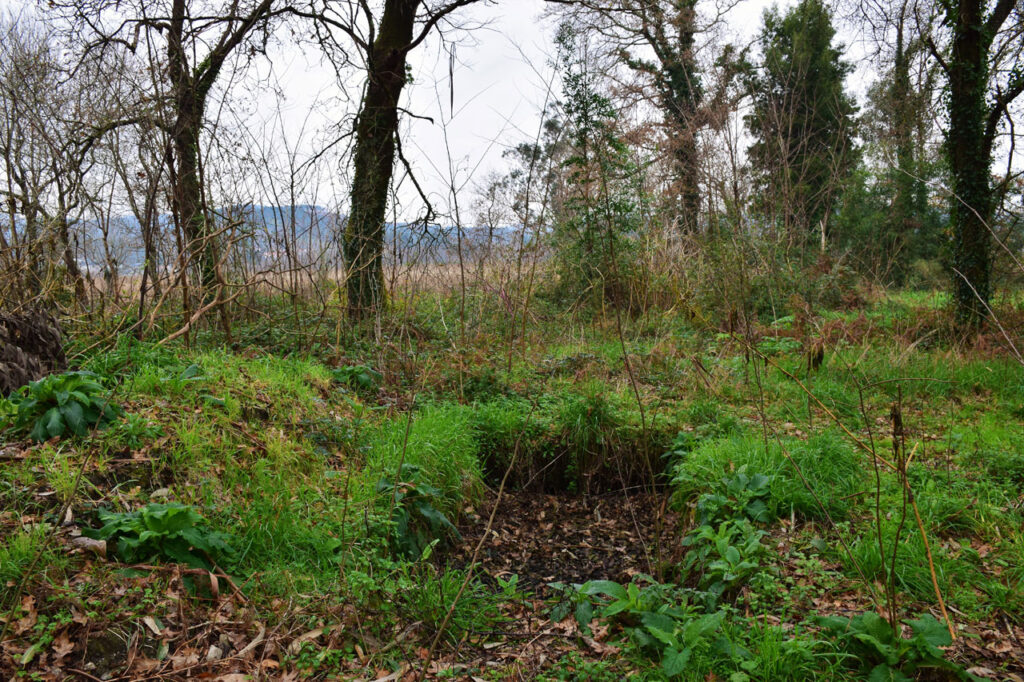
The Roman port´s settlement, also known as the “Mercado dos Mouros” (Mouros Market), is a recent discovery that denotes the commercial activity of the area since ancient times.
This first excavations of this recent discovery were directed by the archaeologist David Fernández. He realized the wealth and richness of the encounter since the fragments of pottery and tiles could be seen almost at first sight.
Finally, in subsequent interventions, they have brought to light more than 5.000 pieces of historical value that confirms the commercial nature of this site.
The settlement is located on the Ulla banks, in Laxes, and it is about 11.500 m2, it has an oval shape and is above the surrounding land.
The period of occupation is longer than originally thought. The Mouros market was active before the 4th century B.C. and up to the 4th century A.C. The appearance of a housing trench made of perishable materials and materials from the 4th century B.C, is what takes the settlement to an even earlier period, the Ancient Bronze Age.
Among the pieces that have been found are a necklace´s bronze elements, decorated ceramics, amphorae, irons, and many imported materials, such as Punic ceramics, which confirms that, in antiquity, the site was closely linked to trade. Furthermore, the encounter of a straight wall with materials associated with the Roman period ratifies the extension of the settlement, until that historical moment.
As has been noted, the final stretch of the Ulla has been used by river boats since ancient times. Legend has it that the Apostle James entered the Arousa estuary and went up the river Ulla until he reached Padrón, in Iria Flavia´s Fluvial Port, in the Roman city. They would arrive in a stone boat that was possibly an old coastal vessel used to transport mineral rocks.
The most contemporary boats have a rectangular shape and were used to reach the fisheries or lampreys and for fishing. Although their uses were also multiplying because they were also used by loggers as cargo boats, but also for the passage of people and livestock.
In Carcacía (Padrón) these boats sailed with four oars and could carry up to three tons. In Sarandon (Vedra), the passage of three pairs of oxen with their chariots to bard from one of these boats remains in memory.
To learn more
The Roman settlement on Ulla river´s banks occupies an area of about 11.500 km2, it has an oval shape and is above the surrounding land.
First excavations were carried out by the archaeologist David Fernández Abella and consisted of a simple superficial investigation where fragments of pottery and tiles from the Roman era dated between the 2nd century B.C and 5th century A.C were found.
In one of the surveys, a possible warehouse was also found, and in another, a negative trace of a hut. The storage ceramics are consistent with those found in other Galician coastal settlements, such as Halltern 70, Campaniensis and Dressel I. This archaeological site would be coetaneous with the existing archaeological sites in Galicia such as A Lanzada.
In the archaeological interventions of 2016, researches unearthed more than 5.000 pieces of interest. Among them are bronze elements such as necklace, decorated pottery, amphoras and irons. Many of them are Punic imports, which would confirm the commercial nature of the village. With this latest research, the settlement would be three centuries older than expected.
The Ulla river is part of the Natura Network 2000, it has 1.633 hectares that cover an important hydrographic network around the Ulla river. It has been declared a Special Conservation Area (ZEC). The Ulla – Deza river system runs through the municipalities of Touro, Boqueixón, Vedra, Teo, Ames, Brión, Rois, Padrón, Dodro and Rianxo in the province of A Coruña, and the municipalities of Catoira, A Estrada, Pontecesures, Silleda, Valga and Vila de Cruces in the province of Pontevedra.
To know it better
On the Ulla river´s banks, in a Valga´s corner, archaeologists have just discovered an old commercial port from the 2nd century B.C. and 5th century A.C. from the Roman period. This site, known as “Mouro market” or “Agra de Xaz”, occupies 11.500 square metres, and in its first excavations, fragments of pottery and tiles have been found. For this reason, it will be included in the Spanish protected heritage, known as “Site of Archaeological Interest”.
In the past, this port would have been of great importance, as it was where ceramic goods were moved. Like that, it has been ratified through the various investigations.
Valga is a municipality that belongs to the province of Pontevedra with less than seven thousand inhabitants. Its territory borders the municipalities of Dodro and Pontecesures to the north, and Catoira and Caldas de Reis to south.
Gallery
Location
- Town
- Valga
- Municipality
- Valga
- Province
- Pontevedra
- Country
- Spain
The asset
- Type
- Port
- Eco-destination
- Ría de Arousa
- Environment
- Rural
- Relevance
- Regional
How to get there
- Access
- By sea By land
- Distance
- 0 km
The visit
- Accessible
- No
- Parking
- No
Coordinates
- Latitud
- 42.70564000
- Longitud
- -8.70598900