


The Traditional Galician Granary of Araño (Hórreo of Araño)
About this heritage
The traditional Galician granary (hórreo) is a specific construction of this autonomous community, used for agriculture and intended to dry and store corn and other cereals before threshing and grinding. It met an essential task since it was the most reliable method to keep the grain from humidity and animals, such as birds, insects, and rodents that could devour and spoil it. Nowadays, some of these structures are still in use for the preservation and storage of potatoes, onions, and garlic.
The traditional granary (hórreo) is composed of an oblong storage chamber, narrow and permeable to the passage of air. It has a separation from the floor to avoid the entrance of humidity and animals.
In Galicia, there are three basic types of granaries (hórreos): the Galician type, also called "Galician-Portuguese," made of chestnut wood, stone, or both; the Asturian type; and the “hórreo de varas.” The latter, less elaborated and made of plant materials, was small, lightweight, and sometimes portable. In 2004, there were an estimated 30,000 traditional Galician granaries (hórreos).
Customarily, they have a rectangular floor plan, although there can be square, round, L-shaped, and there is even an octagonal one in Fonsagrada in the province of Lugo. However, the most predominant form is still the rectangular one, varying in length.
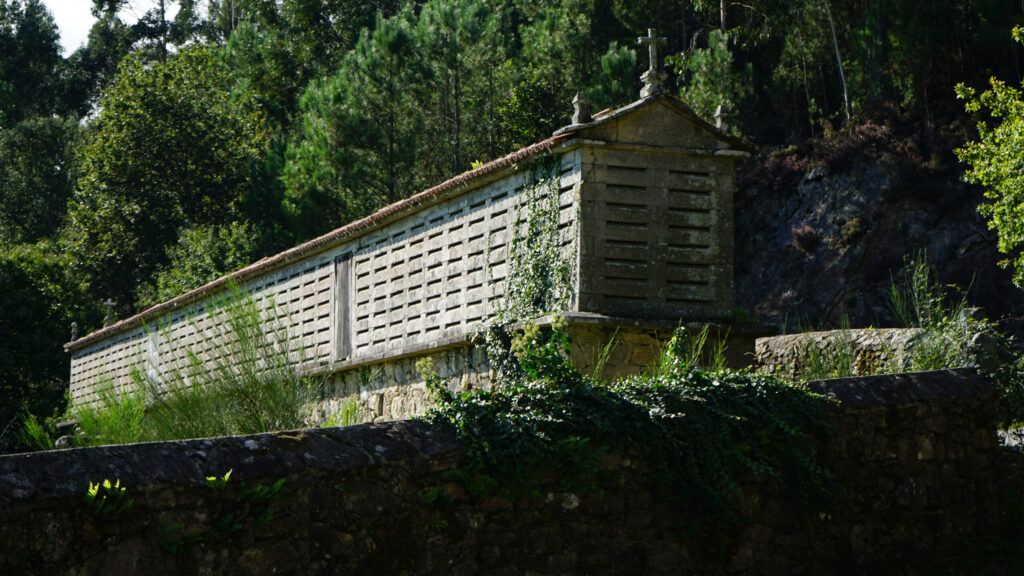
The longest one in Galicia is the Araño granary (hórreo), located inside a property closed by a stone wall of the rectory and built in the mid-17th century, constituting a sample of the economic power that the Galician rural clergy had reached at that time.
This stone granary (hórreo) has a gabled roof and dimensions on average of 37.05 meters long, 2.40 meters wide, and 2.70 meters high. It has pinnacles with a central cross and two small pyramidal figures on the sides. The two doors in its longitudinal part face the church of Santa Baia. Currently, it only has one access staircase.
The construction rests on a continuous stone base, with slabs (tornaratos) as capitals standing out at the top of this base. It serves to protect against rodents from entering during the harvest - mice can climb vertically but never upside down; thus, when they reach the slabs (tornaratos), they fall before coming into the granary (hórreo).
The ones of greater capacity used to be near rectorial houses and churches since part of the gross product of the crops, the tithe, the tenth part, was what the faithful gave to the church as a contribution.
To learn more
The origin of the term hórreo comes from the Latin horreum since already in ancient Rome were used as storage for food-produce, mainly wheat, including fruits. They built the first traditional granaries (hórreos) on the banks of the Tiber River.
The first graphic representation of one dates back to the second half of the 13th century, between 1270 and 1282, found in the Cantigas de Santa María, attributed to Alfonso X the Wise.
Galicia is a land of granaries (hórreos). Primitively, these Galician aerial granaries were in direct relation to the cultivation of millet, a cereal with small seeds; cultivation already practiced in the Castilian culture, and its tillage lasted through the middle Ages. Later, they replaced this cereal with corn upon its arrival in Europe in the 17th century.
At that time, the primary food of the people was bread. The introduction of corn increased the production of this bread cereal, improving the living conditions of the villagers and the rents of the land. Mainly they paid in the form of tithes through payments-in-kind to secular lords, many of them rural hidalgos who were intermediaries of ecclesiastical lords in the collection of the rents. The large granaries (hórreos) were always near the churches and rectory houses. In 1973, the Spanish State approved a decree of protection for all the existing traditional granaries (hórreos) in Galicia and Asturias, trying to stop the consequences of abandoning the rural lifestyle and the loss of granaries use.
The granary (hórreo) of Araño is in Traba, a place in the parish of Santa Baia de Araño in the municipality of Rianxo, province of A Coruña. It is the longest traditional granary (hórreo) in Galicia with 37.05 meters in length and the largest total capacity with about 170 cubic meters distributed between the chamber with 109.31 cubic meters and the granary with 59.09 cubic meters.
These data offer a sample of the real power of the church in the 17th century in Galicia. The difference between this granary (hórreo) and the others is its lack of feet since the entire structure lies on a chamber 36.75 meters long.
The inhabitants of the area stored in it the harvest and had to give part of it to the clergy. Its distinctive design determined that neither humidity nor mice could spoil the grain stored inside. Because of the high length of the winters and the non-stop rain, they had to harvest much early, which meant having a storage place able to dry and preserve the crops to serve as a food throughout the year.
The granary (hórreo) of Araño is part of a significant architectural complex: the Santa Baia Church, the small chapel dedicated to Our Lady of the Miracles of Araño. Outside the enclosure, there is also an old dovecote and the rector's house.
Rianxo has three of the longest granaries (hórreos) in existence. Besides the Araño one, it is worth mentioning the Rianxiño one with its 24.90 meters in length, and the Isorna's Rectory one with 24.50 meters in length. A point of interest worth seeing in the natural route "Sierra de O Barbanza."
To know it better
Rianxo in the Barbanza region is a municipality that borders with the mouth of the Ulla River, forming a natural division between the Coruña and Pontevedra provinces. Its name is always associated with her famous song La Rianxeira and the Virgin of Guadalupe, its patron saint.
Its territory comprises six parishes: O Araño, Asados, Isorna, Leiro, Rianxo, and Taragoña. In 1821, the region had three town halls: Rianxo, Taragoña, and Asados. However, by 1836, with the territorial reorganization, only Rianxo remained.
In the parish of Araño stands out a significant architectural complex: the Santa Baia Church, the small chapel dedicated to Our Lady of the Miracles of Araño and, next to it, the longest traditional granary (hórreo) of Galicia.
The Hórreo of Araño dates back to the 17th century. Like many others, its function is to store food, such as wheat, corn, or rye, and hence, serving as a pantry.
The materials used for its construction were mainly stone for its structure and tile for its roof; its stone base does not have legs to support it, unlike other granaries (hórreos) in the Galician community.
The most outstanding characteristic of the "Hórreo de Araño" is its size, making it the longest in Galicia, with 37.05 meters long, 2.40 meters wide, and 2.70 meters high. It has two doors, but only one of them preserves the staircase to it. Further, its façade features a small cross and two figures that make it even more special.
Location
- Town
- Rianxo
- Municipality
- Rianxo
- Province
- A Coruña
- Country
- Spain
The asset
- Type
- Hórreo
- Eco-destination
- Ría de Arousa
- Environment
- Natural
- Relevance
- Regional
How to get there
- Access
- By land
- Distance
- 8,2 km
The visit
- Visitable
- No
- Accessible
- No
- Parking
- No
- Signposted
- Yes
Coordinates
- Latitud
- 42.69427073
- Longitud
- -8.80112254