


Marín. Lourizán Gardens. Camellias
About this heritage
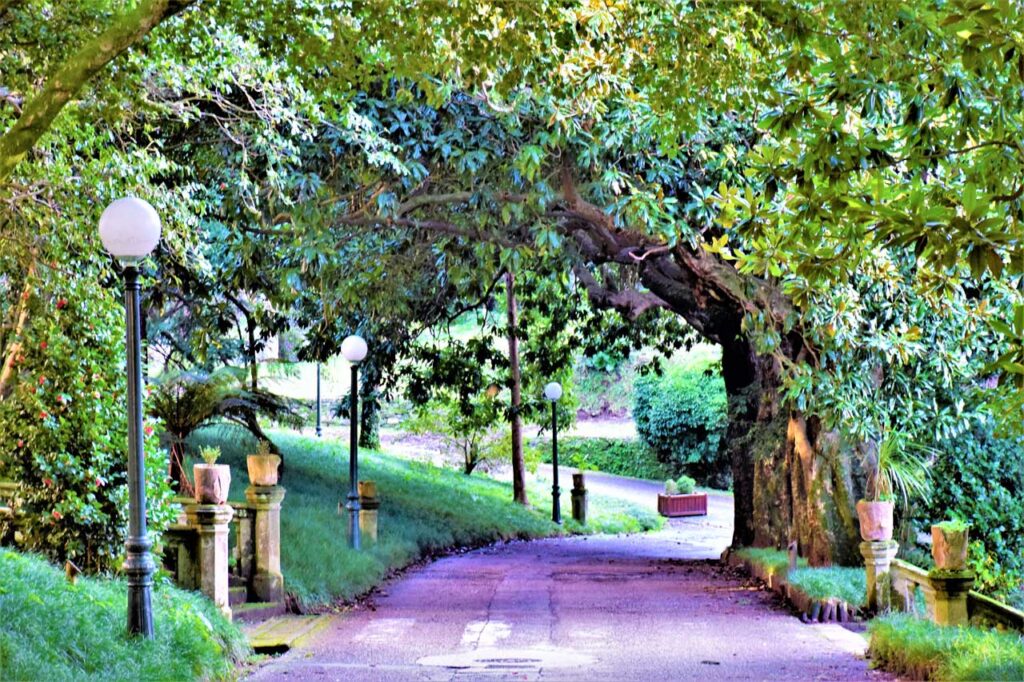
The gardens of the Lourizán Lordly House (Pazo) cover fifty-four hectares. Inside, besides the garden, there is room for an orchard and a grove. However, the significant place is its botanical garden, in which visitors can see both exotic and endemic species. It was created in 1949 under the name of Arboretum.
The garden is of double importance, on the one hand, it is essential at a natural, landscape, and cultural level since its trees are included in the "Galician Catalogue of Unique Trees," with specific interest because of their exceptional and social value. For instance, it has the dawn redwood (Metasequoia glyptotroboides) and the formation of Japanese and Chinese chestnut trees, and without diminishing the significance of other species, such as the Dutch Elm, the Queen Palms, or the Avenue of the Magnolias.
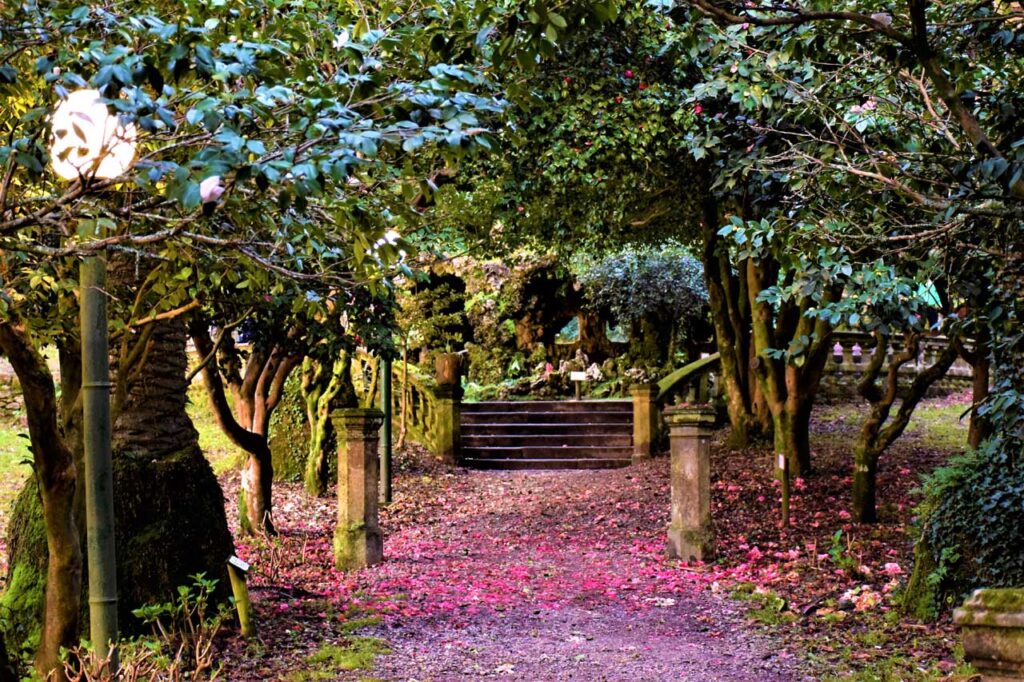
There are more than 2500 varieties of camellias, and in this garden, one can find more than 800 types.
The first camellias in Europe had come to Portugal in the 18th century before they got to England. They spread from Portugal throughout the entire peninsula, specifically, Galicia, where they have been present since the early 1800s.
It is a shrub or small tree, perennial, with many slow-growing branches, of between five and ten meters high. The flowers are of variable size of between three and ten centimeters. Their color changes from the purest white to the most intense red, through all shades of pinks and reds.
The genus is endemic of East Asia, and ninety percent of the currently known species come from China.
To learn more
The park is between the Pontevedra and Marín Towns. The origins of the Lordly House (Pazo) date back to the 15th century when it was still a farm. The politician Montero Ríos acquired the property in the 19th century to make it his summer residence and to use it as a meeting point for the most influential personalities of the time. As a historical curiosity, in its halls, representatives of Spain and the United States negotiated the Treaty of Paris, by which they agreed on the new status of the islands of Cuba, Puerto Rico, the Philippines, and Guam.
The garden is of romantic style and in it are several historical fountains, such as the shell fountain, the lathes fountain, and the mirrors fountain or grotto characterized for being ornamented by colored glasses.
Currently, this space is public and holds the Lourizán Forest Research Center.
It is believed that the Lourizán ancient specimens of camellia originated in the neighboring country, and in the 19th century, belonged to the Portuguese Horticultural Establishment of Jose Marques Loureiro. In 1993, coinciding with the First Spanish-Lourizán Forestry Congress, the Park of the Autonomies (Parque de las Autonomías) was created with samples of the most representative tree species of each one of them.
There is a garden circuit linked to the Camellia's culture because of its significance in Galicia and the collaboration between Turgalicia and the Spanish Camellia Society. Following this circuit, one can discover unforgettable sites, authentic botanical gardens.
To know it better
The Lourizán Lordly House is between the Pontevedra and Marín Counties. This property served as a farm during the 15th century. Later, in the 19th century, when Montero Ríos acquired this House, it became his home and a gathering-space for influential people, such as politicians. In fact, in one of its chambers, they could have dealt with significant deals, such as the Treaty of Paris.
This Lordly House (Pazo), which is currently owned by the Pontevedra City Hall, has become the Forest Research Center in Lourizán. It has fifty-four hectares of garden, land, and numerous trees.
The house is of modernist style, from the beginning of the 19th century, designed by Genaro de la Fuente. The romantic style garden has several historical fountains: the lathes fountain (la Fuente dos Tornos) from the 17th century, the shell fountain (la Fuente da Cuncha) from the 18th century, and the mirrors fountain (la Fuente de Los Espejos) from the 19th century. Besides, the garden has exotic and endemic species, such as camellias. The camellias are shrubs between two and four meters high that produce bright and elegant flowers. These can have several colors, white, pink, red, and yellow, among others, and their leaves are always green and shiny. Besides, it is one of the shrubs decorating the gardens throughout the year.
Gallery
Location
- Town
- Lourizán
- Municipality
- Marín
- Province
- Pontevedra
- Country
- Spain
The asset
- Type
- Garden
- Eco-destination
- Ría de Pontevedra
- Environment
- Rural
- Relevance
- International
How to get there
- Access
- By sea By land
- Distance
- 3,600 km
The visit
- Visitable
- Yes
- Interpretation
- GUIDED VISITS
- Accessible
- No
- Parking
- Sí
Coordinates
- Latitud
- 42.40948100
- Longitud
- -8.66483700