


Product. Atlantic Mackerel
About this heritage
The Atlantic Mackerel is one of the most fished in the Atlantic Ocean since ancient times. It is one of the most popular species in the Atlantic region, being very common also in the Mediterranean. Even though in winter moves in large groups to deeper waters, it usually inhabits mid-waters.
It is an oily fish of saltwater rich in omega-3 acids and of high nutritional value and is considered an economic product. Its lifespan is short; thus, it accumulates little mercury. If one takes into account that it is advisable to eat oily fish twice a week, mackerel is a good option.
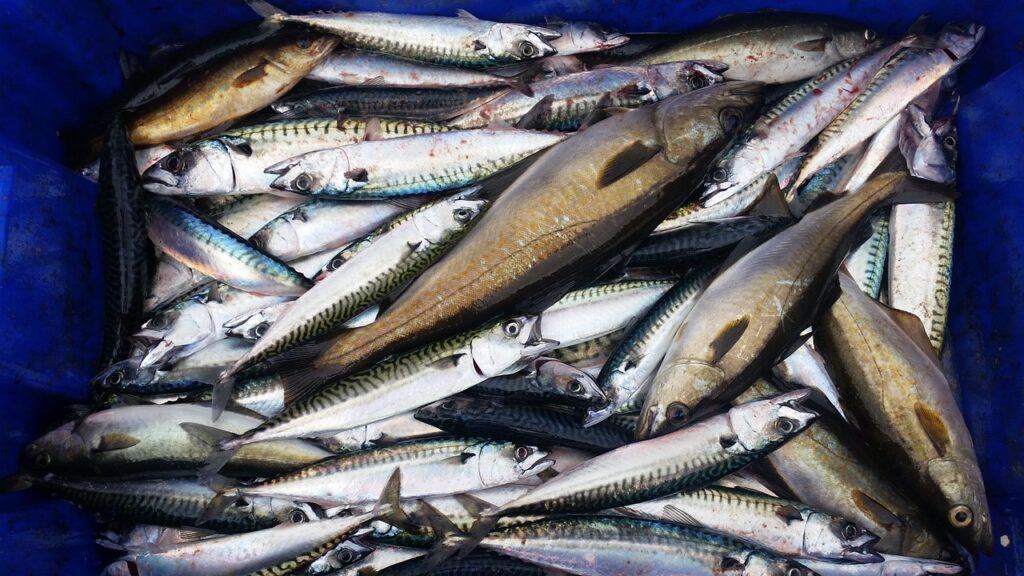
It has an elongated body with a sharp head; it is bluish-green with black vertical lines and a silvery belly with white tones. It can measure up to 50 centimeters, reaching maturity at two or three years, and it reproduces during the months of May to July.
When young, they are omnivorous and feeds on organic detritus, which are residues, generally permanent solids coming from the organic plant and animal matter decomposition. As adult specimens, they become predatory fish and feed on crustaceans, mollusks, sardines, and herring.
Mackerel is a species of great presence in the markets; thus, found in different fish markets, such as authorized first sale centers. It is usually caught during the first quarter of the year when it approaches the coast.
To learn more
The scientific name of the Atlantic mackerel is "Scomber scombrus;" it is also known as "Sarda" or in Galician "Xarda." It can be found at about 250 meters of depth in mid-waters, frequently coming to the surface to hunt. In winter, they go to deeper areas to make long transoceanic migrations.
The female usually lays between 200,000 and 400,000 eggs in shallow waters or at the surface near the coast. The most common sizes range from eighteen to thirty centimeters, although they can reach 50 centimeters. Their average lifespan is approximately nine years. It feeds abundantly on small fish, such as sardines, anchovies, and sprats.
The fishing methods for this species varied, although the most used are purse seine, gillnet, seabed and pelagic trawling, longline, and trolling. It can also be fished with artificial bait. The Greeks and the Romans had already practiced mackerel fishing.
Current legislation prohibits fishing mackerel smaller than 20 cm; the correct way to measure them is from the tip of the head to the end of the caudal fin, commonly known as the tail.
There is a fish similar to the Atlantic mackerel called the chub mackerel or Pacific mackerel (Scomber japonicus). It is a higher migratory species and prefers warmer waters. In its appearance, it is lighter in color on the back and head, has more irregular patterns and larger eyes.
Finally, the Atlantic mackerel meat is excellent and can compete with any other species.
To know it better
The Vigo Estuary is the deepest of the South Estuaries (Rías Baixas) and is 35 kilometers long. It is protected from the ocean by the Cíes Islands, where one can find different treasures, such as the San Simón Island or the sunken galleons loaded with gold from the Americas. Cangas is a county in the Pontevedra province within the Morrazo region and has five parishes: Aldán, Cangas, Coiro, Darbo, and Hío. This county has dedicated to fishing and fish trade for many years due to the diverse fish and seafood species of its coasts.
Known also as Sarda, and in Spanish as "verdel," "verta," or "macarela," the mackerel is an economical oily fish with a protein-laden flesh. This species is found in the salty waters of the Morrazo area.
Gallery
Location
- Town
- Cangas
- Municipality
- Cangas
- Province
- Pontevedra
- Country
- Spain
The asset
- Type
- Fish product
- Eco-destination
- Ría de Vigo
- Environment
- Natural
- Relevance
- Regional
How to get there
- Access
- By sea By land
- Distance
- 0,050 km
The visit
- Accessible
- No
- Parking
- No
Coordinates
- Latitud
- 42.246145
- Longitud
- -8.827009