


Pastime Park
About this heritage
The Pastime Gardens or Pastime Park was built thanks to the generosity of Juan García Naveira, a Betanzos emigrant that made his fortune in Argentina. The park is on the outskirts of Betanzos, and of its initial nine hectares, only one remains.
This peculiar park is one of the so-called encyclopedic or cultural parks since, along its route, one can see numerous representations, from the Pyramid of Cheops to prehistoric caves.
Cement was used for its construction, a novel material at that time. Visitors can find caves (grottos), underground passages (tunnels), ponds, fountains, and polychrome murals dedicated to air transport.
Additionally, one can also see a mural of monarchic Spain and its 18 republican daughters, several clocks set to different time zones, exotic animals, and many more.
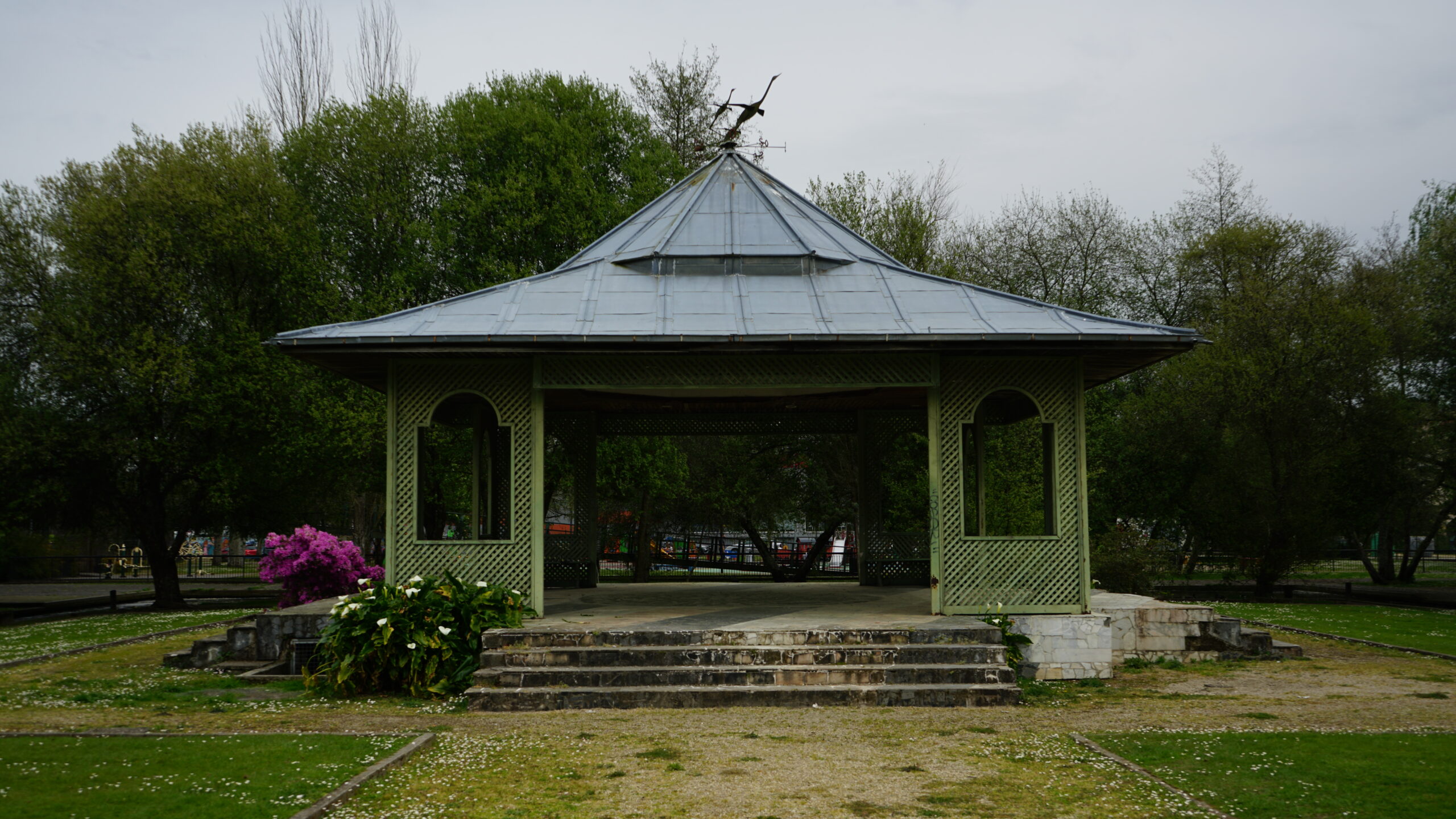
Throughout the tour, one finds streets flanked by gardens and rest areas and, in its surroundings, the Pastime Labyrinth, a pond, a stage or platform, and the Pastime stands.
To learn more
It is a garden in the outskirts of Betanzos, originally had 90,000 square meters, but currently only preserves a tenth. Its construction began at the end of the 19th century by Juan García Naveira, the eldest of the García Naveira brothers.
The Spanish economic, social, and political situation forced the two brothers to immigrate to Argentina, where they worked tirelessly and developed their intellect and skills to become good prosperous people. Their hard work made them economically wealthy, and in 1983, they decided to return to Galicia, specifically to their hometown of Betanzos, where they improved their town's situation through various investments. Until their deaths, they helped by creating social buildings and generating jobs to combat unemployment.
The garden has the objective of reflecting and/or expressing the experiences encounter through the brothers' numerous journeys, and they conceived it as a didactic park. This park's conception makes it a precursor of the theme parks know today.
It is an original space that, where everyone walking through it can find prehistoric caves, prestigious writers statues, such as Dickens or Cervantes, clocks marking the hours of the world's most significant capitals, ponds, exotic animals, mythological elements, relief-sculpted murals, the Chinese Wall, the pyramid of Cheops, or the Panama Canal.
The Pastime Garden started its construction between 1893 and 1895 but officially opened its doors in 1914. The initial garden occupied 90,000 square meters, but over time, it diminished, and today, only a tenth of its size remains. Juan García Naveira conceived, financed, and directed this park, intended to create an extensive educational one, capturing, in this oasis, all the experiences acquired through his time abroad.
The developing team included local artists, workers with no previous education or specialization, and Don Francisco Sanmartín Murias, as their manager. All of them, always with Don Juan overseeing every step. The garden transports visitors to those English romantic gardens of eclectic baroque style. The park integrated architecture, sculpture, ceramics, and gardening by mixing construction and design materials, such as marble, granite, cement, shells, bottles, pebbles, and lots of exotic vegetation.
It has two distinct and well-defined zones, the gardens and the Pastime area.
The garden has an extension of approximately 80,000 square meters, all on the complex flat terrain, which is closest to the town. The Mendo River divides this area, leaving some little houses in the middle.
Two large marble lions presided and protected the entrance, one on a lurking pose and the other sleeping. These felines' reproductions were imitations of those that guarded the mausoleum of Pope Clement XIII; hence, their grandiose size, made by the artist Antonio Canova. These lions are currently at the Covadonga Sanctuary, serving the same purpose.
Straight forward, on the right side, visitors could find the Roman Emperors Avenue, a covered promenade with arches from which many plant species grew, creating a mysterious effect. This promenade had a closing gate on the right side and the busts of twelve Roman emperors on the left, giving the name to this promenade. After this trail, visitors would find themselves in Poplars Avenue, decorated with reproductions of literary personalities, such as Cervantes, Dickens, Dante, or Hilton.
The garden benches had country flags painted on them in consideration to those countries. In the original park, there were several fountains, such as those of Cupid, Neptune, Florentine, Agriculture, and the Four Seasons, as well as large ponds, such as the Popes' pond, which adorned the garden with cement statues of more than a hundred Popes or the Japanese pond with astounding mosaics.
Noteworthy is the myrtle trimmed designs, such as a dining room and a bedroom fully furnished. Likewise, there were significant marble statues as that of the García Naveira Brothers, currently in the Galicia Square, or that of the Roman Charity, a 3-D reproduction of the Roman Charity painting by Gaspar de Crayer, currently in the Prado National Museum.
The Pastime or Encyclopedic-recreational Park covered some 8000 square meters, organized in five levels, taking advantage of the slope and inclination of the mountain. The levels are connected through open-air staircases and tunnels through impressive artificial grottos and had vegetated esplanades with completely open fronts with Chinese viewpoints overlooking the town.
On the first level, the Retirement (Retiro) Pond stood out, occupying 660 square meters, and its five meters of dug depth enhanced it even more. It had an island with an oriental template in the center and two women emptying pitchers under it. It also had a canoe with the silhouettes of two Indian-origin people paddling in it. Mollusk and shells paved half of the vertical walls, while the other half of the walls simulated caves. Nowadays, creative staircases allow us to descend into the pond, and even walk along the water's edge. On the walls and the pond's mezzanine level, high reliefs were representing various events, such as Christians’ deaths in the Roman Circus, the sacrifice of the Indo-American Túpac Amaru, and scenes of its founder's life, as well as his words professing a lifestyle, like Homeland, Liberty, Fraternity, and Legality.
The second level could be accessed through a grotto with stalactites, artificial dock ropes, and full-size representations of a giraffe and an elephant on the walls. Still today, visitors can also observe the Panama Canal, tourists at the pyramids of Egypt, the Wall of China, the first locomotive, and an aerostat balloon. Through the caves network, the largest of the entire park, visitors can reach the third level, which used to be completely landscaped overlooking the town from its viewpoint with a colossal concrete lion that today is half-naked. The fourth and fifth levels were a zoo with all kinds of animals, which was not surprising that the park attracted tourists traveling through Galicia or pilgrims walking to Santiago and stopping in Betanzos to discover its cultural richness.
After the death of Juan García Naveira, the park began its decline since his will did not include any economic provisions for the maintenance of the garden, and it was impossible to self-finance it. Additionally, and because of the Civil War, the park suffered higher deterioration and decay, and, the economic crisis in the 40s caused the massive theft of materials, leaving an endless list of expenses. Later, during the beltway (ring road) construction, the workers torn down the garden's rear wall, leaving all debris and damaging the park further. To this day, many of the busts or sculptures have been stolen or sold, becoming private or public properties as decoration. However, today, the Pastime Park is sufficiently well preserved in its first three levels, which are the most important.
To know it better
The Galician municipality of Betanzos, known as "Betanzos of the Knights" (de Los Caballeros), is in A Coruña in the High Estuaries (Rías Altas), and its urban center lies on a hill extremely close to the Mandeo and Mendo Rivers.
Betanzos was one of the seven provinces forming the ancient Kingdom of Galicia. When civilization settled, its most characteristic feature was its walls, and during the Middle Ages, Betanzos had plenty of commercial traits, principally from the fishing activity.
In the years 1849 and 1853; hence, in the mid-19th century, two brothers native of Betanzos, Juan and Jesús, immigrated to Argentina. There, they found work at a prominent company and managed to increase their fortune, at which point, they decided to return and invested in their hometown, creating free schools, an elderly residence, known as Brothers García, a physical disabilities' center, a public laundry, and the well-known Pastime Park.
The Pastime Park was the brainchild of Juan García, where he tried to capture impressions from all his travels so that people visiting the park could learn about the world's different wonders. Constructions began in 1893 and finished in 1914. It has an older area with extensive baroque-style gardens and a more recent one with ponds, green areas, an open-air auditorium, underground caves, and a children's recreational area.
At the entrance of the original enclosure, there were two lions and benches with painted flags in honor of the corresponding countries. Additionally, it has several fountains, such as those of Cupid, Neptune, the Florentine, Agriculture, and the Four Seasons, and ponds like the Popes Pond with approximately a hundred Popes' statues. Besides these representations, visitors can find two of the most symbolic designs, one reminiscent of Jules Verne's book, “20,000 Leagues under the Sea,” and another of 41 clocks marking different time zones.
Gallery


Location
- Town
- con grandes jardines de estilo barroco y una más reciente formada por estanques, grutas subterráneas y una zona infantil de juegos. En la entrada del recinto original, intentó plasmar ideas de todos los viajes que había realizado para que así, la Agricultura y la de las Cuatro Estaciones, la Florentina, las personas que fueran al parque, Neptuno, pudieran conocer diferentes curiosidades del mundo. El parque se empezó a construir en 1893 y se terminó en el año 1914. Cuenta con una zona más antigua, se encontraban dos leones y bancos dedicados a diferentes países con sus banderas pintadas. Además, también tiene varias fuentes: Cupido, un auditorio al aire libre, un lavadero público y el conocido Parque del Pasatiempo.El Parque del Pasatiempo fue ideado únicamente por Juan García y en él, zonas verdes
- Municipality
- Betanzos
- Province
- A Coruña
- Country
- Spain
The asset
- Type
- Park
- Eco-destination
- Rías de Ares y Betanzos
- Environment
- Urban
- Relevance
- Regional
How to get there
- Access
- By land
- Distance
- 1,400 km
The visit
- Schedule
- From 9:00 a.m. to 9:00 p.m.
- Visitable
- Yes
- Accessible
- No
- Parking
- Sí
- Signposted
- Yes
Coordinates
- Latitud
- 43.27768978868237
- Longitud
- -8.219606402694078