


Dorna Meca
About this heritage
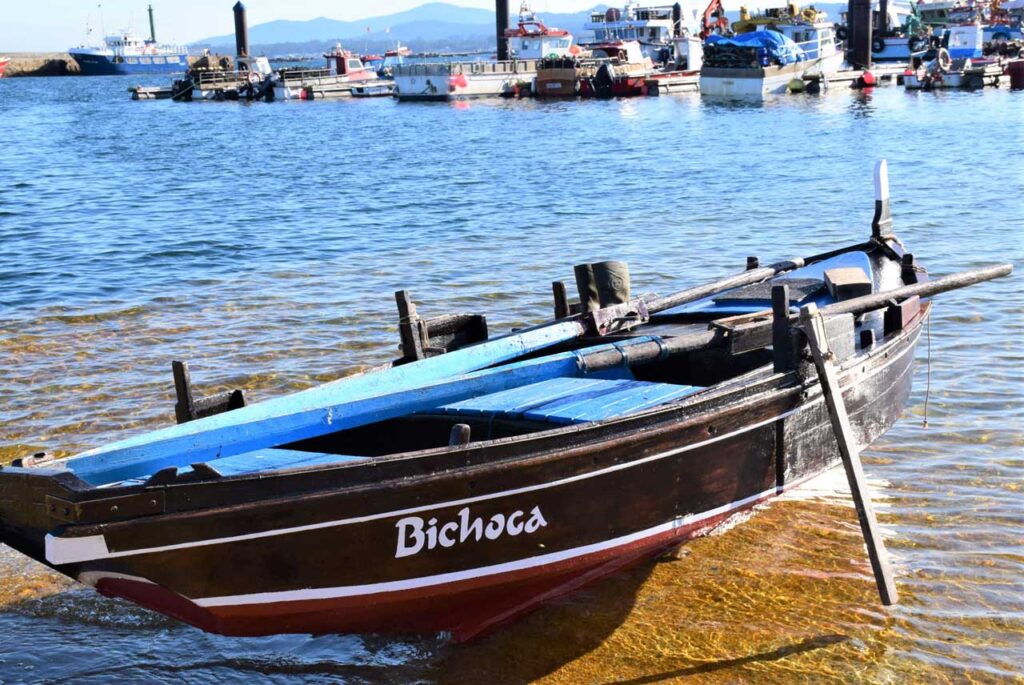
The Dorna Meca is a traditional boat designed and built in O Grove. It is of the same type as the dorna, but the difference is its larger size and the bow with a sharper appearance. These boats were common on this coast until the 1960s when they practically disappeared. They were built with 10 or 12 quarters of keel and up to 18, and historically were crewed by between 3 or 4 men, one of whom was usually a boy. It is a vessel capable of covering long distances and achieving greater speed. During the summer, they went "ao Xeito" and to lobster pots between Fisterra and Cabo Silleiro, making stops of between 7 and 21 days without returning to O Grove. In winter, the dornas mecas worked inside the estuary with rascas and trammels. "O Xeito" is a type of drifting gillnet consisting of a rectangular panel stretched between two trallas, the upper one, which has a flotation system with buoys allowing it to be set at variable depths, and the lower one which is weighted with lead. This type of boat had to exist, but there were no plans of this type of dornas, so the Garrido brothers, helped by former carpenters from Ribeira, old sailors, and old photographs, built the dorna meca in 1995, recovering a heritage legacy of great importance in the maritime culture of the area.
To learn more
The Amigos da Dorna Meca association was founded in 1980 out of the concern and need to recover the maritime culture in the area and to organize sailing dorna regattas again, a tradition that had been lost for 30 years. In 1993, they collaborated with the "Fundación Galega pola Cultura Marítima e Fluvial," a leading organization in the recovery of Galician maritime and river heritage. During 1995, the recovery of the most emblematic traditional boat that gives this association its name was carried out: the dorna meca. Then, in 1997, the II Encuentros de Embarcacións Tradicionais "Galicia 97" was held in O Grove, where other associations driven by the same impulse exhibited their traditional boats according to the region of Galicia. A notable date was in 2000 when the emblematic Dorna Meca made an appearance at the International Maritime Festival of Brest, forming part of the Galician expedition that year. The Dorna is a type of traditional wooden boat built with a clinker construction and is characterized by its navigability both by oars and sail. It is believed to have Viking origins due to its resemblance to the drakar used by the Scandinavians. The remains of these boats, left during invasions attempting to besiege the coast, served as a pattern for shipwrights to create this new boat at the time. There are different variants of this boat depending on the place of construction, as the carpenters of Ribeira optimized the build according to the characteristics of each estuary and the needs of the sailors. Thus, different types of dornas are found such as the Dorna de Tope, a typical variant from the O Barbanza area that has the joints of the hull planks butted together to reduce sea resistance, usually the smallest dornas. The Dorna Polbeira, common in the estuaries and typical of Bueu, used for fishing squid and octopus, a more rounded boat to provide greater stability. The Dorna Tramalleira, adapted for fishing with trammel nets. The Dorna Xeiteira, a large boat with a crew of three to eight people, designed to operate in open sea where fishing is done with "xeito" nets for catching sardines, horse mackerel, and anchovies. And the Dorna Meca, a larger variant typical of the O Grove area, its larger size due to its use in open and rough seas, in areas with strong currents.
To know it better
Besides its landscapes, coasts, and gastronomic fame, the Autonomous Community of Galicia is truly famous for its maritime history. To fish or go out sailing, sailors need strong and sturdy boats. One of the most used boats in Galicia in the 1960s was the Dorna Meca. The Dorna Meca is a type of vessel designed and built in the shipyards of the municipality of O Grove, in the province of Pontevedra, and relied solely on oars and sails for navigation, with a minimum crew of four. Its bow was sloped forward and it had a length of about 7 meters. This type of boat fell out of use. To prevent this part of our maritime culture from being forgotten, from 1980 onwards, a group of people became interested in its recovery by creating the "Asociación Os Amigos da Dorna Meca." One of their main tasks is to carry out repairs on the boats with the help of carpenters and technicians.
Gallery
Location
- Town
- O Grove
- Municipality
- O Grove
- Province
- Pontevedra
- Country
- Spain
The asset
- Type
- Vessel
- Eco-destination
- Ría de Arousa
- Environment
- Urban
- Relevance
- Regional
How to get there
- Access
- By sea
- Distance
- A pié desde el puerto menos de 15 minutos, está en el propio puerto de O Grove
The visit
- Visitable
- Exterior only
- Interpretation
- No
- Accessible
- Sí
- Parking
- Sí
- Website
- dornameca.org/
Coordinates
- Latitud
- 42.49513200
- Longitud
- -8.85930500