


Aldán. Lordly Houses (Pazos) and Parish Church. The Aldán Estuary and its Stories
About this heritage
Aldán belongs to Cangas County, in the Pontevedra province, specifically, located in the northwest part of it. It is a seafaring town, and as such, it has the charm of all Galician coastal towns. It is a highly recommendable destination, where everyone can see the traditional houses and centenary granaries (Hórreos) as a sample and testimony of the rich Galician conventional architecture.
It is bathed by the stunning and often unknown Aldán Estuary, into which the Orxas River flows. Its beaches are of crystalline waters, and its sands are white and soft. Menduiña, Francón, San Cibrán, or Areabrava are waiting for you!
Aldán also has a monumental heritage, such as the Lordly House of the Aldán Tower, a private property integrated into the urban area, and not open for visitations. The facade has a tower with battlements and pinnacles, as well as a coat of arms and a medium-size cropping farm.
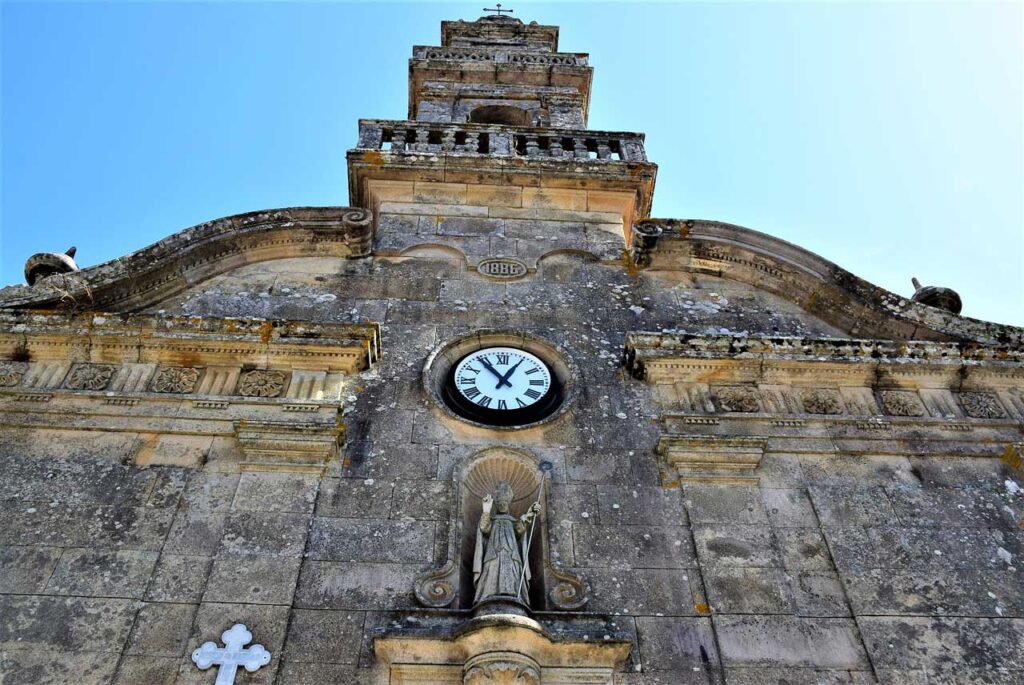
It has a church, the church of San Cibrán, a neoclassical building dated back to 1866 and built in the same place as a sixteenth-century temple. It has a longitudinal plane with granite ashlars walls. The image of parish's patron saint, San Cibrán, presides its facade. It is noteworthy, the large two-section tower with balustrades that houses the bell.
To learn more
It is not easy to find a community with the characteristics of Aldán, a villa with an estuary and protected by Udra Cape and Couso Point. Aldán also surprises with its church of neoclassical influences and its crenelated tower, protruding from the walls that delimit the church's atrium (adrio). Walking along a narrow street, visitors can reach the Lordly House (Pazo) Torre de Aldán, which, as previously mentioned, is not open to the public; however, it is worth seeing even if only from the outside.
Aldán comprises six places, namely San Cibrán, Herbello, Gandón, Menduiña, Piñeiro, and Espiñeira. It also has numerous beaches, namely, from north to south, San Cibrán, Con de Sestadelo, Cova da Balea, Areacova, Francón, Sartaxéns, Menduiña, and Lagoelas. All of them deserve anyone's dedication, and of course, we are referring to their enjoyment.
Besides the beaches, Aldán has other tourist proposals, such as a medieval-origin bridge that crosses the Orxás River, ending up in the Aldán Estuary, and the route of the mills along this river, running from the Sobreira place to the well-known Enchanted Forest. There is also a recreational area, which until the beginning of the 20th century was part of the Aldán Tower-House.
Aldán also has worthy parties and celebrations, such as San Sebastian, San Amaro, Santa Mariña Fair, and the Celebration of Carmen during the last week of July; all considered main festivals. Among all these festivities, on January 20 in Aldán stands out the San Sebastian and the Dance Day, declared of Galician tourist interest.
To know it better
The Lordly House (Pazo) Torre de Aldán (Aldán Tower), with a coat of arms on the facade, is in the Aldán Town. A large part of its property is for cultivation. It is private property, accessed through a gate in its side, and ends in a courtyard with two stairs.
Another Lordly House (Pazo) in this town is the "Enchanted Forest" (Bosque Encantado), "the Count House" (Casa do Conte), or "Frendoal Manor" (Finca de Frendoal). Although only part of the facade and its drawbridge are preserved, it is open for visitation. During the 20th century, it was an estate used by the Count's family to rest and hunt.
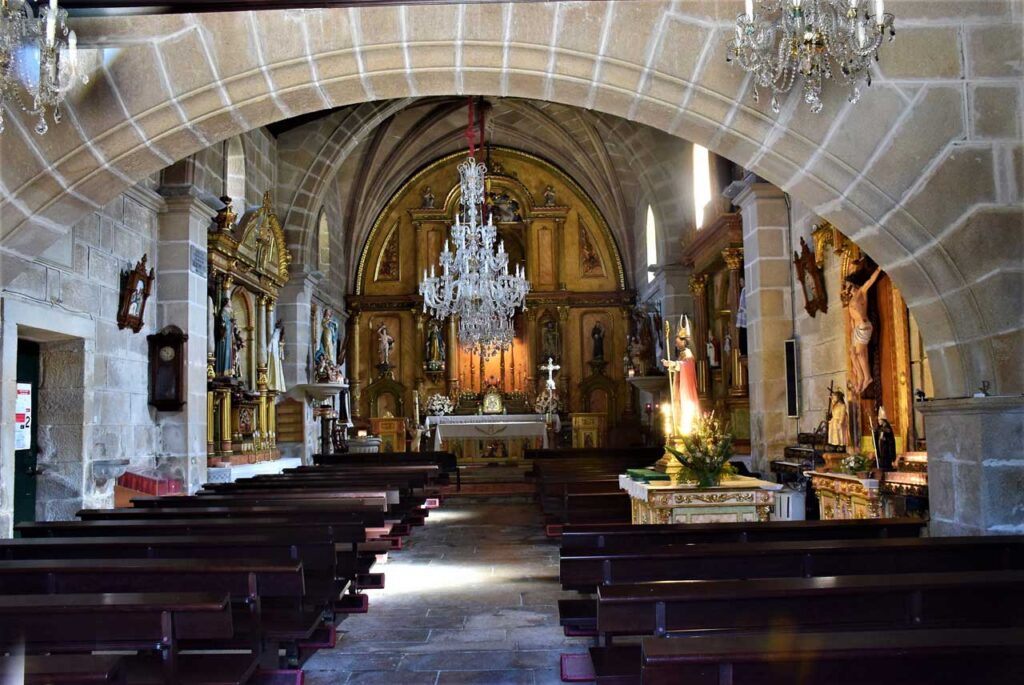
On the other hand, in the San Cibrán neighborhood, there is a parish church from 1866 built on top of a 16th-century church, the best example of neoclassical art in the Town. Made up of a single nave, this church has on its facade the image of San Ciprián.
Cangas County in the Pontevedra province belongs to the Morrazo region and comprises five parishes: Aldán, Cangas, Coiro, Darbo, and Hío.
Aldan Town belongs to Cangas do Morrazo County, located at the end of the Morrazo peninsula with one of the main river called Orxás River crossing much of the territory. Its fluvial course born in Castiñeiras, located in Beluso, and finally, it ends in the Aldán Estuary.
Gallery
Location
- Town
- Aldán
- Municipality
- Cangas
- Province
- Pontevedra
- Country
- Spain
The asset
- Type
- Manor house
- Eco-destination
- Ría de Pontevedra
- Environment
- Urban
- Relevance
- National
How to get there
- Access
- By land
- Distance
- 0,800 km
The visit
- Visitable
- The pazo is private property and cannot be visited. Exterior visit.
- Accessible
- No
- Parking
- Sí
Coordinates
- Latitud
- 42.27880200
- Longitud
- -8.81532400