
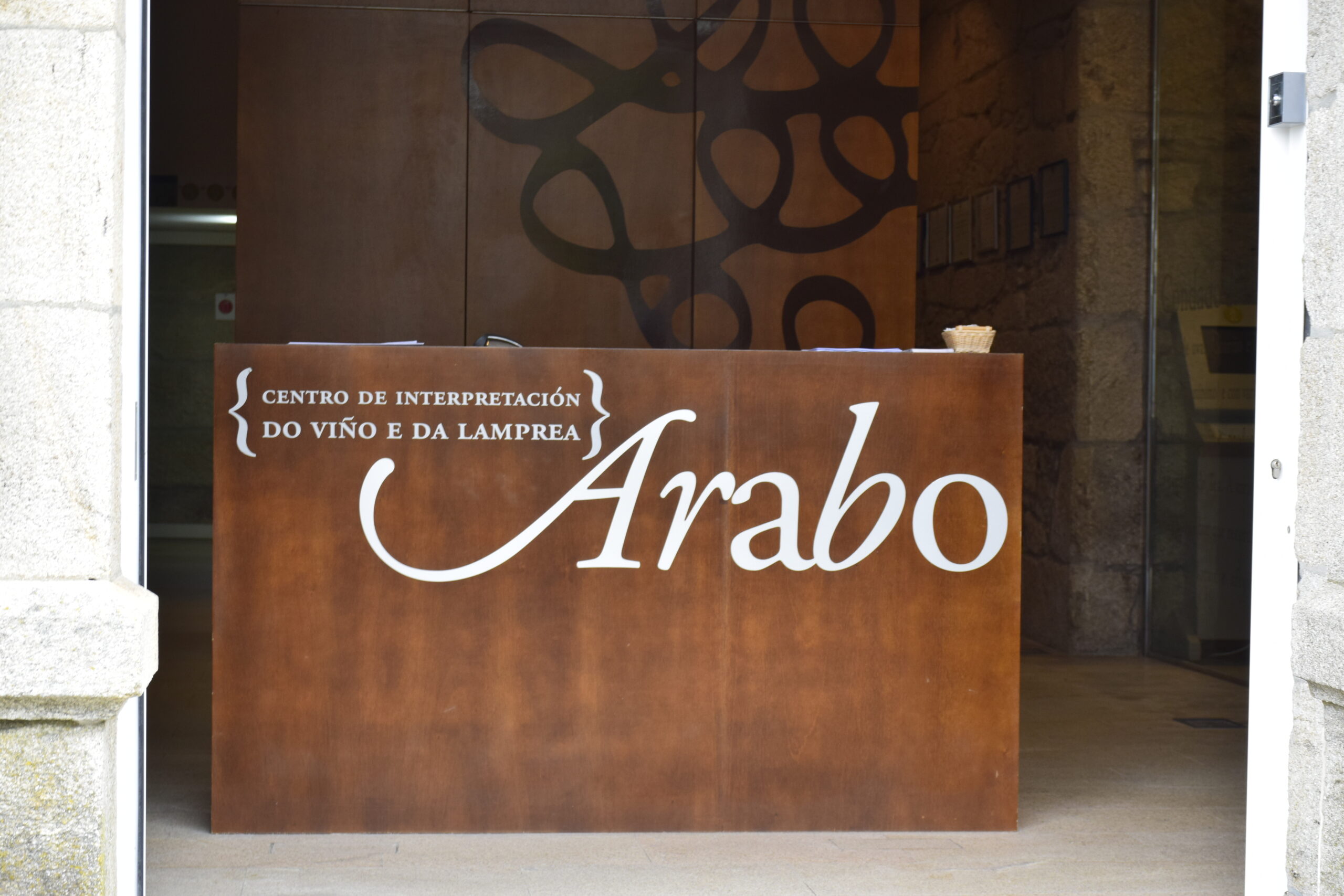
Arabo. Wine and Lamprey Interpretation Center
About this heritage
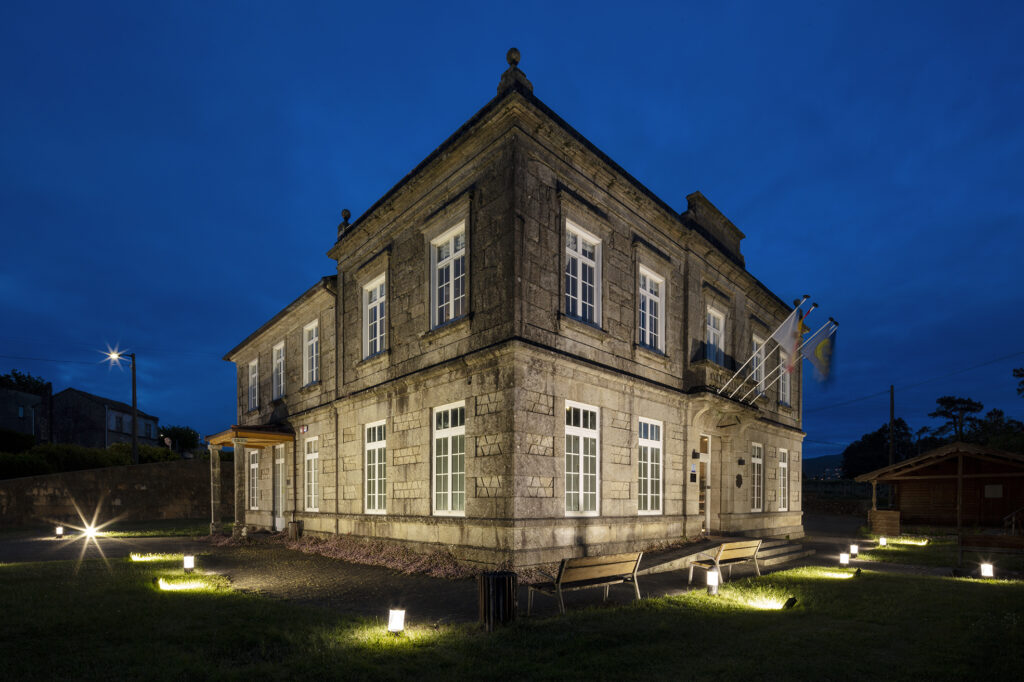
This museum is an associate of the South Estuaries (Rías Baixas) Wine Route. It is dedicated to lamprey and the wine of the South Estuaries (Rías Baixas) Denomination of Origin in the area of the Tea County, through which it shows visitants the historical link between its Arbo villagers and these two products. Its building where is located is an old Indian house with three floors. The Indians were Spanish who lived in America, specifically in Cuba in 1925 and returned to Spain about that same year of their emigration with large sums of money. The purpose of this museum was very different from the current one; it would serve as a school for the people until July 2003, when it was inaugurated by Manuel Fraga as the center we know today.
On the ground floor, there is a reception, an assembly hall, a small section with merchandising, and a wine bar, which offers tasting and shopping of ten wineries from the South Estuaries Denomination of Origin (Rías Baixas D.O.) and videos about them. On the second floor, there are two rooms, one dedicated to Arbo's history and the other to wine and its history, from the Egyptians, its vicissitudes in grapevine cultivation, the monasteries influence, the Lutheran Reformation, and the South Estuaries Denomination of Origin (Rías Baixas D.O.). This floor also provides a small summary of the cultivation and periods of the vine.
Visitors can also appreciate from the tools found on Mount Cabrón that, with most certainty, the oldest hominid in Galicia left this place, that the Romans, as tradition has it, already brought lampreys to Augustus, and find the Lagoa mine, which had 600-kilogram annual gold production.
Finally, the third floor is dedicated exclusively to the lamprey; everyone can also appreciate the fauna of the Miño River and know how the lamprey is fished in Arbo.
To learn more
The Arabo museum, "Wine and Lamprey Interpretation Center," is in the old school of Arbo, built thanks to the fortune of the emigrants of this town. The museum has three floors, the lower one comprises a reception, an assembly hall, and a wine bar also could be called a winery, where locals and visitors can find wines from up to nine wineries.
On the second floor, there are two rooms, one dedicated to Arbo's history and the other to wine. Visitors will discover that the site of O Cabrón reveals that the first man who lived in the lands of Arbo was the Archaic Human "Homo neanderthalensis." From this first history of man as a social and sedentary being, there are manifestations like the mámoas of Chan do Rei in Cabeiras or the one of San Martiño de Sela, as well as more than fifty groups of rocks with petroglyphs like the one of San Xoán de Mourentán or the one of Cándido.
Everyone will also discover how the Romans did not forget to pass through the lands of Arbo. From Portugal, they tried to cross the river Lethes, today Limia or Lima, by confusing it with legendary Lete River or the river of oblivion, of Hades, which in Roman mythology was believed to have the property of erasing the memory of those who crossed it. Later by the Miño River, which was closest, they invaded the Arby territory in the year 137 B.C. The process of Romanisation brought about social, cultural, political, and also economic change. From these numerous changes, there is the Lagoa Roman Mine, the biggest in the Mid-lower Miño, from which the Romans extracted large quantities of mineral they highly valued, gold. On top of that, they fished precious lampreys, transferred sacrificially in ad hoc pools, to send to Caesar in Rome.
The middle Ages and the Order of Cistercians left their mark on this land bathed by the Miño. In the 12th century, King Alfonso VII granted the lands of Arbo to the monastery of Melon. The written documentation of this concession was signed as "Sanctus Petrus de Aravo." Aravo being the Latin word that gave rise, over time, to the name of Arbo.
With these monks, the Templars, and the invaluable influence of San Martiño, the lands of Arbo reached a prominent viticultural, as well as, fluvial impulse. Romans were not the only ones who valued Lampreys, so were these monks, who also knew how to appreciate this delicacy since the Cistercians were forbidden to eat four-legged animals. Later on, the lamprey began to be prized and marketed. The monks realized its extremely high value and got the king to give them ownership of the "pesqueiras."
In the room dedicated to wine on the second floor, visitors can find a brief history of these lands wine. Already known by the Egyptians and Greeks, it was with the Romans when it reaches its first impulse. During the Muslim invasion, wine declined in extension and production, due to the Islamic prohibition of its consumption, but not completely eradicated since alcohol was an indispensable weapon in wars. It was in the middle Ages when the monks once again promoted the cultivation of the grapevine.
The lamprey and consequently the pesqueiras, is nowadays, the most precious thing for the Arbo Town Hall. The pesqueiras are lithic constructions based on "poios," whose disposition in parallel or in perpendicular creates a strong flow of water against the current, which facilitates the ascent of the lamprey.
In Arbo, the locals honor with two gastronomic festivals the lamprey, which exalt this prized delicacy. The first festival is during the last weekend of April and the second called the Dry Lamprey Festival is at the beginning of August. The lamprey and the “pesqueiras” are a reflection of the way of life, culture, and tradition of the mid-lower Miño.
At the third edition of “the South Estuaries (Rías Baixas) Annual Tourism Gala” held in Vigo on March 12, 2019, the Arabo Museum received the "SICTED" recognition and certificate, which rewards excellence and professionalism of companies and tourist services.
To know it better
In the Arbo town hall, in the Pontevedra province, the tourist attraction is none other than the museum and Interpretation Centre of the Wine and Lamprey.
Known for the past twenty-five years as the school of Arbo, this place is today "Arabo, Interpretation Center." Its collection helps both locals and tourists to know and understand the history of wine and lamprey.
Built thanks to a group of Galician men and women who donated money for its construction, the building has three floors. On the first one, there is a reception, an assembly hall, and a wine bar, where they kept wines from up to nine wine cellars of the Arbo Town Hall, among them, Eidosela, As Laxas, Pazo de Almuíña or Marqués de Vizhoja. Going up the stairs to the second floor, one can see two rooms. One focuses on the history of the Arbo town hall while the other one is dedicated to the wine sector. Finally, on the third floor, visitors can learn a little more about the lamprey, the most famous oily-fish of Arbo, and around which locals hold two gastronomic celebrations.
Galería
Location
- Locality
- Rural
- Municipality
- Arbo
- Province
- Pontevedra
- Country
- Spain
The asset
- Type
- Interpretation center
- Eco-destination
- Río Miño
- Environment
- Rural
- Relevance
- National
How to get there
- Access
- By land
- Distance
- Menos de 30 minutos en coche
The visit
- Visitable
- Yes. It has guided tours in several languages
- Interpretation
- The museum has brochures and posters of the exhibitions
- Accessible
- Sí
- Parking
- Sí
Coordinates
- Latitud
- 42.11297400
- Longitud
- -8.30782000