
Carabela La Pinta Museum. Baiona
About this heritage
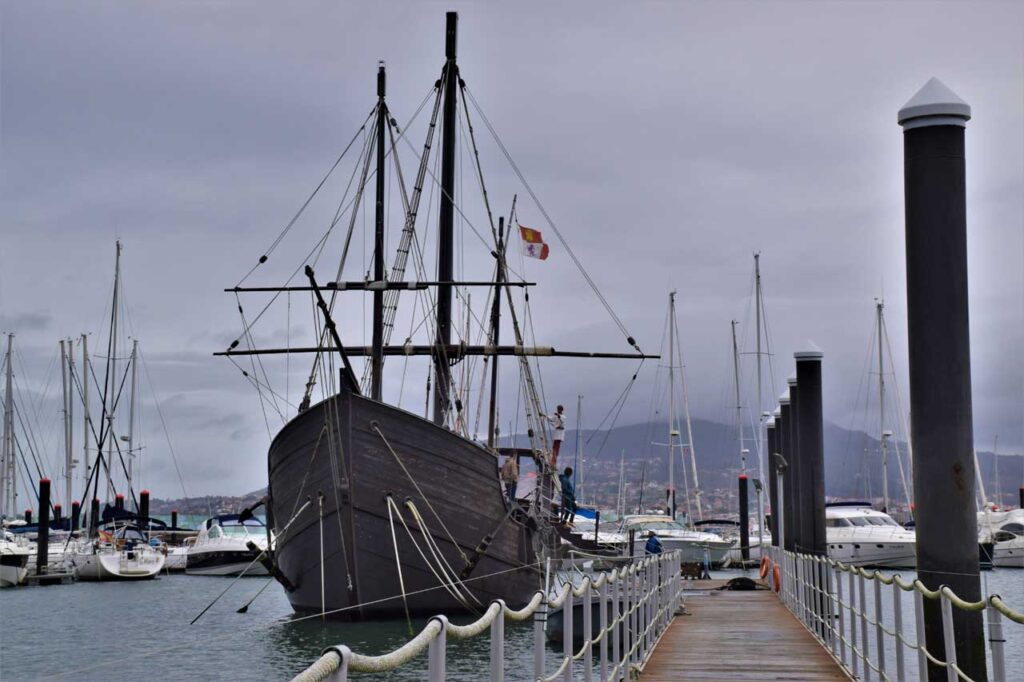
With the commemoration of the fifth centenary of the Discovery of America, the replica of the Carabela La Pinta was built, made in the shipyards of A Guarda where it periodically returns for maintenance. It was converted into a museum by the city council and was refurbished in 1999, equipped with all the elements of the Columbian era, so that it can be viewed just as it arrived in Baiona in 1493.
The replica of the Carabela La Pinta is located in the middle of the port of Baiona. Access to the vessel is via a gangway that connects it to the promenade leading directly to the ship's deck where the bow and stern are observed, differentiated by levels. At the stern is the cartographer with several tools from the era used for navigation and behind him the helm.
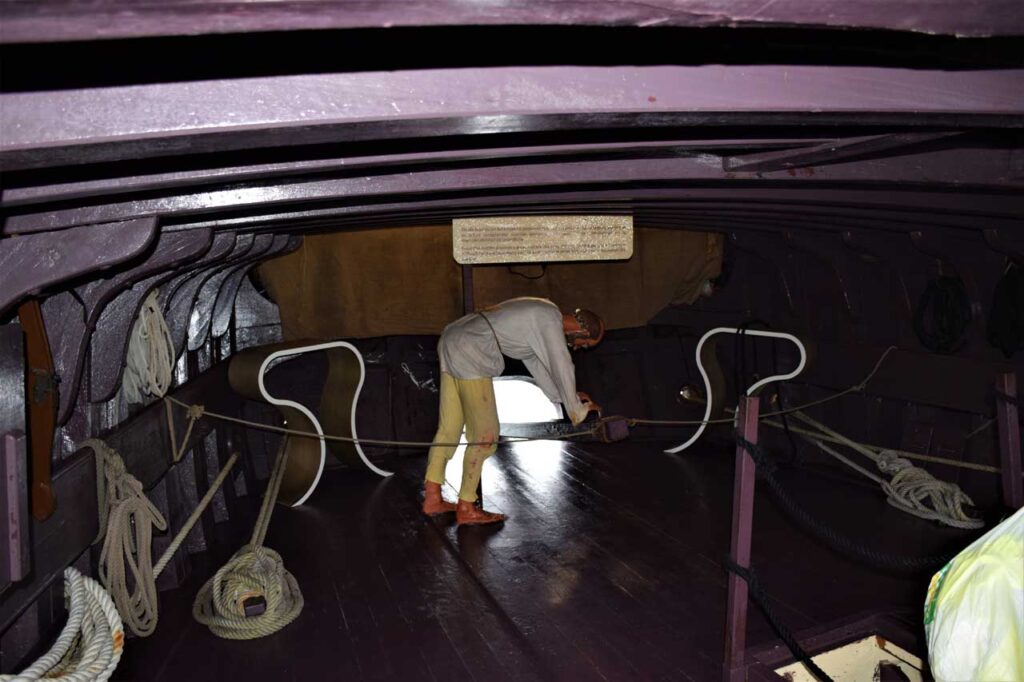
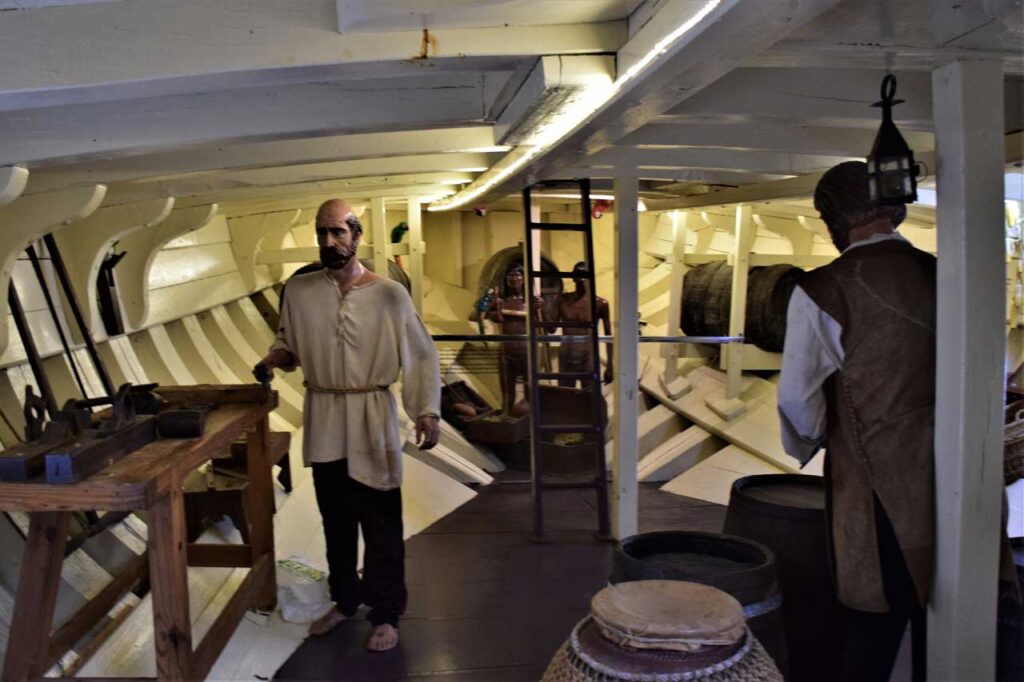
In the middle of the deck are the stairs that go down to the hold where several informative panels and figures related to the voyages and the goods they brought can be read: gold, plants and seeds (corn, cassava, sweet potato, beans, peanuts...), spices (chili, cinnamon...), textile plants (cotton, manguei), medicinal plants (tobacco, mochoacán and almáciga), dye plants (bija and jagua), fruits, timber trees (hiáco, mangrove, ceiba and mahogany) and animals.
The information available about the caravels is very scarce. They were imported from the East by the Portuguese, who incorporated the lateen or triangular sail. It evolved throughout the 15th century, replacing the lateen sail with the round sail which made it more manageable and less vulnerable to sea impacts. Additionally, it was made more stable and its center of gravity lowered. La Pinta was the fastest of the three ships, reaching speeds of up to 15 miles per hour.
To learn more
The launching of the replica took place at the Camposancos dock in A Guarda on September 23, 1991. It was built by the Castro shipyards and measures 22 meters in length, 6.60 meters in beam, and 2.30 meters in depth, having cost 150 million of the old pesetas. For its construction, the plans made by naval engineer José Luis López were followed, who previously researched the documentation from the caravel era.
The idea was that, along with the replicas of La Niña and La Santa María, they would cross the ocean and serve as floating embassies of Spain in American lands. When the Fifth Centenary society was dissolved and the funds ran out, the idea was gradually forgotten.
The arrival of the caravel Pinta to Baiona came in a favorable historical context for the town since in 1425 King Juan II decided that the ports of A Coruña and Baiona would be the only ones allowed to unload foreign goods, authorizing Baiona to import and export any kind of merchandise. Thanks to this order, the port of Baiona was the most important in southern Galicia and northern Portugal, and the town's inhabitants enjoyed good socio-economic development.
A significant date is March 1, 1493, when the Torre del Príncipe of the Monte Boi castle spotted the arrival of a famous ship: La Pinta, captained by Martín Alonso Pinzón and crewed by Cristóbal García Sarmiento, making it the first town in Europe to learn of the discovery of the New World. La Pinta sailed around Monte Boi castle, with Pinzón landing on Ribeira beach. The Catholic Monarchs granted numerous privileges to the 650 residents of Baiona, such as exemption from serving in the Castilian Navy and permission to undertake privateering warfare on their own. Likewise, the Monarchs granted Baiona the titles of Noble and Loyal Town, and the Monte Boi peninsula was henceforth called Monterreal.
In 1974, the Ministry of Labor established March 1, the day of La Pinta's arrival, as an official local holiday, celebrated on the first weekend of March commemorating this arrival with theatrical performances, shows, and a medieval fair, currently known as the Fiesta de la Arribada.
To know it better
La Pinta is one of the three caravels or sailing vessels used by Christopher Columbus on his first voyage to the New World as a result of the discovery of America in 1492. The other two caravels are La Niña and La Santa María.
The port of Baiona, in Pontevedra, was the first in Europe to receive news of the discovery of America. In 1493, Captain Martín Alonso Pinzón docked in these Galician waters. For the 5th Centenary of the Discovery, a replica of the vessel La Pinta was built. After the interior was refurbished, it can be visited as it is located on one of the docks in Baiona.
To remember that this town was the first port to learn of Columbus's discovery, the Fiesta de la Arribada is organized. It is one of the most popular celebrations in the province and holds the title of Festival of International Tourist Interest.
Galería
Location
- Locality
- Baiona
- Municipality
- Baiona
- Province
- Pontevedra
- Country
- Spain
The asset
- Type
- Museum
- Eco-destination
- Ría de Vigo
- Environment
- Urban
- Relevance
- Regional
How to get there
- Access
- By sea By land
- Distance
- 950 m
The visit
- Visitable
- Guided visit with applications (audioguides, etc.)
- Interpretation
- Interpretive panels and audioguides in Spanish, Galician, English, and French. Link to download the audioguide: http://www.baiona.org/web/turismo/multimedia/audioguias
- Accessible
- No
- Parking
- Sí
- Signposted
- Yes
Coordinates
- Latitud
- 42.12146700
- Longitud
- -8.84713200