
Corrubedo, a seafaring town. The Lighthouse of Corrubedo. Grip Sculpture
About this heritage
Corrubedo is a seafaring town belonging to the Municipality of Ribeira. Its official name is Santa María de Corrubedo, which holds the Collective Medal for Shipwreck Rescue.
In the 19th century, the town became notorious for its fishing activity and the installation of several salting factories. By 1930, it had a population of 2,500 inhabitants. The census was gradually decreasing until the present day due to the increasing emigration to other fishing ports of Spain. Although its estimated population in 2019 is 610 inhabitants, it has become for several years an eminent tourist town.
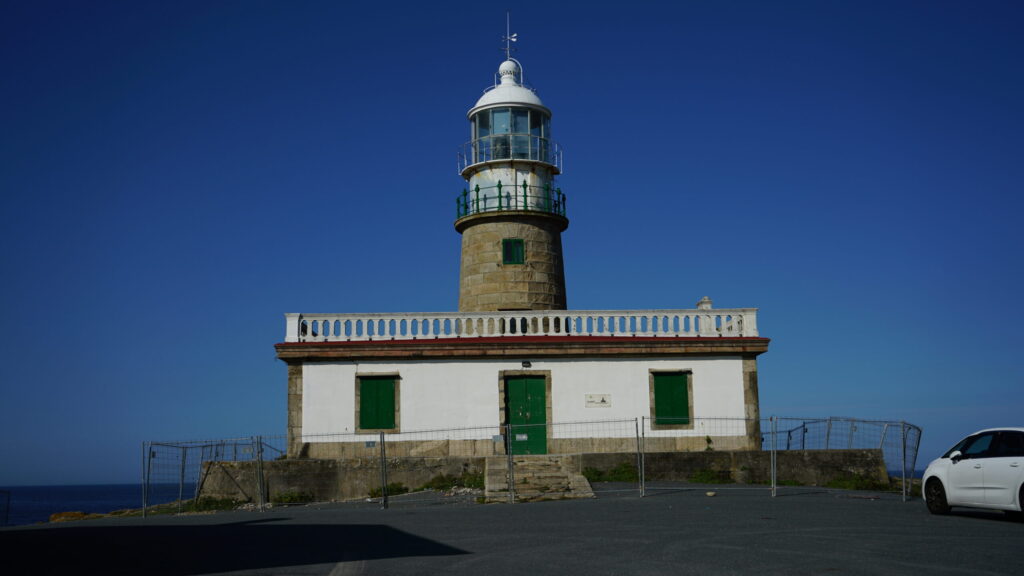
One of the tourist exponents of this town is its lighthouse, located in the parish of the same name in the municipality of Ribeira in Coruña. Its location at one of the rocky ends of the Corrubedo Cape makes it the westernmost point of the Barbanza Peninsula.
Its construction, directed by the Basque engineer Celedonio de Uribe y Urbiquiain, began in May 1852 and finished in 1853. The lighthouse building has a semicircular façade towards the sea and a rectangular one towards the land. Part of its tower is inside the building, and it has a truncated cone section, meaning the trunk's shape resembles a cone.
Inside, there is a spiral staircase, manufactured in the Sargadelos Foundry, before becoming a ceramic factory. It has a spotlight 14 meters above the ground and 32 meters above sea level, making its total height at 9.60 meters.
First lit on February 20, 1854, when it began to serve as a guide for the boats in the area. At first, they used oil to illuminate it, and then petroleum; however, for the past 35 years, the lighthouse has been using electric current.
From the top, visitors can see the Dune System of the Natural Park of Corrubedo, the lagoons of Carregal and Vixán, as well as the lights of the Fisterra and the Cíes Islands lighthouses, which are perfectly distinguished.
The port of Corrubedo is the catalyst space for all kinds of activities; it has become its downtown, where visitors can admire the most traditional Galician boats, "the dornas." Inshore fishing is the main activity of this area, and their most used fishing gear are the long line, the artisanal fishing creels, and the ring netting. From the fishing activity, the principal fish and seafood species commercialized are sea bass, sea bream, pout, European pollock, spotty and plain Ballan wrasse, pipefish, razor clam, Pod razor (Ensis siliqua), octopus, squid, and velvet crab.
Life gathers in the surroundings of the port, most specifically, the restaurants, which offer typical cuisine of the place, fish and seafood. The last remodeling of the port facilities was in the 1930s.
Very close to the pier, in the area of Os Casqueiros, visitors can see the "Grip" sculpture by Antony Gormley. He is an honorary doctor of the University of Cambridge and one of the top names in English sculpture worldwide. This sculpture is 100 meters from the shore, in a rocky area between the Corrubedo dock and the Robeiriña beach.
The Grip sculpture is in an area of the coastal system of Balieiros, declared as Places of Community Importance (PCI) (Lugares de Importancia Comunitaria, LIC). It is one of the coastal ecosystems with the highest wealth of flora and well-preserved plant communities in northwest Spain, which gives this PCI its original and rare characteristics. The vegetation of the beaches and the dune systems stand out, as they are home to some 200 species of phanerogams. The vegetation of the beachhead is very well-represented. Noteworthy is the vegetation of the tertiary dunes and the stabilized dunes, located in the areas somewhat far and more protected from the sea.
To learn more
The Corrubedo town is at the northern end of a large protected bay on the Galician Atlantic coast. Its constructions are narrow strips of buildings that, although formed by houses of various heights and geometries, open their holes and balconies to the street. In contrast, however, they have reduced their windows to little holes as protection against the sea.
Among other things, Corrubedo is famous for its lighthouse, which indicates the entrance to the "Costa da Morte" (Deathly Coast) but above all for its Natural Park. The Dune System Natural Park of Corrubedo, Lagoons of Carregal and Vixán stands out for its mobile dune, a large mass of sand, approximately 1,300 meters long, 200 meters wide, and about 20 meters high.
Corrubedo was also on the itineraries of yesteryear. In fact, from this Riberian town, an old Medieval Jacobean Way also crosses the municipalities of Pobra, Boiro, Rianxo, Dodro, and Padrón.
The Lighthouse of Corrubedo is one of the most significant in the area due to the dangerous nature of the cape, at whose end it stands, and the numerous sets of rocks on the seabed that surround it, known as the "Bajos de Corrubedo." This point is one of the westernmost in the Southern Estuaries (Rías Baixas).
For the last 100 years, this Lighthouse has been uninhabited and working autonomously as many others along the coast. Its configuration is flat and not very high in comparison to Corrubedo Cape, seeking to draw attention to the risk produced by sets of rocks on the seabed (Bajos) that enhanced its coast, sometimes, far from the landline. Its constructor, Mr. Celedonio de Uribe considered such conditions when he projected the lighthouse building with a semicircular façade towards the sea and a rectangular one towards the land to mitigate the effects of the storms.
The lighthouse provides safety to navigation in a place of the extreme hardness of the forces of the sea because of its latitude at sea and its environment characterized by a rocky area of small cliffs, low scrubs, and bushes typical of coastal scrub. Therefore, one can find wet and dry heaths, orchids, retama broom bushes, centauries, thistle-like flowering plants, and cliff plants like the sea thrift (Armeria pubigera).
This enclave is also suitable to observe migratory birds that seek shelter in the cliffs and sandy areas of this zone. Among the species that stand out are the European shag (Phalacrocorax aristotelis) and the European herring gull (Larus argentatus), the lesser black-backed gull (Larus fuscus), and the Caspian gull (Larus cachinnans).
The Lighthouse of Corrubedo is one of the constructions seen from the ocean when participating in "the Sea Route of Arousa and Ulla River." A unique maritime-fluvial route to commemorate the arrival by sea to Galicia of the remains of the Saint James the Apostle (Saint James the Great) after his martyrdom in Jerusalem in 44 BC.
The unique geography and the confusion of its light among the others nearby have led to various maritime accidents. The most memorable was the shipwreck of the Santa Isabel ship in 1921, considered the greatest tragedy at sea experienced in Galicia. In it, 213 people died out of the 268 who were traveling on the ship.
They changed from a white light beam to a red one, so it was distinguishable from the others, as well as, to reduce the miscalculation on the part of the ships.
Because of this, the people of the area named it the Communist Lighthouse. Although not a very big construction, it is incredible the gigantic bulb and lenses that it has, more appreciated at night.
The surroundings of the Lighthouse of Corrubedo also became one of the filming locations for several scenes of the famous Spanish Tv-series "Fariña," broadcast by Antena 3 in 2018.
The port of Corrubedo is the nerve center of the town. The first artificial mooring dock in the region was Palmeira. After submitting a bid of 135,627.42 pesetas, Jesús Montero Suárez carried out the project of Corrubedo's wharf, which he finished by January 29, 1935. The work included the creation of a 111-meter-long promenade and a breakwater up to Concheiro do Chan, as well as a stone pier linking the two facilities.
When the tide is low, a few meters from the Corrubedo dock, anyone can see a work of art, imitating a human figure. This piece symbolizes the man's fight against the elements; for this reason, when the tide rises, the water hides the image.
The sculpture is made of half a ton of cast iron and has an estimated value of half a million euros. The architect David Chipperfield has ceded it to the Ribeira Municipality for a period of 20 years, extendable for another decade.
In this area is the coastal system of Balieiros, declared as Places of Community Importance (PCI) (Lugares de Importancia Comunitaria, LIC). It comprises the beaches of Furna, Portiños, and Balieiros, all flanked by the dune system. Mainly on the border between Espiñeirido and Balieiros beaches, there are also segments of rocky coast, cliffs with areas of scrubland, and coastal meadows.
To know it better
The parish of Santa María de Corrubedo, commonly known as Corrubedo, is in the municipality of Ribeira in the province of Coruña. Its location is crucial since its port is between the Muros and Noia Estuary and the Arousa one.
During the middle Ages, more specifically, in the 15th century, this seafaring town was extremely significant for its fishing activity and the installation of factories dedicated to the salting process. These economic activities made it a prosperous place, but years later, the inhabitants began to emigrate to other towns with larger ports.
In the seasons of strong waves, Corrubedo Cape becomes a dangerous port and, because of this, some boats have suffered accidents, ending in terrible tragedies. This seafaring village was the first in Spain to receive the Collective Medal for Shipwreck Rescue for its solidarity actions with the “Debonair” vessel, which had had an accident at sea.
Besides the spectacular views from Corrubedo Cape, travelers can also find a lighthouse dated back to 1853. Designed by Celedonio Uribe, this enclave offers a landscape of the Dune System of the Natural Park of Corrubedo, lagoons of Carregal and Vixán. It has become a great tourist attraction, formed by a large mass of sand in constant movement.
In 2018, the British architect David Chipperfield collaborated in the design of some houses and the installation of a sculpture known as "GRIP" by the artist Antony Gormley. This work of art is on the beach of Furnas in Corrubedo, an area of the coastal system of Balieiros, and it attracts attention because visitors can only see it depending on the tides.
Location
- Locality
- Corrubedo
- Municipality
- Ribeira
- Province
- A Coruña
- Country
- Spain
The asset
- Type
- Village
- Eco-destination
- Ría de Arousa
- Environment
- Rural
- Relevance
- Regional
How to get there
- Access
- By sea By land
- Port
- Puerto de Aguiño
- Distance
- 0 km
The visit
- Visitable
- Yes
- Accessible
- No
- Parking
- Sí
- Signposted
- Yes
Coordinates
- Latitud
- 42.57355800
- Longitud
- -9.07249600