
Crecente. Pesqueira de A Follagueira
About this heritage
The pesqueiras are spaces created in the rivers to fish, primarily the coveted lamprey. The lamprey is a blue fish, primitive, jawless, and one of the first vertebrates on Earth, even older than dinosaurs! Nowadays, we can find it at depths of 200 and 400 meters. Known as "vampire fish" or "the queen of the river," it has inhabited the Galician rivers for more than 500 million years.
The construction of the pesqueiras dates back to Roman times, although some claim that they existed before their arrival. They were made of masonry and sat on both banks of the rivers.
Anglers seek areas appropriate for this, preferring rocky outcrops and sections with sufficient water strength so that it is well oxygenated, as these types of stretch were the lampreys' favorite.
In the middle and lower courses of Miño River throughout Salvaterra de Miño, As Neves, Arbo, and Crecente, the latter being the one that concerns us, concentrate the highest number of pesqueiras.
Restored in 2016, the Pesqueira of Follagueira has four "poios" forming three open channels, where anglers place the "voitirón" or "buitrón," a type of netting wire basket, for lamprey fishing.
To learn more
The pesqueiras are constructions of one or several stone channels, called "poios," separated from each other in a parallel or diagonal position to create water currents to facilitate the path to the different fish. Anglers place between each channel cone-shaped nets to catch their prey when swimming upstream, primarily salmon, allis shad, and lamprey. The Miño River once had more than 700 pesqueiras, of which about 400 remain today.
Their construction and use, for lamprey fishing, date back to Roman times and are considered of architectural and ethnographic interest. Nowadays, they are part of the cultural and gastronomic life of the inhabitants of the villages that bathe the Miño River along its course. These villagers still use them with the same purpose and enjoy fishing throughout the year, employing identical artisanal techniques, which are sustainable and environmentally friendly.
The pesqueiras, also called "Pescos," are in the lower course of the Miño River along an approximate length of 25 kilometers. Visitors can encounter all of them when following the so-called “Route of the Pesqueiras." They date back to Roman times since lamprey fishing is centuries old. In the middle Ages, the pesqueiras were the property of monasteries and feudal houses, and in the twentieth century, specifically since 1979, they officially became an artistic monument, listing them as ethnographic elements in the municipal registry. In the pesqueiras, different fishing gear is necessary, but the main one is a type of netting wire basket known as biturón, butrón, voitirón, voteirón, masoura, or nasoura. Lamprey fishing is carried out at night, checking the condition of the nets at least every two hours.
Their bodies are anguilliform with smooth skin for lack of scales and small eyes. They have a sucker-shaped mouth with small, hard teeth. They breathe through a row of seven pairs of tiny gill openings located on each side of their body. They have boneless skeletons supported by a cartilaginous notochord. Young lampreys have two dorsal fins, which are joined together in adulthood.
They feed on the blood and flesh of live prey (fish of different sizes) by attaching and producing an anticoagulant substance to prevent the host's blood from clotting.
Between the time they live in the sea and the river, they can live up to 18 years. Their fishing season lasts throughout the year.
To know it better
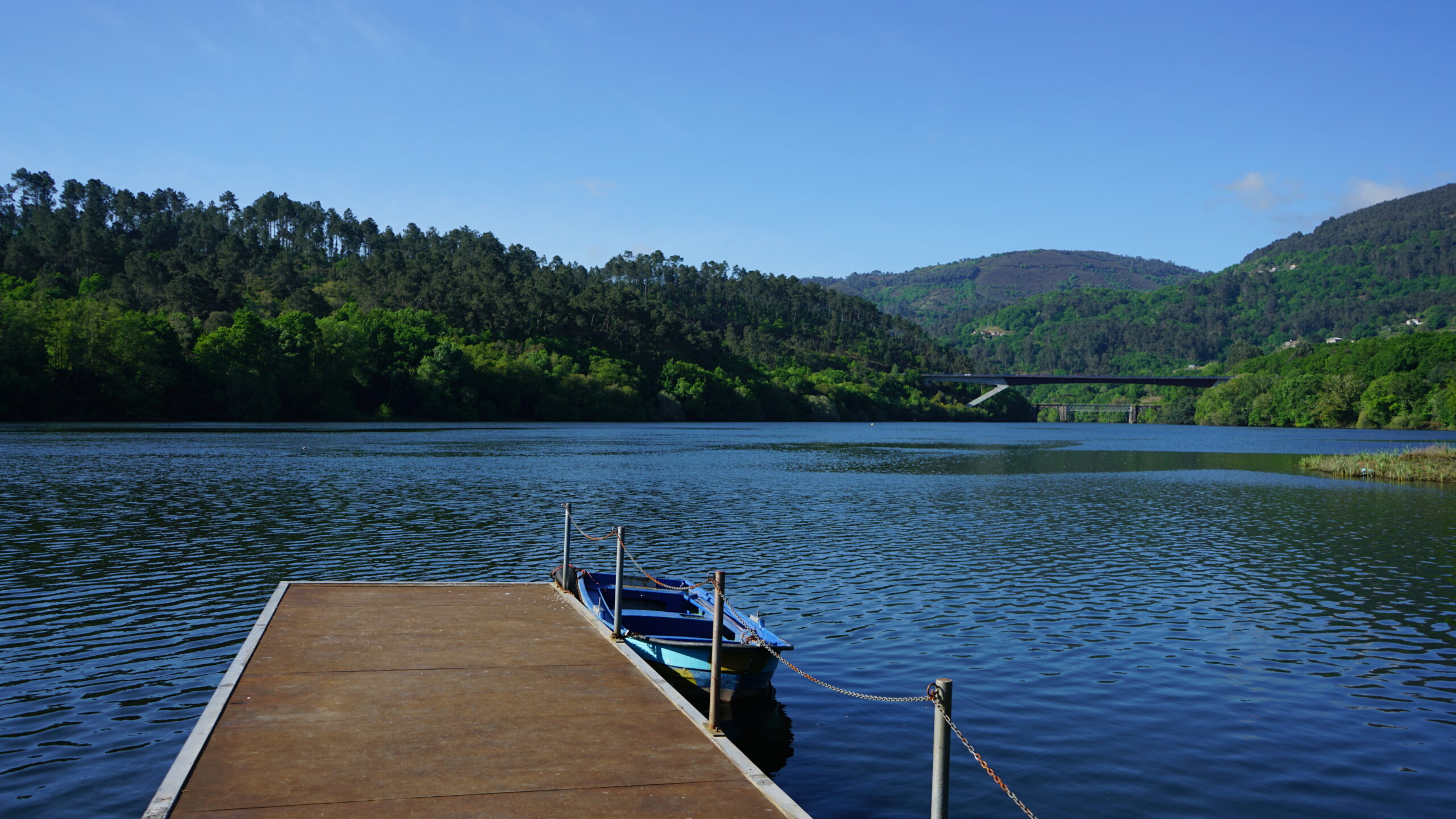
Even today, Galicia has a series of centuries-old constructions called Pesqueiras or Pescos and use for fishing in its Rivers. One of these traditional constructions is the Pesqueira of Follagueira in Crecente, a municipality located in the Pontevedra Province.
The Pesqueira of Follagueira is a dam built in a traditional form as part of the Miño River's history. This structure divides the river course into three channels called "poios," which favors the currents flow, creating faster waters. The poios' orientation directs the waters' flow, forcing the lampreys to swim through them. The construction of the pesqueiras used to be in stretches of already fast waters since they are the lampreys' favorite.
All these characteristics make it a great fishing area, and with the use of a large cone-shaped net, known as buitrón, anglers successfully catch this coveted prey. Nowadays, in the Miño River, visitors can appreciate several pesqueiras since this river holds the highest concentration of them. Besides, in 2006 because of the agreement signed with Tourism of Galicia, they rehabilitated the Pesqueira of Follagueira in two phases: first, the cleaning and restoration of materials, and subsequently, the installation of information panels and accessibility improvements. All this allows us to visualize how they used this structure in Roman times.
Gallery

Location
- Locality
- Filgueira
- Municipality
- Crecente
- Province
- Pontevedra
- Country
- Spain
The asset
- Type
- Fish trap
- Eco-destination
- Río Miño
- Environment
- Natural
- Relevance
- Local
How to get there
- Access
- By sea
- Distance
- 0,500 km
The visit
- Accessible
- No
- Parking
- No
Coordinates
- Latitud
- 42.15261189188467
- Longitud
- -8.20194728423806