


Mediterranean Mussel. General
About this heritage
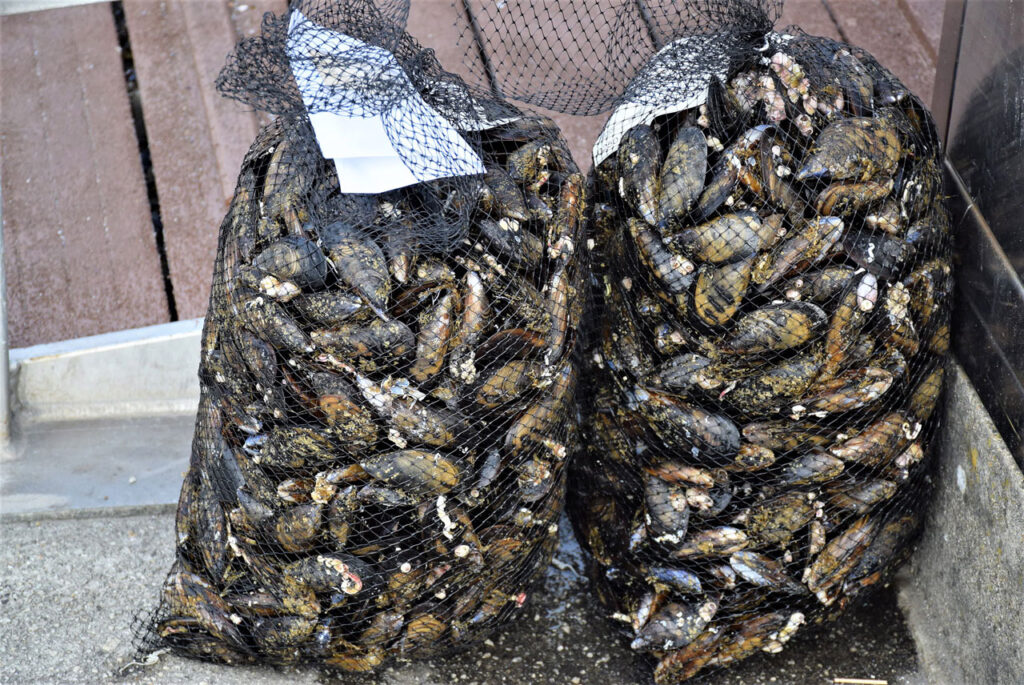
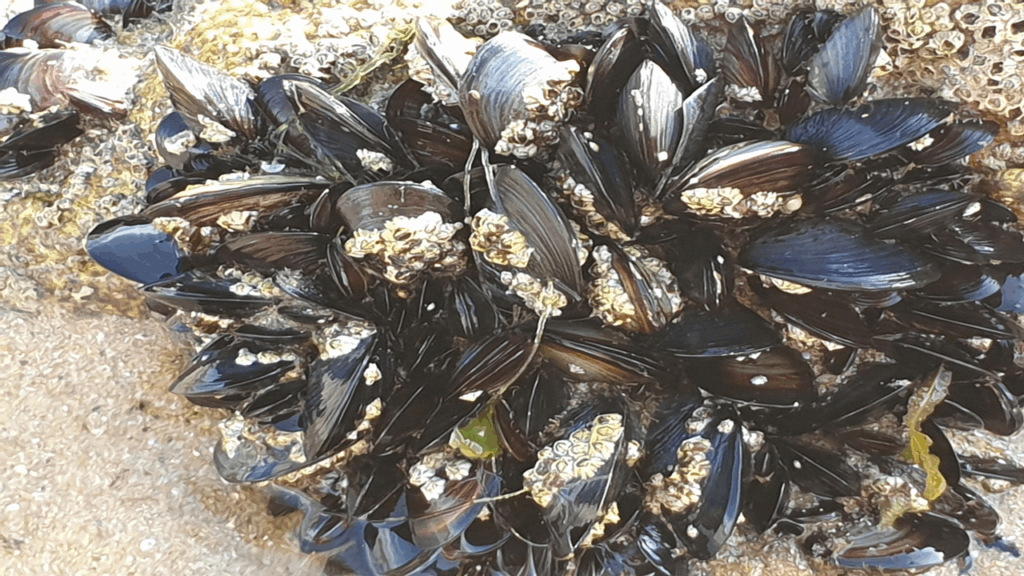
The Mediterranean mussel (Mytilus galloprovincialis) is a species of bivalve, a marine mollusk of strong blue tones. It lives forming aggregates in the most exposed and battered coastal rocks by the sea and in the saltier waters ones towards the interior of the estuary. They adhere to the rock employing the filaments of the byssus in its foot. Generally, they do not live farther than 15 meters deep; however, they have been found in the remains of rafts at thirty-five meters deep.
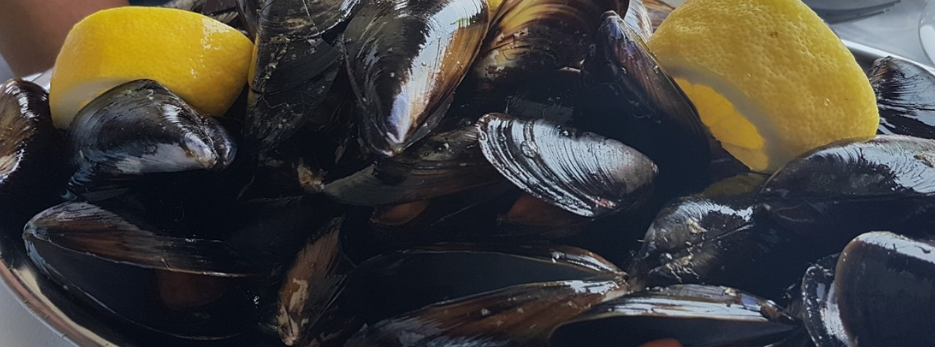
The internal aspect of the mussel is regularly orange, more pronounced in females because the males, at the time of reproduction, have a whitish coloration.
The dimensions for their commercialization are between 7 and 10 centimeters. They are filter-feeder organisms; they feed on phytoplankton and zooplankton, and even decomposing organic particles, found in seawater, which they filter through their gills. The filtration capacity of the mussels is enormous, pumping up to eight liters per hour.
Its predators are the starfish; the perforating marine snail, which absorbs the mussel’s body by drilling a hole in the shell; fish with strong jaws (seabream and triggerfish); and the seagull. The latter, to eat the mussel, drops it onto the rocks causing its shell to break.
Generally, they are cultured in a raft, which is a floating structure that consists of bow, stern, and the sides, where the bow is the part design for mooring. It has a beam system, usually made of wood, from which the ropes hang, which functions as a flotation system, a fastening system, and a breeding system.
The mussel is an animal of two distinct sexes, and its fertilization is external by the release of gametes into the environment (open water). The larvae have pelagic life for a few weeks while completing their development; then, they attached to the substrate by the filaments of the byssus.
In Galicia, this process takes place throughout the year with two major peaks occurring in spring and autumn; the first is more significant because fixation is stronger. A single female can release between 600,000 and a million eggs, and after spawning, it gets extremely thin.
To learn more
The Mytilidae family includes many genera and species, found all over the world. Although their habitats are different, their common characteristic is the fixation employing the byssus. Some live in intertidal zones and others below the tides minimum level; some cling to rocks and beach gravel while others are partially buried in mud or sand. Moreover, others excavate and live inside white rocks, whereas others reside in marine depths close to volcanic escapes feeding on sulfurous bacteria.
The Galician mussel (Mytillus galloprovincialis) is perhaps the most resistant species in Europe since they have never been affected by a destructive plague as it has happened with M. edulis in Holland, England, and Italy. The most logical explanation is that in Galicia, these mussels feed of the richness of the plankton of these estuaries.
Their culture is performed in floating structures called rafts (bateas). In 1956, they installed 400 of these, and in 1967, the number rose to 2537. A decade later, it reached a density between 3100 and 3300 rafts. Moreover, from 1959-60 to 1975-76, the production rose from 51,000-61,500 Tm to 173500-192,000 Tm, making Spain the leading producer of mussels in the world.
In Spain, over the last few lustra, their harvest has remained between 170,000 and 240,000 tonnes. Production was stable, and inter-annual differences were due to incidents of red tides that prevented regular harvesting of mollusks. In Spain by 2018, the harvest was estimated at 273,600 tonnes, which became a record figure in the history of mussel production with a total first-sale value of 133.2 million euros.
There are five Spanish autonomous communities where mussels are cultured, Catalonia, Andalusia, Valencia, and the Balearic Islands, and Galicia. It is precisely in Galicia, where production represents 97% of the total national mussels. Spanish aquaculture is a reference on a European and world level for the quantity and quality of its shellfish breeding.
To know it better
The mussel is a bivalve mollusk composed of elongated black or blue shells. Its scientific name is Mytilus Galloprovincialis, and it is found in large rocky areas, where it attaches using parts of its foot.
The mussels live in tidal zones and at low depths; thus, the rafts or mussel platforms are used for their collection. These are structures placed neatly and accurately in the estuaries; in the Arousa estuary case, thick ropes called "maromas" hang from these constructions, where these protein bivalves are cultivated.
They feed on marine microorganisms and diverse plankton and can live up to 60 or 70 years. To keep preserving these mollusks, it is essential to respect its habitat as well as controlling its consumption since many studies classified them as an endangered species.
Gallery
Location
- Town
- Vilanova de Arousa
- Municipality
- Vilanova de Arousa
- Province
- Pontevedra
- Country
- Spain
The asset
- Type
- Fish product
- Eco-destination
- Ría de Arousa
- Environment
- Maritime
- Relevance
- National
How to get there
- Access
- By sea
- Distance
- 0 km
The visit
- Accessible
- No
- Parking
- No
Coordinates
- Latitud
- 42.56356800
- Longitud
- -8.83019900