
Miño Estuary
About this heritage
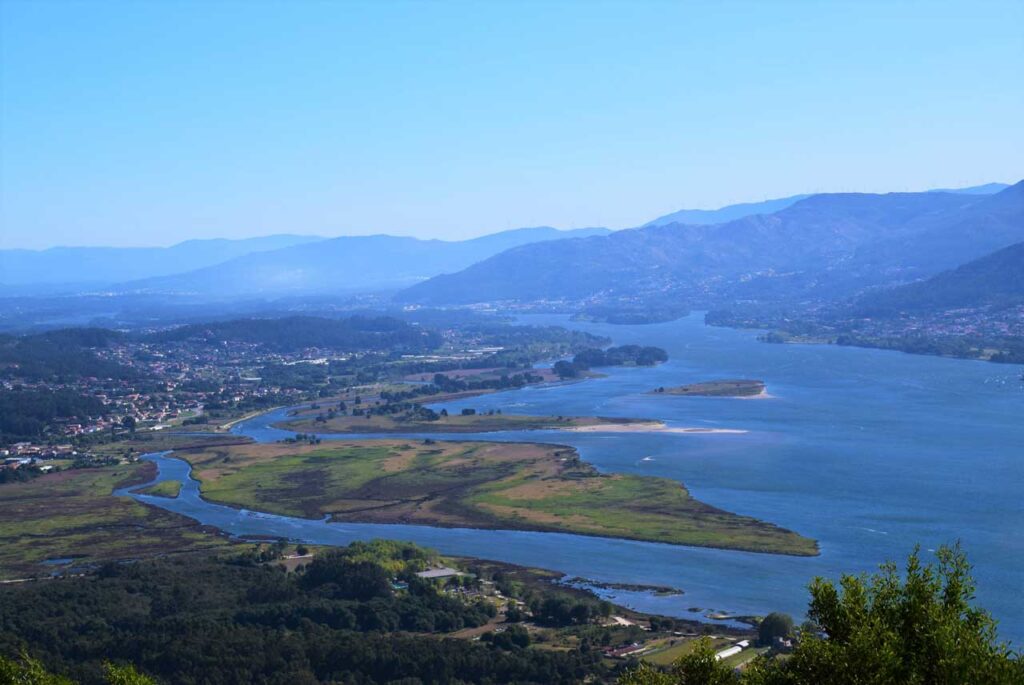
Before reaching the entrance to the Atlantic Ocean, the Miño River forms an estuary, considered one of the most important wetlands on the Iberian Peninsula with the confluence of two ecosystems, the fluvial and maritime. It includes the towns of A Guarda and O Rosal and extends over 15 kilometres, forming a natural border between Spain and Portugal.
It belongs to the Baixo Miño Special Area of Conservation (SAC) (ZEC in Spanish) within the Natura 2000 Network. This area covers the last 80 kilometres of the Miño River and its area of socio-economic influence extends through the city councils of A Guarda, O Rosal and Tomiño.
The Miño estuary is well-known for its area of special protection for birds (ZEPA Esteiro do Miño) since it is possible to observe colonies of birds that choose for the wintering or nesting. These birds are the Aquatic Warbler Acrocephalus paludicola, the Little Bittern Ixobrychus minutus or the Slender-billed Curlew Numenius arquata. The wintering populations include the tufted duck Aythya fuligula, the tridactyl sandpiper Calidris alba, the Great Plover Charadrius hiaticula and the Eurasian Oystercatcher Haematopus ostralegus.
There are also taxa of other groups such as the Gold-striped Salamander Chioglosa lusitanica or the Otter Lutra lutra.
Throughout the estuary there are predominantly fluvial-marine environments, with the presence of intertidal sandy mud banks, salt marshes and reeds. The sedimentary deposits form several islands of considerable size on the Galician side (Canosa, Morraceira do Grilo, As Varandas, Pozas), with wide grasslands, some of them densely wooded. The beaches of the rivermouth also have an interesting dune system with plants specially adapted to dehydration and salinity.
Since 1965, it is also included in the "List of Wetlands in Europe and North Africa of National Importance" and in the Zone of Special Protection of Natural Values (ZEPVN in Spanish).
The PRG-160 path, departing from the parish church of San Lorenzo, passes through the first route in Galicia of the Portuguese Coastal Way and joins the Blue Path from the beach of O Muíño, the Coastal Path from the area of O Puntal and also passes through the recently discovered Roman salt deposits sites.
To learn more
The Miño estuary belongs to the Special Area of Conservation (ZEC Baixo Miño) within the Natura 2000 Network. This area covers the last 80 kilometres of the Miño River and its socioeconomic zone of influence covers the towns of A Guarda, O Rosal and Tomiño.
The wetland is identified as a Special Protection Area for Birds (SPA), Esteiro do Miño and located along the final stretch of the Miño river, before flowing into the Atlantic Ocean, and occupies an extension of 16.97 Km2.
The most noteworthy are the groups of marine and coastal habitats, of which the best represented are the coastal habitats and halophytic vegetation.
The Estero do Miño SPA includes an important colony of migratory and nesting birds such as the Aquatic Warbler Acrocephalus paludicola, the Great Bittern Ixobrychus minutus or the Slender-billed Curlew Numenius arquata. The wintering populations of the tufted duck Aythya fuligula, the tridactyl sandpiper Calidris alba, the Great Plover Charadrius hiaticula or the Eurasian Oystercatcher Haematopus ostralegus are notable.
Also in the environment are taxa of other groups such as the golden-striped Salamander Chioglosa lusitanica or the Otter Lutra lutra. The Miño joins ecosystems such as the estuary habitats with an extensive area of reeds and wet meadows, islands and sandbanks with coastal elements, such as dune systems and intertidal rocky areas.
There is a path, the PRG-160, that starts at the parish church of San Lorenzo and continues towards the river passing through the first course in Galicia of the Portuguese Coastal Way to then reach the bird observatories. It passes through the last kilometres up to the mouth of the river Miño, in the area of O Puntal and ends in O Seixal. The route has information panels on the importance of the estuary, fauna, vegetation and ecological aspects. This path connects with the Blue Path from Muíño beach, with the Coastal Path from the O Puntal area and also passes near the recently discovered Roman salt deposits sites.
To know it better
An estuary is the widest and deepest part of a river mouth and is formed through the freshwater of the river course combining with the salt water of the ocean at high tide. The Miño Estuary, about 15 kilometers long, is located in the towns of A Guarda and O Rosal, in the province of Pontevedra, and borders our neighboring country, Portugal.
A great variety of birds can be found in this estuary. It is for this reason that it belongs to the Natura 2000 Network and is considered a Special Protection Area for Birds, aside from being appearing on the "List of European and North African wetlands of international importance" since 1965. On the other hand, it has fluvial islands, sandbanks, as well as a wide representation of autochthonous flora on its shores, featuring pine forests, holm oaks, cork oaks, brooms and acacias.
Gallery
Location
- Town
- La Guardia
- Municipality
- A Guarda
- Province
- Pontevedra
- Country
- Spain
The asset
- Type
- Estuary
- Eco-destination
- Río Miño
- Environment
- Natural
- Relevance
- International
How to get there
- Access
- By sea By land
- Distance
- Caminando desde el puerto: 40 minutos. Distancia en coche: 9 minutos
The visit
- Visitable
- Yes
- Interpretation
- Brochures and interpretive panels
- Accessible
- Sí
- Parking
- No
Coordinates
- Latitud
- 41.87054100
- Longitud
- -8.87360600