


Nature Room. Fluvial beach of Vilarello. Site of Community Importance (LIC). Eco-museum
About this heritage
Valga has several natural spaces, grouped in its Eco-museum, which consists of a network of natural areas of interest and whose backbone is water.
Currently, the network consists of four places of interest: the waterfalls of the Valga River, the Mina-Mercédes lagoon, Mount Beiro, and the fluvial beach of Vilarello.
When winding along the path of the Valga River, one can find the waterfalls of Parafita and Raxoi. The itinerary allows visitors to enjoy the gorgeous riverside woods scenery with a variety of mills. In the Parafita falls stands out the so-called Grande (Grand) waterfall, where the water overcomes a six meters high rocky wall and creates a pond of singular beauty. Following the river route upwards, one encounters the Small waterfall, which creates a perfect spot to rest.
Formerly, it was open-pit exploitation of clay, and currently is a lagoon spread throughout 30,000 m2, which makes it the largest in the Pontevedra province. It reaches a depth of about 20 meters in its central area, and its surroundings have a walk of about 900 meters long with wooded areas and several rest spaces and viewpoints.
The viewpoint of Monte Beiro is 140 meters above sea level from where one can enjoy a wide panoramic view of the Ulla River valley, which is near the mouth of the Arousa estuary, the O Barbanza Mountains, and the mounts of Oleirón, Meda, and Xesteiras.
The viewpoint has a windmill, built in the early nineteenth century and now restored.
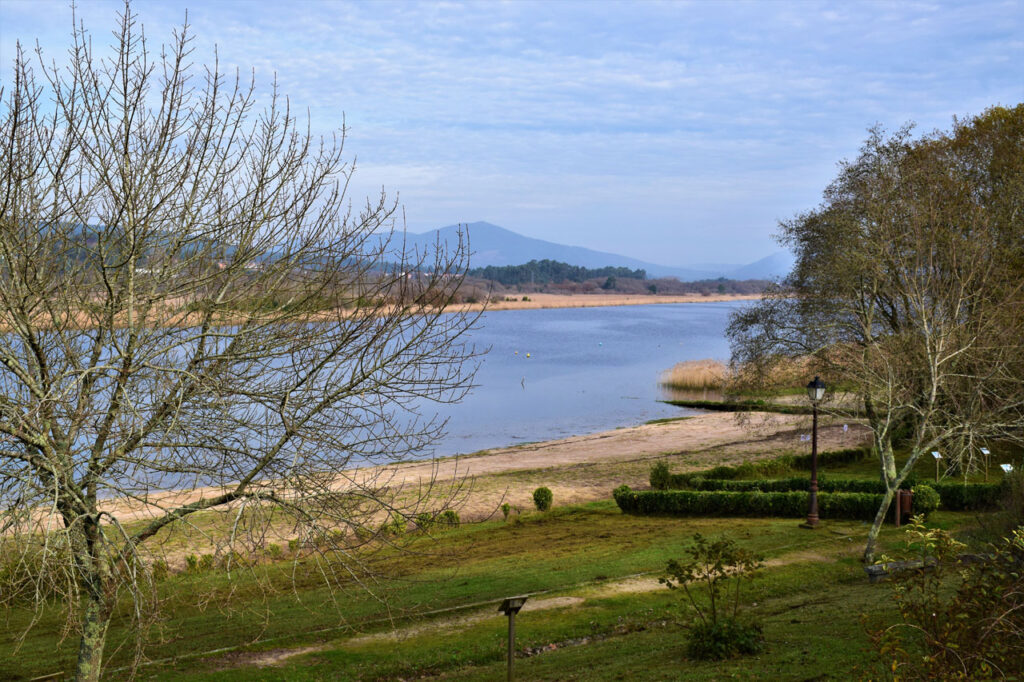
The viewpoint has a restored windmill from the early nineteenth century. Finally, within this Eco-museum and within the Ulla River is the fluvial beach of Vilarello. It is an area close to the river marshes, where flora and fauna of this particular habitat constitute ecosystems of exceptional ecological value like its pastures, meadows, and reedbeds (brañas, vegas, and junqueras). This area is included in the Natura 2000 Network as a Special Conservation Area (ZEC) Ulla-Deza River System.
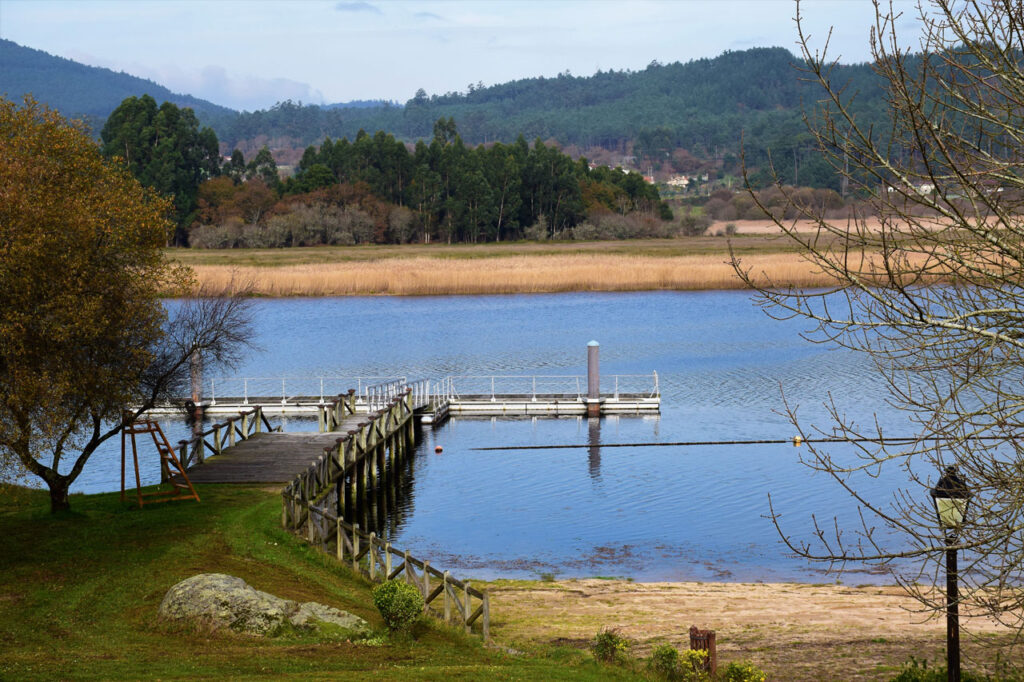
Besides a sandbank, the beach has a dock, showers, coffee bar, and extensive green areas.
To learn more
The Eco-museum includes spaces within the Natura 2000 Network, which, with its 1,633 hectares, covers an essential hydrographic network around the Ulla River. It has been declared a Special Conservation Area (ZEC). The Ulla-Deza river system crosses the Touro, Boqueixón, Vedra, Teo, Ames, Brión, Rois, Padrón, Dodro, and Rianxo Counties in A Coruña Province and Catoira, A Estrada, Pontecesures, Silleda, Valga, and Vila de Cruces in Pontevedra.
Concerning the surrounding flora, the Common or European oak (Quercus robur) is the dominant tree in the Ulla watershed. However, human action has completely reduced it to small patches, mainly located on the riverbanks and the most inaccessible escarpments. Gorse and Heath (tojal-brezal) are the most frequent shrub formation on treeless slopes, and its chromatic variety is an attractive landscape at almost all times of the year. Alders (Alnus glutinosa), ashes (Fraxinus spp.), birches (Betula alba), and willows (Salix spp.) constitute the riverside woods. Moreover, in this watershed, there are fish resources of enormous ecological and economic importance, such as the brown trout (Salmo trutta), sea lamprey (Petromyzon marinus), or the European eel (Anguilla anguilla).
Species of birds and mammals adapted to life in rivers deserve special mention. One can find the presence of the white-throated dipper (Cinclus cinclus), common kingfisher (Alcedo atthis), grey wagtail (Motacilla cinerea), grey heron (Ardea cinerea), Eurasian otter (Lutra lutra), Pyrenean desman (Galemys pyrenaicus), and European badger (Meles meles).
To know it better
The fluvial beach of Vilarello, in the Cordeiro parish of Valga, is a small space 70 meters long. This beach is located within the Arousa Estuary at the beginning of the Ulla River.
This place allows visitors to get close to the Ulla River and its flora and fauna, which are of great ecological value. Its pastures, meadows, and reedbeds (brañas, vegas, and junqueras) make this River's mouth a natural area of interest. No en vano, está incluida en la Red Natura 2000 por ser Lugar de Importancia Comunitaria (LIC). Therefore, it is included in the Natura 2000 Network since it is a Site of Community Importance (SCI, in Spanish LIC). Moreover, this fluvial beach has a variety of services to spend a pleasant day: coffee bar, dining area with barbecue, a children's playground, bathing area, and even an outdoor auditorium.
Valga County is in the Pontevedra province and has less than seven thousand inhabitants. Its location limits to the north with Dodro and Pontecesures Counties and to the south with Catoira and Caldas de Reis.
Gallery
Location
- Town
- Cordeiro
- Municipality
- Valga
- Province
- Pontevedra
- Country
- Spain
The asset
- Type
- Beach
- Eco-destination
- Ría de Arousa
- Environment
- Natural
- Relevance
- International
How to get there
- Access
- By sea By land
- Distance
- 0 km
The visit
- Accessible
- No
- Parking
- No
- Signposted
- Yes
Coordinates
- Latitud
- 42.70564000
- Longitud
- -8.70598900