
Pedornes Petroglyph and Phoenician Navigation
About this heritage
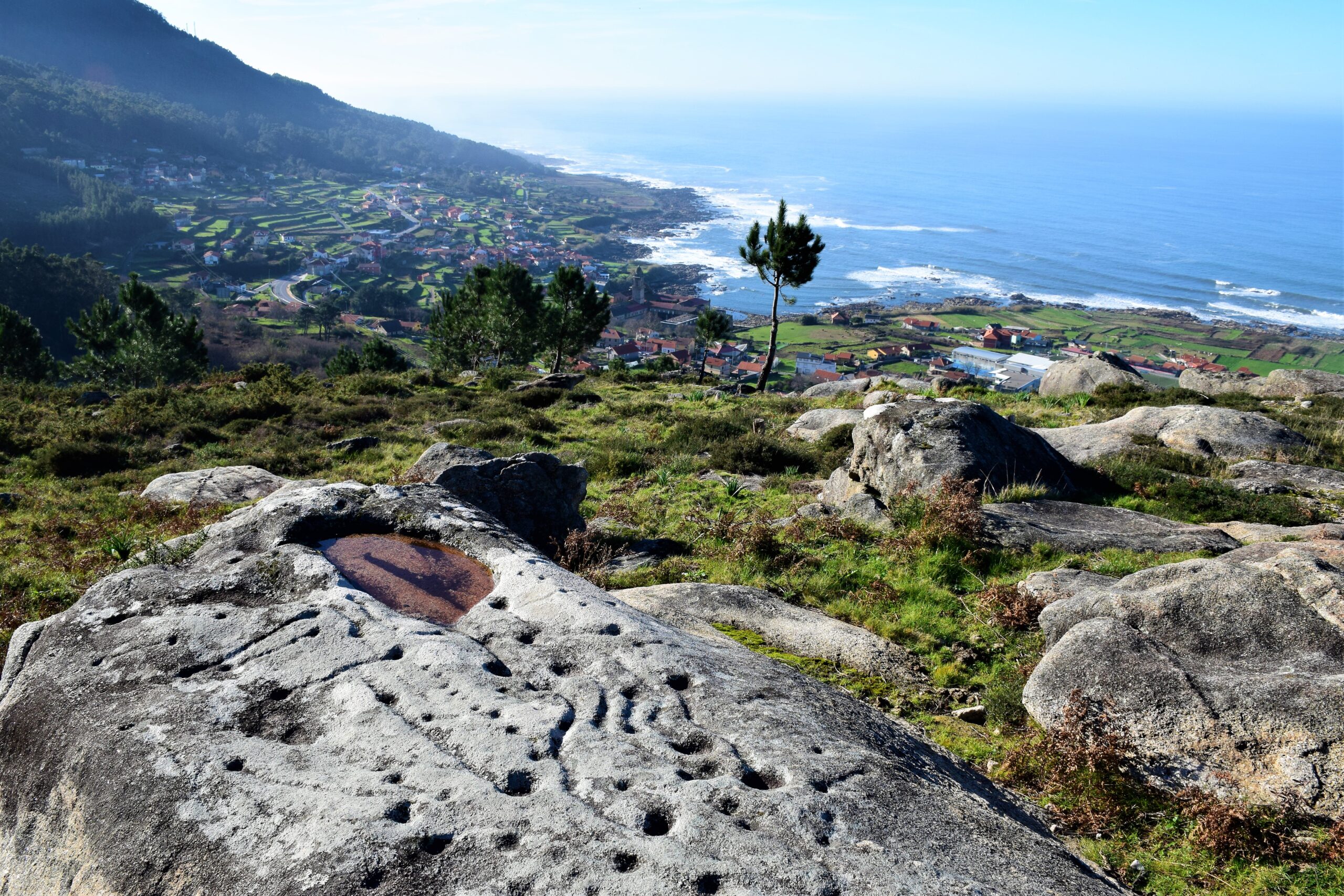
The coastal strip of Oia is also known as the "Coast of the Castros." Among the dozen Iron Age settlements known in this area, those of Chavella, Cono dos Mouros, and A Cabeciña stand out. The latter is a beautiful castro, with numerous rock engravings, among which the complete circular combinations interlinked with each other stand out. In the parish of Pedornes, in Santa María de Oia, is the petroglyph known as a Laxe de Auga dos Cebros, unique in Europe, which depicts a Mediterranean vessel from the second millennium BC, surrounded by fifteen deer of different sizes. It is one of the most spectacular petroglyphs on the Galician coast, due to its significance as a connection between the two most important cultures of prehistoric Europe: the Atlantic and the Mediterranean. At the beginning of the 20th century, the petroglyph was partially dynamited by treasure hunters who believed they would find riches underneath. The engravings are located in a very sensitive area and are affected by the intermittent course of the Vilar River.
To learn more
The vessel depicted in the Oia petroglyph, unique in Atlantic Europe, refers to Cretan or Egyptian models found in seals and temple engravings. It measures 150 centimeters in length and features a curved stern and bow. Also visible are a mast and part of rigging with five ropes, three of which connect the mast to one end of the ship. It could be a Phoenician hippoi, small low-sided, low-tonnage boats with a bow and sometimes also a stern shaped like a horse and propelled by oars, mentioned by Strabo in his Geography. In its surroundings, two other rock engravings of ships are cataloged, also Mediterranean, though of lesser significance. These representations are evidence of the relationships between Atlantic and Mediterranean cultures since prehistoric times. The most complete and oldest Phoenician ship documented underwater is the "Mazarrón 2," discovered in the port of Mazarrón, Murcia, which is preserved in situ, covered by a metal structure as a protective measure.
To know it better
In the parish of Pedornes (Oia), in Pontevedra, is the only naval petroglyph in Europe called "Auga dos Cebros." It is an engraving located on a rock and depicts a ship similar to Mediterranean vessels along with deer of different sizes. The ship has a rectangular shape with one end raised in the form of a bow and the mast located in the center. This representation shows the relationships between the first settlers of the Atlantic Ocean culture and those of the Mediterranean Sea since prehistoric times. This petroglyph is over 3,000 years old. Although it is not perfectly preserved, thanks to the initiative of Costa dos Castros, it receives certain care necessary to continue maintaining such a precious element for the history of Galicia. The Phoenicians, besides being skilled artisans, were excellent navigators and among the best shipbuilders of their time. This facilitated citizens learning to navigate in the best possible way and settling in coastal areas and places rich in raw materials.
Gallery
Location
- Locality
- Oia
- Municipality
- Oia
- Province
- Pontevedra
- Country
- Spain
The asset
- Type
- Petroglyphs
- Eco-destination
- Ría de Vigo
- Environment
- Rural
- Relevance
- National
How to get there
- Access
- By land
- Distance
- Distancia: 3,5 KM / 7 minutos en coche
The visit
- Interpretation
- No
- Accessible
- No
- Parking
- No
Coordinates
- Latitud
- 42.02256600
- Longitud
- -8.87843000